
Simon Owen tees off in the playoff against England’s Peter Oosterhuis for the 1974 German Open
Following a surreal finish to my initial year caddying on the 1973 European Tour (outlined here) I returned to New Zealand, by then fixed on the idea of returning to Europe in 1974.
I had met a fascinating lady on the evening of the final round of the World Match Play which certainly played a role in my desire to return to Britain but the excitement of the World Match Play and the chance to caddy for Graham Marsh in the three or four events he would play in Europe in 1974 was perhaps more of an influence.
I would also re-establish the working arrangement with Bob Shearer who I had last caddied for in early September of the previous year although I, of course, had seen him during the events in New Zealand.
Back in New Zealand, I and Michael Glading, a new-found friend from the 1972 New Zealand Tour, hit the road to caddy in events in Dunedin, Christchurch, Palmerston North, Auckland and Tauranga.
After several years living in South Africa, Michael had appeared at the Otago Charity Classic in Dunedin late in 1972 to caddy for family friend, Bob Charles, and we hit it off straight away and became travelling companions for the 1973 / 1974 New Zealand events and have remained friends since.
Michael experienced his first taste of winning as a caddie when Charles won the New Zealand Open at Palmerston North that year and my boss, John Lister, won both the Garden City Classic (Christchurch) and the Otago Charity Classic (Dunedin) so we were having a lot of fun.
Once the New Zealand circuit was completed, however, I began to think how I could earn some money to underwrite my return to Britain in late April and, with a sister and her husband living in Invercargill in New Zealand’s south, I decided to explore the possibility of work at the Tiwai Point Aluminium Smelter near Bluff.
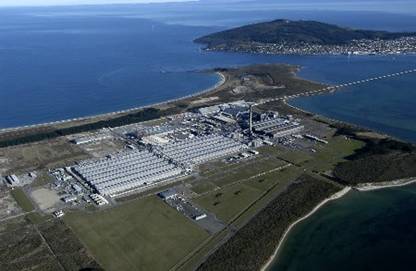
Tiwai Point – not exactly fun but the money was good
I managed to secure a gig there for 10 weeks and headed south. Again, the role was hardly an exciting one as I essentially laboured on the potlines, but the money was brilliant and the opportunity to work a double shift on occasions further assisted in that regard.
I headed for Britain in late April with my first event in Worthing on the south coast of England. There, I caddied for Australian, Stewart Ginn, but on Bob Shearer’s return I caddied for him in Coventry, Harrogate and Dublin before the arrangement Graham Marsh and I had discussed to team up at the Open Championship eventuated.
Marsh played in practice rounds with Jack Nicklaus, Miller Barber, Bruce Devlin and David Graham amongst others at Royal Lytham & St Annes and many were considering him a great chance to win, so well was he playing prior to event getting underway.
Any such hopes were soon put to bed however when he opened with a round of 79 and although he played all 72 holes, he finished well back. I think it was a case of over-preparation (too many practice rounds ahead of the event) and have often thought since that there is a real danger in that.
During that week Bob Charles had spoken to me and asked if I was available to caddy for him in Sweden and Switzerland in the following two weeks and, although I had initially been unsure about heading to Sweden, when he asked me to do both events I jumped at the chance.
I spoke to Bob Shearer about it all as there was the thought that I would be caddying for him, but he very kindly gave me his blessing as he had not been playing well. It was arranged that Shearer and I would join up again in Germany three weeks later and, so, the day after The Open I was on a ferry / ship from Harwich on England’s east coast to Esbjerg in Denmark.
On landing in Esbjerg, we drove the car of one of the players, whose caddy had been tasked with delivering it at each of the destinations for the events in Sweden, Switzerland, Germany and Holland, across Denmark to Copenhagen and onto the ferry (there’s a bridge there now) across to Malmo in Southern Sweden.
Charles finished 6th there behind the 11-shot winner, Tony Jacklin, and so we were again on the move via a ferry to Puttgarden in the north of Germany and the long drive across Germany and through the mountains by train to Crans-sur-Sierre in Switzerland.
Crans-sur-Sierre is a stunning alpine ski resort alongside the more familiar Crans Montana. It sits high above the Rhone Valley with simply breathtaking views from every angle. I had seen it, first, the previous year but despite being raised in New Zealand’s South Island where spectacular scenery prevails, I was again captured by its majestic surrounds.
In the winter the golf course acts as beginner slopes for the ski resort and in the summer it has played host to the Swiss Open or its equivalent since 1939.
A typical backdrop from the Crans sur Sierre Golf Club
Charles began well but trailed the halfway leader, Dale Hayes, by five shots heading into the weekend. A third round of 67 had him sharing the lead with Hayes and Belgian Donald Swaelens and one ahead of the 1969 Open Champion and 1970 US Open winner, Tony Jacklin.
Hayes dropped away in the final round and it would be Jacklin who provided the biggest threat. Charles led by one playing the last and I can recall him asking me how far it was for his approach at the last and after being told it was 129 yards he would say when it was in the air; “Well that feels to me like 129 yards.”
It finished six feet or so exactly pin high and right of the hole and although he missed the putt, he had done enough to win by one over Jacklin with Hayes three shots further away in 3rd place.
As a New Zealander, whose early golfing hero was Bob Charles, to have caddied for him in winning an event in Europe was amazingly pleasing but more was to come.
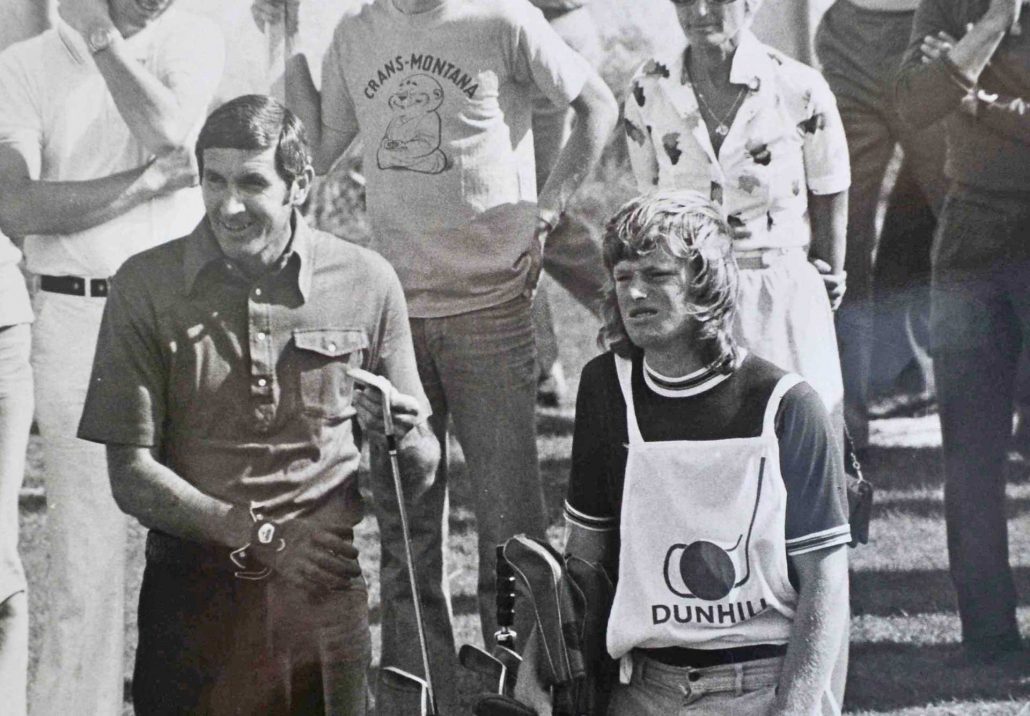
The final hole of the Swiss Open – It was a great thrill to caddy for a childhood hero in such a significant win
As I sat around waiting for Charles to wrap up his media commitments, I began to think about what I might do the following week. Shearer had advised he would not play in Germany but, rather, he was to head back to London to spend time with his girlfriend and now wife Kathie and would see me next in Holland for the Dutch Open.
I had thought of the idea of taking a week off in Germany but soon realised I was getting a little carried away and saw New Zealander, Simon Owen, and asked what his plans for a caddie the following week were.
Owen was in his first season in Europe and had been doing quite well but, although he was making cuts, he was not making any big cheques and had reached a point where money was becoming an issue.
I had caddied for him in an Under 25 event in Bristol earlier in the year where he did well and had actually shared an apartment with he and Australian Peter Croker in Knightsbridge in London for a while. So we knew each other well but he was unsure whether he could afford a ‘tour caddie’ and would think about it and let me know.
Twenty minutes later he sought me out and we agreed on a fee that would cover at least some of my expenses and so it was off to Krefeld in Germany, again via car and the train line through the mountains (we put the car on the train), for the 1974 German Open.
Owen began the event brilliantly and led through 36 holes. As a sideline, in those opening two rounds he played with a young German kid (then 16) who would turn out pretty good (Bernhard Langer), although that week, in his debut in his national open, Langer missed the cut by many, many shots.
Owen kept the momentum going in round three and took a one-shot lead over Dales Hayes into the final day although European Tour superstar, Peter Oosterhuis was lurking three off the pace.
This was a day full of pressure for Owen as not only did he have a potential title at stake he had the chance to cement his place in Europe for the immediate future and I have to say I was so full of admiration as to the way he went about his business especially for one so relatively inexperienced.
Oosterhuis was closing fast, however, and signed for a final round 66 in the group ahead to set the mark and when Owen stood in the middle of the final fairway he asked me if I could confirm the situation as even though the leaderboard said one thing, Simon wanted to be sure.
I advised he was now tied for the lead and when he hit a lovely shot to the middle of the green and two-putted he was into a playoff against the Englishman.
Despite his incredible success, Oosterhuis had a bit of a reputation for blocking shots under real pressure and that is exactly what he did when attempting to follow a superb drive by Owen at the first extra hole. He found the trees and when the 23 year old Owen went on to birdie the par five it was all over.
It was a most satisfying moment for me to have been able to caddy for two different New Zealanders in consecutive weeks in their respective wins in Switzerland and Germany.
I was somewhat disappointed when I later found an excerpt from The World of Professional Golf for 1974, written by Michael Williams, which was so blatantly wrong
It read: “The New Zealander handled the 14th safely but failed to get his birdies on the long holes and was not helped as he stood over a 20 footer for birdie on the last green by his caddie’s observation that he needed the putt to win. He missed and went into a playoff with Oosterhuis.”
Neither Simon nor I recall anything of the sort. That is journalistic license for you, I guess. Never let the truth spoil a good story.
Don’t think for a moment I was getting wealthy as a result of this dream run. It helped, for sure, but when Charles won in Switzerland he earned a first prize of around £4750 and Owen £2670 for his victory.
Victories in equivalent events now are worth nearly 100 times that amount. While there is a certain level of relativity in the disparity of those figures between then and now, the growth in prizemoney in world golf since, has been exponential.
And, so, it was off to Hilversum in Holland for the Dutch Open and the return of my regular bag, Bob Shearer.
That is a whole new story and one I will go into in another piece.

1983 – The End Of An Amazing Ride
1983 would see me caddying in my last season in New Zealand. To some extent the season was bitter/sweet in that it brought to an end a long, rewarding and very successful association with New Zealander John Lister but opened up a new chapter in my golfing and professional life with Australian, Graham Marsh.
John was coming to and end of his playing career as his playing fortunes in the USA continued to wane and we agreed that the New Zealand Open at the then Auckland Golf Club late that year (now Royal Auckland) would be the end of a journey which had seen John win ten events in New Zealand with me on the other side of the bag.
I had learned so much from Lister and he provided me with many great opportunities but as I looked ahead I was keen to make the golf industry a career and Marsh’s growing business interests appeared to me as if they might open career prospects beyond caddying.
I took two weeks off from my hotel job in Nelson and drove north to Auckland for the first of what was to be two events but eventually became three. Lister and I teamed together for our swansong at Middlemore which was won by Ian Baker-Finch, John once again having his struggles with the New Zealand Open style set-ups.
We said our professional good-byes which for both of us I am sure was an emotional moment because of the success we had experienced together and for me especially because John had opened the door to a new world for me.
I still rate him as one of the more dynamic players I have seen when he was in the right frame of mind and form. He was a great shot-maker, doing things with the golf ball that many more credentialed players could only dream about. He was blessed with tremendous length from the tee but, when he was on song, he was also a brilliant putter.
Marsh did not play the New Zealand Open but, as arranged, was there the following week for the Airlines event at Titirangi Golf Club, also in Auckland, and that was where we would team up for the first time since the Piccadilly World Match Play Championship in October of 1975.
The West Australian played well that week and, if my memory serves me correctly, finished 3rd behind Bruce Devlin in an event reduced to 54 holes.
The reason for the reduction in holes from the original 72 was that on day one weather had cancelled out the opening round. Ironically, the man who suffered most from the cancellation of play on the opening day was John Lister who recorded a round of 63 only for it to be washed out.
I am not sure what signal that was giving from Lister. I felt for John but was happy for him that he had found some form at long last after a long hard year in the US.
I discussed with Marsh that week the prospect of working for him in some capacity amongst his growing business interests and while he indicated an interest in my involvement it would be another six years before that actually came to fruition. I will elaborate on how that all transpired in another memoir.
Marsh asked during the week if I would be available to caddy the following week as he had been unexpectedly and belatedly invited to play the New Zealand PGA Championship at Mt Maunganui, about a three hour drive south.
I quickly contacted my employers in Nelson to seek approval for another week off which was given so I headed off to what is one of my favourite holiday destinations in New Zealand – the Mount as it is affectionately known.
I had caddied for Jumbo Ozaki there in his win in 1972 and for Lister when he won in 1977 and also when Lister lost a playoff to Brian Jones in 1981 so I knew the course well and was excited to be continuing my rekindled arrangement with Marsh.
Marsh would go on to win the event by two shots over Vaughn Somers giving me a 4th NZPGA Championship title as a caddie as I had also caddied for Lister when he defeated Bill Brask in a playoff at the nearby Tauranga Golf Club.
I might not have looked it but I was excited about Marsh’s win at the 1983 NZPGA
The two weeks had reconnected Marsh and I and opened the door for ongoing discussions on the possibility of working for him in some capacity at a later date.
I recall him saying to me that he felt I needed more background in sales. While disappointed that nothing had immediately come out of the decision I had made, it gave me thought as to how I might further my skills to allow myself to be more employable in the golfing arena.
I returned to Nelson and was back behind the bar two days later pouring beer and having fun, but with the memories of what would be my final event as a caddie in New Zealand to the front of my mind.
A photo accompanying an article on my return to Nelson
It would be another 4½ years before I caddied again, after relocating to Australia. In the meantime, however and after a few more months in the hotel industry, I would work in the Aquaculture Industry in the Marlborough Sounds of New Zealand and, for a few months before heading for Australia in 1986, in the Kiwifruit Industry in the Nelson area.
They provided further background for what lay ahead but, while fascinating, I never really felt they were what I wanted in the long term.
And so, my journey with John Lister was over but what a journey it had been. We had worked together in some seventy five events in New Zealand, Australia and the US, 55 or so of those in New Zealand in which there had been ten victories and two or three runner-up finishes.
There had been so many highlights but perhaps the Garden City Classic in Christchurch provided some of the greatest memories, John winning on four consecutive occasions and sharing the runner-up position behind Bob Shearer when attempting to win five in a row in 1976.
Lister could win from anywhere and often did. One of his victories in Christchurch came in 1974 when beginning the final round nine shots behind the lead of Tasmanian David Good.
It was heady stuff at times, his sheer brilliance thrilling the crowds and leaving so many, including myself, in awe of his power and deft touch.
He provided me a start in the game for which I will be forever grateful and have nothing but the upmost admiration for his ability to, at times, produce the seemingly impossible.
It was a fun ride.
Lister and I during one his his four consecutive victories at the Garden City Classic.
The USPGA Tour – Yet Another Great Adventure
After three seasons in Europe, my caddying in 1976, 1977 and 1978 had been restricted to Australia and New Zealand and, even then, on a part time basis.
Although there had been several highlights, including three consecutive wins by John Lister in New Zealand in late 1976 and early 1977, a runner-up finish by Lister at the 1977 Australian Open and the match against Seve Ballesteros in 1977, I was beginning to look further afield to satisfy my caddying appetite and lust for travel.
I had worked in various roles including a period in 1978 on a horse stud near Auckland and while the thoroughbred breeding industry was, and still is, a field in which I have had interest, the lure of caddying on the PGA Tour contained more appeal.
I talked with John Lister at events late in 1978 and it was decided that I would caddy for him in the US in 1979. John had been on the PGA Tour since 1971 and given the good rapport and success we had experienced together in New Zealand and to a lesser extent in Australia we were both keen to join forces in the US.
It was too good of an opportunity to turn down. After all, the prospect of caddying on the holy grail of professional golf was, to a caddie, what playing that tour was to a professional golfer.
John’s Lister’s best performance in Australia – runner-up against a strong field at the 1977 Australian Open.
It was decided that I would not leave until late April of 1979 and join John at the Byron Nelson Classic in Dallas.
I needed a job to tide me over until departing for the US and decided to head to Nelson in New Zealand’s South Island to spend time with my close friend Corals D’Ott and her boys and seek work there.
I looked for work in the hospitality industry and managed to secure bar work at the Wakatu Hotel, a popular watering hole and a very enjoyable but brief period in my life it was. I loved Nelson and dependant on how things worked out in the States felt sure I would return there at a later date.
Sydney based New Zealander, Bob Moore, was keen to head to the US also. I had met Bob caddying in Australia and New Zealand and, after time in Sydney amongst the SP gambling industry, he was keen to escape to a friendlier and less stressful environment and so we headed to Dallas, Bob to caddy for American Mark Lye and myself for Lister.
Despite my extensive travelling experience, I had only spent a limited time in the US and so caddying on the USPGA Tour was an adjustment but one I thoroughly enjoyed despite Lister’s lack of success there in 1979.
Following the very first event in Dallas, John was ineligible for the tournament at Forth Worth the following week and so he, his then wife Diana and I drove the lengthy road trip to their home in Clearwater near Tampa on the west coast of Florida where we stayed for a couple of weeks.
If you had to spend time off anywhere, Clearwater was not a bad place to do so. John was an avid fisherman and he loved nothing more than heading down to the nearby Dunedin beach and encouraged me to join him fishing from the shore and, sometimes, up to our waists in the warm waters of the Gulf of Mexico.
It was the first of two periods of stay at the home of John and Diana and their hospitality during such a great adventure to the PGA Tour is something I will always be thankful for.
We re-joined the tour in Charlotte in North Carolina for the Kemper Open and from that point on I got to visit some great places and some fine golf courses and, as a 25/26-year-old, had a lot of fun.
John was unable to reproduce some of the heroics he would so often display against, admittedly, weaker fields in New Zealand and it remains a mystery to me how the amazing talent and skill set he so often displayed at home was unable to be replicated in the US.
He had won the Quad Cities Classic in 1976 but his best finish in 1979 was at the Greater Milwaukee Open in Wisconsin where he finished 5th behind Calvin Peete and his career in the US never saw the true talent of the real John Lister.
From that point of view the season was a disappointment but I loved my time on the PGA Tour, my knowledge of the game, professional golf and the golf industry in general building on what I had developed while caddying in Europe and Australasia.
Amongst the places I visited while caddying in 18 events that season were courses such as Pinehurst #2 for the Colgate Hall of Fame Classic, Inverness in Toledo in Ohio, where Hale Irwin won his second US Open, Glenn Abbey near Toronto for the Canadian Open and Westchester Country Club north of New York City where the wealth of the American country club set became apparent.
I would revisit Pinehurst 15 years later to caddy at the US Senior Open and fall in love with the place even more, the reason to be expanded on in another memoir.
A special memory was standing alongside the great, but enigmatic and eccentric, Moe Norman, while he was hitting balls on the driving range at Glenn Abbey. He was 50 at the time and visiting with one of the players in the Canadian Open and had been asked to hit a few.
He did so with very formal clothing on but I recall a series of 7 irons being hit almost on a string. I was aware of his reputation at the time but he was not all that familiar to me. I have subsequently become aware of just how much of a legend he was.
Moe Norman – seeing him casually hit balls in Canada was a treat.
While the higher profile courses were interesting, in many respects just because of the fact they carried profile, it was often the less familiar places we visited that provided great opportunity for fun.
Columbus in Georgia, Pensacola in Florida, Sutton in Massachusetts, Davenport in Illinois, Milwaukee during Summer Fest, Valley Forge in Pennsylvania and Endicott in New York State, amongst others, all hosted PGA Tour events and rekindle memories of great times and experiences on and off the golf course the USPGA Tour provided.
The BC Open in Endicott in New York was always a highly anticipated week for the caddies as, on the Monday following the tournament, the caddies’ championship was held on the En-Joie Golf Club and sponsored by several of the players. Not that I played well in it but the chance to play a PGA Tour layout in tournament conditions for a bit of cash was a real attraction for the caddies.
On one two occasions when John Lister had either failed to make the field in the era of Monday qualifying or was not playing for another reason I had the opportunity to caddy for other players and one that sticks in my mind was when working for Gene Littler in Atlanta.
One of the game’s finest golf swings and what a gentleman – Gene Littler
Even at the age of 49 that week, Littler was a beautiful player and a fine gentleman. He would win 29 PGA Tour titles including the 1961 US Open and was beaten in a playoff on eight further occasions.
He was blessed with a magnificent, classical and uncomplicated golf swing and his capacity to plot his way around the golf course stuck in my mind. He made the cut that week but finished only midfield although to have experienced this iconic American golfer at such close quarters was one of the treats of my time on the PGA Tour.
Littler and I got on well and during the week I talked with him about the idea of playing in New Zealand. I had an ‘arrangement’ with Air NZ who had provided a little support for my visit to the US and the New Zealand Airlines tournament was to be played in Wellington later in the year.
I promoted the idea to him and he would eventually travel to New Zealand to play the event which of course was overshadowed when one of Air New Zealand’s fleet crashed into Mt Erebus in the Antarctic on the eve of the tournament, killing 257 people.
My time in the US would come to an end at the Pensacola Open in Florida and it would be another 15 years before I got back there when the opportunity to caddy for Graham Marsh on the then US Senior Tour presented itself.
I will write a piece on those experiences later but to have caddied on the 1979 PGA Tour was yet another eye-opener and played a role in providing the sort of experience that would lead to ongoing roles in golf as the years progressed.
As I write this I cast my thoughts back to Bob Moore with whom I travelled for much of the time I was caddying in the US. Bob was a great looking guy with a relatively carefree attitude to life and was fun to be around. His looks made him a very handy ‘Wingman’ when we ventured out at night.
On several occasions Bob and I would drive Mark Lye’s van between events and meet Lye at the next venue, one sleeping while the other navigated and drove his way through large parts of the USA.
John Lister also got me to drive his Lincoln Continental between events on one or two occasions, one a lengthy trip after dropping John off at O’Hare airport in Chicago for him to attend a corporate day and meeting him at Valley Forge near Philadelphia the next day. To say the least, driving alone and over long distances on the great US freeways provided a great sense of freedom and escape.
I was devastated to learn years later that Bob had passed away while living the high life in Hong Kong, having developed seemingly successful gambling software there and lived the life of a gambler. He was found deceased in his apartment with some reports suggesting suicide.
Never quite sure how he got to the point of operating in such circles in Hong Kong but he was a wheeler / dealer and gambler although, in my experience, a great guy to travel with. He was always a mysterious and intriguing character, his passing perhaps a reflection on the high life he was leading there.
I loved my time in the US. The caddies were generally very welcoming, the weather warm, although at times oppressive, each week a new adventure and the chance to see some of the greats of the game I had not always encountered in my time caddying elsewhere.
In a later memoir I will discuss my return to caddy in several events on the US Senior Tour in the mid nineties.
Two Great Days Against Seve Ballesteros
As outlined in my previous post, 1975 was a year of mixed results for those of whom I was caddying. There were both highlights and lowlights but, as the year progressed, I would get to experience my first exposure to a young man who would go on to become one of the greats of the modern game.
I had seen Seve Ballesteros at several events in 1975, effectively his rookie season in Europe, but I had not seen him at close quarters as such although that was about to change. He had already recorded four or five top tens in European Tour events and was, even then, being considered one of Europe’s great future stars.
In September of that year, an event would be played at Turnberry in Scotland, the Double Diamond International, which would involve teams of five from the Americas, The Rest of the World and the Home Nations, Scotland, Ireland, England and Wales.
I did not appear likely to get one of the bags in the event as my regulars were not playing. Given that the Americans, with one or two exceptions, were unlikely to be traveling with their caddies however, I decided to try my luck in securing one of their players.
I targeted Jim Colbert, an impressive player who had at that stage already won four events on the PGA Tour and, from what my due diligence had indicated, he would not be bringing his caddie to Britain.
My good friend, Michael Glading, had been caddying in Europe with me for much of the 1975 season which had included a win on the bag of South African, Hugh Baiocchi, at the Dutch Open. He was planning on returning to New Zealand via the United States to caddy for Baiocchi at the World Golf Hall of Fame event at Pinehurst and for Irishman, John O’Leary, at the Ryder Cup at Laurel Valley the following week.
Michael agreed to speak to Colbert at the Pinehurst event and to my delight he was more than happy to have that part of his visit to Scotland sorted ahead of time.
I arrived at Turnberry on the delightful Ayrshire Coast for the second time having first caddied there for Billy Dunk at the John Player Classic in 1973 (see here). It was arranged that I would meet with Colbert on the Tuesday morning of the Double Diamond. When I arrived at the course on the Monday to do my yardages, however, I was advised by one of the Scottish caddies that Colbert was already on the course and had taken a local for the week.
Still unsure whether his comment was in jest or a deliberate act to unsettle me given I had one of the more significant bags for the week (some of the Scottish caddies were capable of doing just that) I did some more checking. Then, armed with the knowledge he was not on the golf course, I eventually headed across to the beautiful Turnberry Hotel on the hill.
The Turnberry Hotel where I first caught up with Jim Colbert.
Reception told me Colbert had only just checked in and when they called his room he was happy to come down to meet me for a coffee in the lobby of the hotel.
He was a delight, certainly a confident sort of character but he was great to me and I could tell even from our initial discussion that we would get on.
That would turn out to be the case as he would go on to win each of his five matches, playing a key role in the success of an American side which included Colbert, Johnny Miller, Lou Graham, Dave Hill and Mark Hayes.
One of those matches was when he tackled the 18-year old Ballesteros, who was a member of the Rest of the World side.
In the absence of a Continental European side that year, Ballesteros was considered enough of a rising star to be included in that team which included he, Gary Player, Bob Charles, Dale Hayes and Jack Newton.
Certainly Ballesteros impressed that week and, already, it was evident that he would become a fine player. It was, though, hard to imagine back then just what an impact he, his golfing skills, charismatic appeal, creative imagination and artistry would have on the golfing world over the next 25 years.
On reflection, however, it is nice to be able to look back and recall being so close to him so early in his professional career and being on the bag of Jim Colbert when the American won their encounter.
Ballesteros – 1975
Two years later I had worked in the real world back in New Zealand for a couple of years although that world was not exactly feeling too real for me. So, at the end of 1977, I headed to Australia for a few events including the West Lakes Classic, the Australian Open and the Australian PGA Championship where I would again team with John Lister.
Lister would finish runner-up to David Graham at the Australian Open at the Australian Golf Club that year but the remainder of the events in Australia and those in New Zealand were not so lucrative for the player who had dominated New Zealand golf events in recent years.
Lister had won the Otago Charity Classic in Dunedin (the first event back in NZ after Australia) on two occasions in earlier years but in 1977 it would be tournament invite, Seve Ballesteros, who would win by three strokes over American, Bob Byman, who the following week would win the New Zealand Open in Auckland.
Following the event in Dunedin, an exhibition had been arranged in the North Island tourist city of Rotorua by cigarette company Benson & Hedges and Air New Zealand. The participants would therefore involve two of the most recent winners on the New Zealand Tour, Ballesteros and Lister, in a face off at the Springfield Golf Club.
Now, it just so happened that I had been a member of Springfield as a 17 and 18-year-old in the early 1970’s. My mother also lived in Rotorua so I had taken advantage of an earlier trip to my Mum’s place to grab some yardages on the golf course well ahead of the day.
Lister, Ballesteros and I flew from Dunedin to Auckland on the Sunday evening immediately following Ballesteros’ win at the Otago Charity Classic and were put up in a hotel near the airport in Auckland ahead of a flight down to Rotorua the following morning.
We flew the 45 minutes down to Rotorua to be met by those organising the exhibition and representatives of the club.
Lister en route to defeating Ballesteros
The spectator numbers that had assembled that day were impressive and I have subsequently heard from a number golfers who have said they traveled from many parts of the North Island of New Zealand to be there.
Ballesteros was, after all, developing a growing reputation in world golf, highlighted of course by his runner-up finish as a 19-year-old to Johnny Miller at the 1976 Open Championship the previous year.
Lister had won on the PGA Tour the previous year, had finished runner-up at the Australian Open a few weeks earlier and was the leading force in New Zealand events of that era. There was, therefore, every reason for the event, despite it being an exhibition, to attract a good crowd.
This was in an era when, typically, players did not bring their caddies across the world and so Ballesteros teamed up with the Club Champion at Springfield, Eldon Carswell. Carswell would no doubt have been excited at the prospect of guiding such an emerging star around his home course that day.
Lister and Ballesteros in Rotorua
It was not all plain sailing for Eldon, however, Ballesteros letting him know in no uncertain terms when he persisted on calling him ‘Steve’ instead of ‘Seve’. Things were tense for a while but in my memory and eventually, I feel sure, that of Eldon, the day overall was a great and memorable one especially, for me, when Lister managed to defeat Ballesteros.
As a sideline to these experiences was that twenty years later, I met up with Jim Colbert (who had beaten Ballesteros in 1975) once again when I ventured to the US to caddy for Graham Marsh in a few events on the then US Seniors Tour.
Colbert by then was not only a very successful golfer having won multiple times on the Senior Tour in addition to his 8 wins on the PGA Tour, but he was a very successful businessman as a prolific golf course owner and developer.
Because of their mutual interest in golf course development Marsh and Colbert had a lot in common. When he offered Graham and I a ride in his own Sabre jet from Atlanta to Washington DC it was agreed we would leave immediately after the Nationwide event in Duluth in Georgia for the US Senior Open to be held at Congressional Country Club.
Jim Colbert, Graham Marsh and I about to board Colbert’s jet in Atlanta
No sooner had the doors closed on the jet as it readied ready for take-off and Colbert had opened beers for us four passengers on board, than he was quickly into conversation about Ballesteros, asking if I recalled the day he beat him at Turnberry.
Ballesteros had of course, in those twenty years since, won 70 tournaments world-wide including three Open Championships and two Masters titles. He had also been responsible, along with the likes of Nick Faldo and Bernhard Langer, for changing the fortunes of Europe in the Ryder Cup.
I think it was a real source of pleasure and pride for Colbert to be able to say he had beaten the brilliant Spaniard so early in his career and so it should have been.
If I had a dollar for every time I have since heard people, many of whom never had the opportunity to see him play, describing the brilliance and legend of Ballesteros I would be a very wealthy man.
To have gained a taste of it first hand and seen him at such close quarters at such an early stage of his career, however, is yet another of the many memorable golfing occasions I have been fortunate to experience.
Europe 1975 – A Season of Mixed Fortunes
The 1974 year had proven to be a good one in my caddying adventures. Not only had I caddied for the wins of Bob Charles and Simon Owen in their respective victories in Switzerland and Germany, but, on my return to New Zealand John Lister had continued his domination of New Zealand scene with yet further wins at the Otago Charity Classic and the Garden City Classic.
As the year ended I began to think about whether another trip to Europe in 1975 would be of any value but the thrills I had experienced there in 1974 got the better of me and I again contemplated a couple of months’ work ahead of a return to the European Tour in late April.
The caddying arrangement with Bob Shearer had come to an end at the Dutch Open in August of 1974 and for the remainder of that year in Europe I worked for Simon Owen and, when he played in Europe, Graham Marsh.
It was arranged that I would again work for Owen and for Marsh in Europe and instead of a paying job, I spent time on the horse stud of friends in the Waikato of New Zealand before heading to Britain.
This time, I would have travelling companions, Michael Glading and Merv O’Brien, with me, making the trip even more enjoyable although Merv’s rather bizarre and comedic tales require and will get a write-up of their own as we move forward.
Compared to his rookie season the previous year it was a disappointing year for Owen in 1975, finishing 86th on the Order of Merit compared to his very impressive 9th in his debut season in 1974.
To add insult to that injury was that Bob Shearer, who I had made the decision to split with the previous year, was developing into the golfer that he had promised to be and finished 5th on the Order of Merit. I was however happy for Bob that he was beginning to realize his significant talent.
Simon Owen and I – Carroll’s Irish Open Bray 1975.
The year and my spirits would be boosted, however, by the efforts of Marsh who would play seven events in Europe that season and, although he did not win any, he performed very well when 6th at the Open Championship, runner-up after a playoff to George Burns at the Scandinavian Enterprise Open and 4th at the Dutch Open.
Marsh’s effort at the Open that year was particularly impressive recording a final round of 71, one of only four rounds under the par of 72 that day in conditions which allowed the fabulous Carnoustie to really bear her teeth.
Marsh finished in 6th place alone, only two shots from the playoff between Tom Watson and Jack Newton with Jack Nicklaus, Johnny Miller and Bobby Coles tied for 3rd just one shot behind the leaders and Marsh another shot back.
The playoff in Sweden was agonising as, having played so well to make the playoff, Marsh blundered with a horror first extra hole to allow US rookie Burns, a standout during his amateur career, his first win in the professional ranks.
Marsh would also play the Benson & Hedges event in York the week after the Dutch Open where he finished 12th. His brother, Rod, and legendary Australian cricketer and commentator, Richie Benaud, had travelled across from nearby Leeds where the third Ashes cricket test was being played to witness the final day at the Fulford Golf Club.
Rod was of course the Australian wicketkeeper in that era, but as was the tradition in test match cricket back then there was a rest day and so he took advantage of the opportunity to watch Graham playing at the nearby event.
I asked Graham if Rod could perhaps get me tickets to the remainder of the test match as it was delicately poised and while in the region I too had thought it a great opportunity to see a match of such significance.
It would become of even greater significance the next morning when vandals / protestors dug up the pitch and poured oil onto it, thus causing the match to be abandoned with Australia needing some 230 further runs to win with seven wickets in hand and Rick McCosker on 95 not out.
The protestors had been campaigning to free armed robber George Davis from jail. My one and only opportunity to watch test match cricket in England had therefore been foiled.
It would not be the last of rather intriguing experiences in the remainder of the season for me.
I will outline in another piece, caddying for Jim Colbert against Seve Ballesteros at Turnberry in a head to head match in September of 1975 but, at the Dunlop Masters in early October, another unusual occurrence took place.
Marsh had returned to Japan after the Benson & Hedges to play further events there and the next time I would see him would be at the Ganton Golf Club near Scarborough on the north coast of Yorkshire for the time honoured Dunlop Masters.
Arriving late from Japan, where he had played the Japan Open the previous week, Marsh had just one practice round over the fabulous Ganton layout before the event got under way but that did not stop him putting together an outstanding effort to lead after an opening round of 70 on a very demanding day.
With the prospect of another crack at the World Match Play the following week, for Marsh to have been in this sort of form was exciting to say the least and after a couple of beers with a few of the boys in Scarborough that evening I was off to bed early looking forward to an early second day tee time and feeling pretty happy with things.
I woke early and was off to the golf course to get the pin positions as were forced to do in those days. Some bright spark would later realise that making the pin positions available to all on the first tee was a much better way of controlling caddy movement on the golf course early each day.
On my way to catch transport to the course I walked past a newsagent and there, in bold print on a board outside the shop, was the headline “Marsh Disqualified”
Now I looked at it for a few seconds, not quite comprehending what I was seeing and initially thought it was referring to something else – perhaps a footballer or whatever.
On closer inspection and having bought the paper I realised that Marsh had, indeed, been disqualified from the event after leading the opening round for inadvertently signing an incorrect scorecard.
On the closing nine at Ganton there are two very similar par 4’s and Marsh’s playing partner, David Chillas of Scotland, had marked down a 3 where Marsh had actually had 4 and 4 where he had 3 and so while the total added up to 70, because Marsh had signed the card with individual hole numbers out of sync he was disqualified.
Marsh first heard of the mistake when a golf writer had noticed the discrepancy while going over his final spiel later that evening and saw that the scores, which had come in from the scorers on the course during play and were posted on the big scoreboard in the media centre, differed from that on the card.
The journalist then contacted Graham at his hotel and advised him on what appeared to be a scorecard issue and so Graham headed out to the course to confirm and had no choice other then to disqualify himself.
I was not staying in accommodation anywhere near as salubrious as that of Marsh’s and in the days of no mobiles he had been unable to contact me to inform. I went over to his hotel and joined he and his wife Julie for breakfast to discuss the situation and when we would leave for London.
David Chillas was an outstanding young man and was devastated by the error he had played a role in although Marsh took full responsibility for not paying enough attention to the details of his card. The similarity between the two holes meant that the indiscretion had gone unnoticed to Marsh’s tired and perhaps jet-lagged eyes.
And, thus, it was on to Wentworth where Marsh would face Open Champion Tom Watson in the opening round of the Piccadilly World Match Play. He would bow out by the margin of 2 down at the 36th hole, the most significant moment in the match coming when Watson drove it out of bounds at the 16th in the morning round and still managed to halve the hole after Marsh failed to get up and down from just off the green.
It brought and end to a rather roller coaster season in Europe, some good, some bad, but back in New Zealand, John Lister, would again add lustre to the year with yet another win (his 4th in succession) at the Garden City Classic.
One of my travelling companions, Michael Glading, experienced a great thrill of his own when on the bag for Hugh Baiocchi when the South African won the Dutch Open and so it was a year which, despite its ups and downs, had added significantly to the adventures we were experiencing.
Marsh during his 1975 World Match Play loss to Tom Watson – my last event in Europe
Late 1975 – Lister wins again in Christchurch
Back to Back N.Z. wins in Switzerland and Germany
Simon Owen tees off in the playoff against England’s Peter Oosterhuis for the 1974 German Open
Following a surreal finish to my initial year caddying on the 1973 European Tour (outlined here) I returned to New Zealand, by then fixed on the idea of returning to Europe in 1974.
I had met a fascinating lady on the evening of the final round of the World Match Play which certainly played a role in my desire to return to Britain but the excitement of the World Match Play and the chance to caddy for Graham Marsh in the three or four events he would play in Europe in 1974 was perhaps more of an influence.
I would also re-establish the working arrangement with Bob Shearer who I had last caddied for in early September of the previous year although I, of course, had seen him during the events in New Zealand.
Back in New Zealand, I and Michael Glading, a new-found friend from the 1972 New Zealand Tour, hit the road to caddy in events in Dunedin, Christchurch, Palmerston North, Auckland and Tauranga.
After several years living in South Africa, Michael had appeared at the Otago Charity Classic in Dunedin late in 1972 to caddy for family friend, Bob Charles, and we hit it off straight away and became travelling companions for the 1973 / 1974 New Zealand events and have remained friends since.
Michael experienced his first taste of winning as a caddie when Charles won the New Zealand Open at Palmerston North that year and my boss, John Lister, won both the Garden City Classic (Christchurch) and the Otago Charity Classic (Dunedin) so we were having a lot of fun.
Once the New Zealand circuit was completed, however, I began to think how I could earn some money to underwrite my return to Britain in late April and, with a sister and her husband living in Invercargill in New Zealand’s south, I decided to explore the possibility of work at the Tiwai Point Aluminium Smelter near Bluff.
Tiwai Point – not exactly fun but the money was good
I managed to secure a gig there for 10 weeks and headed south. Again, the role was hardly an exciting one as I essentially laboured on the potlines, but the money was brilliant and the opportunity to work a double shift on occasions further assisted in that regard.
I headed for Britain in late April with my first event in Worthing on the south coast of England. There, I caddied for Australian, Stewart Ginn, but on Bob Shearer’s return I caddied for him in Coventry, Harrogate and Dublin before the arrangement Graham Marsh and I had discussed to team up at the Open Championship eventuated.
Marsh played in practice rounds with Jack Nicklaus, Miller Barber, Bruce Devlin and David Graham amongst others at Royal Lytham & St Annes and many were considering him a great chance to win, so well was he playing prior to event getting underway.
Any such hopes were soon put to bed however when he opened with a round of 79 and although he played all 72 holes, he finished well back. I think it was a case of over-preparation (too many practice rounds ahead of the event) and have often thought since that there is a real danger in that.
During that week Bob Charles had spoken to me and asked if I was available to caddy for him in Sweden and Switzerland in the following two weeks and, although I had initially been unsure about heading to Sweden, when he asked me to do both events I jumped at the chance.
I spoke to Bob Shearer about it all as there was the thought that I would be caddying for him, but he very kindly gave me his blessing as he had not been playing well. It was arranged that Shearer and I would join up again in Germany three weeks later and, so, the day after The Open I was on a ferry / ship from Harwich on England’s east coast to Esbjerg in Denmark.
On landing in Esbjerg, we drove the car of one of the players, whose caddy had been tasked with delivering it at each of the destinations for the events in Sweden, Switzerland, Germany and Holland, across Denmark to Copenhagen and onto the ferry (there’s a bridge there now) across to Malmo in Southern Sweden.
Charles finished 6th there behind the 11-shot winner, Tony Jacklin, and so we were again on the move via a ferry to Puttgarden in the north of Germany and the long drive across Germany and through the mountains by train to Crans-sur-Sierre in Switzerland.
Crans-sur-Sierre is a stunning alpine ski resort alongside the more familiar Crans Montana. It sits high above the Rhone Valley with simply breathtaking views from every angle. I had seen it, first, the previous year but despite being raised in New Zealand’s South Island where spectacular scenery prevails, I was again captured by its majestic surrounds.
In the winter the golf course acts as beginner slopes for the ski resort and in the summer it has played host to the Swiss Open or its equivalent since 1939.
A typical backdrop from the Crans sur Sierre Golf Club
Charles began well but trailed the halfway leader, Dale Hayes, by five shots heading into the weekend. A third round of 67 had him sharing the lead with Hayes and Belgian Donald Swaelens and one ahead of the 1969 Open Champion and 1970 US Open winner, Tony Jacklin.
Hayes dropped away in the final round and it would be Jacklin who provided the biggest threat. Charles led by one playing the last and I can recall him asking me how far it was for his approach at the last and after being told it was 129 yards he would say when it was in the air; “Well that feels to me like 129 yards.”
It finished six feet or so exactly pin high and right of the hole and although he missed the putt, he had done enough to win by one over Jacklin with Hayes three shots further away in 3rd place.
As a New Zealander, whose early golfing hero was Bob Charles, to have caddied for him in winning an event in Europe was amazingly pleasing but more was to come.
The final hole of the Swiss Open – It was a great thrill to caddy for a childhood hero in such a significant win
As I sat around waiting for Charles to wrap up his media commitments, I began to think about what I might do the following week. Shearer had advised he would not play in Germany but, rather, he was to head back to London to spend time with his girlfriend and now wife Kathie and would see me next in Holland for the Dutch Open.
I had thought of the idea of taking a week off in Germany but soon realised I was getting a little carried away and saw New Zealander, Simon Owen, and asked what his plans for a caddie the following week were.
Owen was in his first season in Europe and had been doing quite well but, although he was making cuts, he was not making any big cheques and had reached a point where money was becoming an issue.
I had caddied for him in an Under 25 event in Bristol earlier in the year where he did well and had actually shared an apartment with he and Australian Peter Croker in Knightsbridge in London for a while. So we knew each other well but he was unsure whether he could afford a ‘tour caddie’ and would think about it and let me know.
Twenty minutes later he sought me out and we agreed on a fee that would cover at least some of my expenses and so it was off to Krefeld in Germany, again via car and the train line through the mountains (we put the car on the train), for the 1974 German Open.
Owen began the event brilliantly and led through 36 holes. As a sideline, in those opening two rounds he played with a young German kid (then 16) who would turn out pretty good (Bernhard Langer), although that week, in his debut in his national open, Langer missed the cut by many, many shots.
Owen kept the momentum going in round three and took a one-shot lead over Dales Hayes into the final day although European Tour superstar, Peter Oosterhuis was lurking three off the pace.
This was a day full of pressure for Owen as not only did he have a potential title at stake he had the chance to cement his place in Europe for the immediate future and I have to say I was so full of admiration as to the way he went about his business especially for one so relatively inexperienced.
Oosterhuis was closing fast, however, and signed for a final round 66 in the group ahead to set the mark and when Owen stood in the middle of the final fairway he asked me if I could confirm the situation as even though the leaderboard said one thing, Simon wanted to be sure.
I advised he was now tied for the lead and when he hit a lovely shot to the middle of the green and two-putted he was into a playoff against the Englishman.
Despite his incredible success, Oosterhuis had a bit of a reputation for blocking shots under real pressure and that is exactly what he did when attempting to follow a superb drive by Owen at the first extra hole. He found the trees and when the 23 year old Owen went on to birdie the par five it was all over.
It was a most satisfying moment for me to have been able to caddy for two different New Zealanders in consecutive weeks in their respective wins in Switzerland and Germany.
I was somewhat disappointed when I later found an excerpt from The World of Professional Golf for 1974, written by Michael Williams, which was so blatantly wrong
It read: “The New Zealander handled the 14th safely but failed to get his birdies on the long holes and was not helped as he stood over a 20 footer for birdie on the last green by his caddie’s observation that he needed the putt to win. He missed and went into a playoff with Oosterhuis.”
Neither Simon nor I recall anything of the sort. That is journalistic license for you, I guess. Never let the truth spoil a good story.
Don’t think for a moment I was getting wealthy as a result of this dream run. It helped, for sure, but when Charles won in Switzerland he earned a first prize of around £4750 and Owen £2670 for his victory.
Victories in equivalent events now are worth nearly 100 times that amount. While there is a certain level of relativity in the disparity of those figures between then and now, the growth in prizemoney in world golf since, has been exponential.
And, so, it was off to Hilversum in Holland for the Dutch Open and the return of my regular bag, Bob Shearer.
That is a whole new story and one I will go into in another piece.
Dream Finish to First European Season
Having outlined in my previous piece how my European caddying adventures came about and began in Bournemouth, this story outlines how the rest of 1973 unfolded and culminated in one of the most exciting experiences I have enjoyed in golf.
Working for Bob Shearer for much of the season, I had travelled to many different parts of Great Britain and Ireland as well as to France, Germany, the Netherlands and Switzerland before arriving at what was to have, initially, been my final event of the season in Birmingham in early September, the W.D and H.O Wills Open.
Shearer had not played well for much of the season and had failed to get starts in the late season events so I had been free to pursue other options in an attempt to extend my time in Europe.
Not one to ignore potential opportunities I was aware that Australia’s Billy Dunk had been invited to play the John Player Classic at Turnberry and the Dunlop Masters in Wales and had written to him (snail mail) earlier in the year in the hope that I might be able to have his bag for those two events.
In mid-August I received advice from Dunk confirming my involvement in the two events thus ensuring that my time in Europe would be extended until early October at least.
The week before Birmingham I had caddied, in the absence of his regular caddie and for the first time, for Bob Charles in the Double-Diamond teams event at the Princes Golf Club near Deal in Kent and afterwards he asked whether I would be available to caddy for him in two practice rounds a week ahead of the John Player Classic as he had to head off for a few days just before the event.
My end of season schedule was, therefore, building nicely but it was to build even further and in the most dramatic of ways in the week ahead.
Following Birmingham, the South African golfer, Dales Hayes, loaned me his car while he headed back to South Africa, my side of the deal being to get it to him at Turnberry more than two weeks later. Things were indeed falling into place as I enjoyed the sporty Vauxhall Firenza over the two weeks and arrived at Turnberry the week prior to the John Player Classic.
The stunning Turnberry – a few good things happened there that week – Getty Images
I spent a couple of days caddying for Charles in practice rounds and while there ran into Australian Graham Marsh who I had met in New Zealand although I couldn’t say I knew him well.
I had known him well enough, however, to write to him in Japan earlier in the year to investigate any opportunity of caddying for him at the Piccadilly World Match Play Championship in mid-October to which he had been invited as a rising star and as the winner of the Scottish Open in June.
On asking Graham if he had received my letter he said yes but that the guy from St Andrews who had caddied for him in his Scottish Open win three months earlier would be with him at Turnberry and at the Dunlop Masters and the World Match Play. I figured that would be the case but that it had been worth the inquiry anyway.
Marsh, too, was at Turnberry well ahead of the John Player Classic as he had business to attend to in Southern France for a few days ahead of the tournament and wanted to get in a couple of practice rounds before heading off. He asked if I wanted to work those rounds to which I, of course, said yes.
I began to finalise my plans for heading home to New Zealand after the Dunlop Masters but you can imagine my delight when, on Marsh’s return from France, he advised he had received word from his Scottish caddie that he was unable to make the John Player and the following two events were in doubt because of an illness to his wife.
Graham found me at Turnberry and asked if I was still available for the World Match Play. I was beside myself as the event at Wentworth was one of the great events of the season and the opportunity to caddy in my first season in Britain in a field where only eight of the world’s best players were involved was almost too good to be true.
The opportunity also existed to caddy for Graham at Turnberry and in Wales and, on reflection, I probably should have but felt an obligation to stick to the arrangement to caddy for Dunk and so organised for my friend, Lee (General) Wilkins, who had been on the bag of the highly successful Peter Oosterhuis in recent seasons, to work the two events for Marsh prior to Wentworth.
Dunk, who rarely played in Europe, performed below his best in the two events, perhaps not helped by me leaving his umbrella in the pro shop ahead of one of the rounds at Turnberry. Dunk was capable of getting fired up at the best of times but when a huge rainstorm hit on the 17th hole that day and he asked for his umbrella I was looking for a rock to crawl under.
In Dunk’s defence, however, it was my blunder and overall he was good to work for. He was a brilliant iron player and never really showed the world just how good he was. He won twice in Japan and countless titles in Australia and New Zealand but he did not enjoy travelling and so seldom did.
And, so, it was on to Wentworth and the chance to caddy in a dream event. Compared to other events we were well looked after by the tournament. Beautiful jackets were provided to each caddie in addition to a per diem in addition to whatever our respective players chose to pay us.
Access to the clubhouse in Britain in those days was never available in regular tour events but in this event not only were we allowed in the clubhouse but to eat the table of our bosses.
Graham faced the Masters Champion that year, Tommy Aaron, in the first round and won comfortably.
His opponent in round two was the Open Champion that year, Tom Weiskopf, and despite losing a ball up a tree early in his 36 hole match, Marsh would go on to win 4&3 and had therefore made the final where he would face four time winner, Gary Player, who had accounted for Johnny Miller in their semi final match.
The semi-final against Weiskopf
For me as a just turned 20-year old it was almost surreal as I headed down the practice fairway on the Saturday morning to fox balls for Marsh. I saw a television crew coming down the fairway towards me.
I could not work out why but as I picked up the balls (yes in those days we had to fox the balls ourselves), it soon became apparent they wanted to have a chat with me which was the beginning of a day like no other I had experienced to that point and since.
The match was tight all the way. All square through 18 holes, a still tied through 27 although Player grabbed a two-hole advantage with four to play. It seemed all over but Marsh birdied the 33rd and when Player three putted the 34th, the contest was set to go to the wire.
As the pair stood on the 35th tee I was standing a little below Graham and noticed that Player was ahead of the markers. It was totally inadvertent but Graham had noticed it also and as Player was getting set over the ball he advised his opponent.
Player was clearly not impressed but when he lost the hole to a birdie and went one down with one to play he was even less so.
As the players walked from the green, Player shook his finger at Graham and said; “Man I’ve got to tell you I teed my ball up in exactly the same place as you back there on the tee but as far as I am concerned I don’t worry about petty things like inches so we’ll forget the whole thing.”
Rather than me explain that incident further and how Player managed to get himself out of jail and win at the 4th extra hole, the longest final in the history of the event, the video below highlights how it all unfolded and Player’s amazing tenacity and grit under pressure.
Despite the agonising loss, this was an unforgettable day and experience for me and brought to a close my first year on the European Tour.
Those final few weeks had provided the incentive to return in 1974.
The 36th hole
European Tour – Here I come
Fellow caddie Duncan Lumsdaine and I photographed for an article in June of 1973 – click to open
Late in 1972, after a trip early in the year to Australia to caddy in the Tasmanian, the Victorian and the Forbes (yes Forbes ) Opens, I spent most of that year working on a horse stud in the Waikato before caddying in events 1972/73 New Zealand Golf season. I began thinking how I might take this growing obsession of caddying in professional golf events to a higher level.
I had caddied for John Lister when he won the first of his four consecutive Garden City events in Christchurch in late 1972 and a week or two later Jack Newton won the City of Auckland Classic at the Grange Golf Club where I had caddied again for Lister.
With Lister fully ensconced on the PGA Tour by then, I began to hatch a plan that might get me to Europe for the 1973 season there and I approached Newton to see whether there might be a chance to caddy for him in Europe where he was already seen as a rising star having won the Dutch Open the previous year.
From the moment he said yes, that was the direction I wanted to take. I was 19 years of age and it was in an era where it was hardly fashionable to travel to the other side of the world to caddy and there was quite a bit of trailblazing involved but that was not about to stop me.
Jack Newton – seen here at the 1975 Open Championship – gave me an initial reason to head for Europe.
First, I had to convince my parents, however, and I will never forget the evening sitting down at the kitchen table at their home in Rotorua to raise the idea with them. I was expecting a rebuff and being told that I either needed to extend my education or get a real job but in an exchange which increased the already high esteem in which I held my parents they gave me their blessing to go ahead with the plan.
I would probably have done so anyway but to have their support made the task easier and so I set about earning some quick money between January and April that would allow me to build the sort of funds I needed to underwrite my trip.
I headed to Dunedin where I managed to secure a job working at the Roslyn Woollen Mills on the night shift. As could be imagined it was hardly the sort of job that inspired me, but the money was good and the role was made significantly easier by the fact that at the end of it all would be this great adventure to the European Tour. It was, after all, a means to an end.
In early April, I left Dunedin for Rotorua for a few final weeks with my parents before heading for Europe. It was while in Rotorua when I was contacted by Newton who called to tell me that as his father Jack Snr had made a relatively late decision to travel to England and caddy for him and so my dreams might well have been shattered there and then.
Newton, however, asked if I might want to caddy for Bob Shearer, another emerging Australian player and the 1969 Australian Amateur Champion, who was about to play his second season in Europe after playing just seven events in his rookie year.
Bob Shearer in Bristol in June 1973 – courtesy of Getty Images
I was so far advanced in my thinking regarding the trip that nothing was going to stop me and it was agreed that I would meet Shearer in Bournemouth in early May for the second of the events in Britain that year after the tour had begun a few weeks earlier in southern Europe.
I left for London via a two-week stopover with friends in Seattle and arrived in London on May 6th which just so happened to be F.A. Cup Final day with Sunderland defeating Leeds that day.
Not that I could have cared too much about that, other than a passing interest, but it made the arrival in London a little busier than it might otherwise have been and having never travelled long distances as such I was a little disorientated, falling asleep on the bed of my very basic bed and breakfast place near Victoria Station in the early afternoon and waking up at 7.00pm thinking it was morning.
Once my brain had cleared I managed to get a reasonable night’s sleep and the following morning caught the train to Bournemouth with my one large bag and asked a taxi driver to take me to a bed and breakfast place near the Queens Park Golf Club where the tournament would begin in a few days’ time.
One settled I thought I might take a stroll over to the golf course to get a feel of where I was. The B&B was just around the corner as it turned out and within easy walking distance which was perfect. The room rate was £1.50 per night bed and breakfast or £2.00 if I wanted dinner.
I was asked by the landlady how often I would want a bath and when I told her at least once a day she was flabbergasted and suggested it would be another 20 pence in the meter whenever I did have one. “Welcome to England,” I thought.
So, on the Sunday afternoon, I headed over to the golf course, only to find it closed as on Sundays the course became a public area for walking dogs etc on that day. Many tournaments in Great Britain in that era finished on Saturdays.
I was standing there observing all of this when I felt eyes on the back of my head. I turned to see and old character in a trench-coat and a Tam o’ Shanter style hat who called to me asking what I was up to.
I advised that I was here to caddy in the event this coming week and when he asked who for and I responded ‘Bob Shearer’ he was quick off the mark in his broad cockney accent and with little in the way of warmth in his comment. “You what – coming over here from the antipodes and stealing our bags.”
Now I was already struggling to come to terms with being on my own and the novelty of it all, but this was my welcome to the ranks of the caddies in Britain.
As it turned out ‘Chingy Maidment’ was an individual who I eventually got on well with, but his initial comments were a little unsettling, especially given I was trying to get my bearings and find my feet.
He was coming to the end of his caddying career which had, apparently, included caddying for the 1936 Open Champion Alf Padgham and, at times, Neil Coles and was happy to share his knowledge of the brotherhood of caddies and make me aware of the characters and pitfalls I might face.
While acceptance of and by the British caddies took a few weeks, I was delighted to find that an Australian caddie who I had met in New Zealand the previous year, Duncan Lumsdaine, had also ventured to Europe to caddie for Ian Stanley.
Neither Duncan nor I knew that the other would be there but, importantly, I had a travelling companion for the initial stages of my time in Europe.
Bob Shearer arrived the next day and, after finishing 8th that week, Duncan and I combined some of our very limited resources and bought a 1963 Austin Mini for £100 and the next day headed for Blairgowrie in Scotland for the Sumrie Fourball event on one of Britain’s nicer inland golf courses of the time, Rosemount.
My caddying in Europe was underway.
Jumbo Ozaki – The Thrill of Winning
Having tasted my first caddying experience late in my last year of high school (1970) and really enjoying what professional golf provided, even as a caddy, I began almost immediately to think how best I could be involved again.
The New Zealand golf circuit back in 1971 was restricted to five or six tournaments over a two-month period between November and January and so there would be a wait of nearly twelve months if I was to enjoy what I had in Dunedin and Hastings.
My parents moved to Rotorua from Dunedin in late January of 1971 and before leaving I experienced my first real job (as a 17-year-old) while digging graves for the Dunedin City Council for six weeks at the Anderson’s Bay Cemetery. Funnily enough it was a job I enjoyed (there were never any complaints from the clients).
I left for Rotorua with my parents as my father had a new role with the government there and my mother also continued her teaching career.
Having decided not to go to University I needed a job and eventually got one working for a plumbing firm which mainly involved driving plumbing products across to the paper pulp mills at Kinleith about an hour’s drive away.
Again, it was an enjoyable job as I was left to my own devices to a large extent but it was never one I imagined I would stay at. As the year progressed I put plans in place to caddy once again in Dunedin where there would be two events in 1971 (the NZ Open and the Otago Charity Classic) and, for the first time for me, the Garden City Classic in Christchurch.
I had earlier developed a close friendship with the outstanding Golf Course Superintendent Bob Bradley who was in charge at the Russley Golf Club at the time and in October he invited me down to join his team as they prepared the golf course for the Christchurch event.
Both Bob and his wife Dorothy had me stay at their house on the golf course at Russley for six weeks or so further enhancing the experience and the learning curve it provided.
That experience became invaluable as my caddying and career in golf generally progressed, becoming aware of the issues involved in peaking a golf course for an annual tournament. Never would I be critical of the preparation of a golf course as that time in the preparation of Russley opened my eyes to why things are and are not done.
I again caddied for John Lister in Christchurch, the two events in Dunedin, one at Paraparaumu and one in Auckland without winning success but I was learning all the time and my great working relationship with John grew further.
Lister had advised, however, he had a friend to caddy for him at the NZ PGA Championship at Mt Maunganui over the New Year of 1971/72 and while I was disappointed, John had won the previous year at the venue and his decision to stick with his friend was typical of his loyalty and integrity.
Being only an hour or so away from my home, I was keen to caddy at Mt Maunganui and after spending Xmas at home I and a new found friend from Australia, Stephen Donaldson, who had caddied with me in events down south and stayed with my family for Xmas, headed for the fabulous seaside resort town in the Bay of Plenty.
Jumbo and I
Word was out that several Japanese players had been invited to the event by the head of the Stars Travel Group Bob Owens and Steve and I decided to investigate the possibility of working for one of those players.
We met with the head professional at the Mt, George Attrill who gave us a couple of options Takaaki Kono and Jumbo Ozaki.
Steve won the toss and went for Kono and so I was left with Ozaki. I was cursing my luck to some extent when Kono led after the opening 36 holes but things would change dramatically over the weekend with Ozaki eventually winning by seven shots over Bob Charles and another of the Japanese contingent, Takashi Murukami.
Ozaki had already established his credentials in Japan having won a dozen events in just his first two seasons as a professional after a brief career in professional baseball. He was an imposing figure, especially for a Japanese, and his powerful hitting with the then small ball was to become legendary.
Ozaki and I soon developed a rapport, despite the obvious language difficulties, and he asked for yardages on nearly every shot. He had an unnerving habit of getting over the ball and just before takeaway would take one last look at me and ask the question – “OK”?
It took a while to get used to it and to be honest I don’t think I changed his mind once and think he was just looking for final confirmation.
One shot sticks in my mind with Ozaki. The 11th hole at Mt Maunganui is a relatively straight par 4 and in the second round of the event Ozaki had walked back to the tee as I walked ahead to the landing area for the tee shot.
His drive found the trees on the right and arriving at the ball a few minutes earlier than Ozaki I had concluded that he had no option other than to chip out sideways. When he handed me back the driver, he asked how far he still had to which I looked at him quizzingly, wondering just what he had in mind. In fact, I gestured to him that his only option was to hit it out sideways.
He was adamant, however, that he wanted to attempt the hero shot through a small gap in the trees which, for the life of me, I could not even see never mind work out how he could negotiate his way through it.
I rushed out into the fairway and got a rough yardage following which Ozaki hit a miracle shot through the gap only he could see to 3 feet and made the putt for birdie. I never questioned his judgement again that week.
Ozaki took control of the tournament on Saturday and won as he liked on Sunday.
I will never forget the thrill of that day, the rush of caddying for the leader of a tournament throughout the final day as he slowly but surely demolished a field that included several of Australasia’s best. I would caddy for the winners of 17 events during my time in that role in professional events but that first win in the role of caddy gave me perhaps my greatest thrill.
Before he headed out for the prizegiving he gave me some money as payment but when I looked at the amount I felt it was well below what I imagined would be the case. I felt I had done a really good job and while his first prize was admittedly small in an event which carried considerable prestige but little in the way of financial reward, I still felt I deserved more.
I spoke to the most respected of the Japanese delegation, Sugimoto, about my situation and expressed my disappointment and pointed out that I was a professional caddy (which was probably a stretch) but he obviously spoke to Ozaki as the big man came over to me after the prizegiving and more than doubled the money he had originally given me.
It was my first experience of a win as a caddy and although Ozaki would go on to win over 100 tournaments in Japan and find himself in the world top ten during the mid-1990’s, the 1972 NZPGA Championship was his only win outside of his homeland.
To have been involved in the legendary star’s only win internationally and for that to have been my first winning experience made that week in early January of 1972 one of the more memorable of my time caddying.
The imposing Jumbo in full flight at Mt Maunganui
The Otago Charity Classic – My Caddying Debut
Following my initial encounter with the world of professional golf, described here in the first of this series, I played golf through my high school years in Dunedin in New Zealand in the late 1960’s and while, like so many other youngsters, I had visions of becoming a much better player than I was ever capable of, I loved the focus and direction the game gave me.
I would spend most afternoons after school rushing down to my local golf course (Chisolm Park), perhaps spending more time there than facing the homework necessary for scholastic success.
Given the experiences I have subsequently had caddying at close to the highest level of the game (around 160 tournaments for 17 wins) I have often been asked how I got started in caddying. Well – for me – this is my story.
In my 5th and final year at school, it was announced that a professional tournament was to be held in Dunedin for the very first time in late 1970 and I began to think how best I could get involved.
Before my high school years, our family had lived in Timaru on the Central East Coast of the South Island of New Zealand and it was there that a family connection would yield benefits.
My sister, Frances, during her school years at Timaru Girl’s High School, had become a good friend of the sister of a man who would eventually have a significant impact on my life, John Lister.
In the late 1960’s John Lister emerged as New Zealand’s best golfer since Bob Charles. In his rookie year on the European Tour in 1969, Lister won two events and was the talk of New Zealand golf as he looked towards a career on the PGA Tour, which he would join in 1971.
Through Lister’s sister, Jenny, I made contact with him and asked if it would be possible for me to caddy for him in the inaugural staging of the Otago Charity Classic.
I thought it was a long shot, but – what the hell – worth investigating at least. When his reply letter arrived, indicating his delight in having me caddy for him, I was ecstatic and set about finding out as much as I could about the role.
Golf on television in 1970, as I recall, was limited to recorded coverage of a couple of the majors and events such as Shell’s Wonderful World of Golf and the World Series of Golf, and so I spent time studying how caddies operated through that means and through one or two books I was able to get my hands on.
The profession of caddying was still in a relative infancy then but I had become aware that some caddies were creating their own yardage books for their players and although I wasn’t sure exactly what I was doing, I set about creating a yardage book for the St Clair Golf Club in the hope that it would be of assistance when John arrived for the event and, hopefully, impress him.
As a 17-year-old meeting a New Zealand sporting star for the first occasion, I was nervous when John arrived in his Mark 2 Zephyr for the event, having driven down from Timaru, but I was relieved with his welcoming nature and we headed out for a practice round.
To my surprise, he was delighted with the extent of the preparation work I had gone to and referred to my yardages from that point on and for the next 12 years or so when caddying for him in New Zealand events, for two or three in Australia, and for eight months in the US.
We actually hit it off very well in that first event, and even though there was an occasion where I (either stupidly or bravely) answered him back when he got a little angry about a shot, he would later say he admired me standing up to him. It was a comment and an incentive to back myself that I remember to this day.
Lister and I in one of his many wins
John played well enough that week and finished 5th behind Kel Nagle but we had gotten on so well that he asked whether I would be interested in traveling with him to Hastings in New Zealand’s North Island the following week to caddy for him at the Watties Tournament at Bridge Pa Golf Club.
I had just finished my University Entrance exam and so was free to travel, and although my parents (bless them) paid for the airfare, John paid for my accommodation, which I shared with him, two other New Zealand golfers Walter Godfrey and Brian Boys and John’s to be wife, Dianna.
Just being accepted as a 17-year-old amongst men was another of life’s valuable lessons.
John finished 4th that week behind a man who would later play a significant role in my golfing life, Graham Marsh, but the two weeks had cemented a long-standing working relationship and friendship with him, and gave me my first taste of caddying at a relatively high level.
While I might not have realised it at the time, those two events formed the catalyst for a love of professional golf and gave me the incentive to further investigate how I might expand on this initial experience.
Further episodes will tell how that experience in late 1970 manifested itself in what was to become and is still, a very special journey.
This link to an article I wrote on John Lister for New Zealand Golf’s Digest highlights the significant regard I had for the amazingly talented golfer.
Circa 1975
The Golfing Hiatus – An Opportunity for Reflection
At this time, when the golfing world is very much in limbo at both the professional and amateur level, I felt it might be an opportunity to describe some of the very special moments I have been blessed to experience during 54 years exposure to the game at a range of levels.
It won’t be all of them, as hopefully I might write a book at some stage, but the stories I tell in this series might be of interest to many golf fans especially those of my vintage and even for those younger who might enjoy an insight into some of the really interesting and fascinating times I have experienced.
Beginning first in 1966 when, as a school kid, attending an exhibition between New Zealand’s greatest golfer, Bob Charles, and one the game’s greatest at that time, Arnold Palmer, through to my most recent involvement at a professional level as an on course commentator at the New Zealand Open in late February, I have lived and worked through some of the game’s great eras and witnessed many of its greatest characters and moments.
It is my intention to share some of them with you in a series of short anecdotes and I trust you will enjoy the stories as much as I know, I will, bringing them to you.
Let’s begin with that first encounter with professional golf.
By early 1966 Arnold Palmer had won all of his seven major titles but he still had plenty of winning golf left in him (he would win the last of his 82 PGA Tour titles in 1973) and was undoubtedly the game’s biggest name when he arrived in New Zealand to play a series of four exhibition matches against New Zealand’s Bob Charles (now Sir Bob).
The match-up between the IMG managed pair was to be played at the Otago Golf Club’s Balmacewan Course in Dunedin in New Zealand’s South Island but first I had to get permission from my high school principal in order to get the afternoon off to attend as it was played on a school day.
I was early in my first year in high school and the idea of approaching the school’s Rector (Principal) to seek permission was a daunting one but given the opportunity I knew existed to see two of the game’s greats playing in the town where I lived was too good to not pursue.
I approached the door of the school principal’s (Harry Craig) with trepidation having told his assistant that I would like to speak with him. I was just 12 and at a new school and just meeting with him was going to be a tough enough task never mind trying to explain to him that I was keen to take the afternoon off to attend a golf exhibition.
The match-up between Palmer and Charles was well advertised and common knowledge in Dunedin but so limited was the golfing knowledge of Mr Craig that he asked me if I was going to ‘caddy’ for one of the players.
Now, several later, that would have been not such a preposterous suggestion as I would later caddy for Charles on three or four occasions but, at the age of 12, Craig’s suggestion was almost laughable
To his absolute credit, however, he agreed to my taking the time off and for that I will be forever grateful.
Many years later, the great Norman Von Nida, with whom I became a close friend in the later stages of his life, told me of the indelible impression that caddying for Walter Hagen at Royal Queensland in 1929 as a 15 year old had left on him.
Hagen’s interaction with the galleries that day and the glamour of his ways gave Von Nida a glimpse into the world of professional golf and to some extent that day in Dunedin had a similar impact on me.
Arnold Palmer carried a charisma that sticks with me to this day and while Bob Charles could never be described as Palmer-like in that regard, he was, as always, immaculately dressed and had quite a presence of his own on the golf course.
In later pieces, I will describe some of the events that led to the me eventually caddying for Bob Charles on one or two occasions, one of which was his 1974 victory in the Swiss Open (photo above).
In early 1966, however, even the thought of caddying for any professional golfer for that matter was the furthest thing from my mind as I walked amongst the largish crowd at Balmacewan just trying to get close-up views of the two golfers who, unbeknownst to me, would create a desire in me to follow the path I have taken.
I can’t even recall who won that day although I do know that Charles won the four round series. It did not matter however as my destiny had been set.
Not the same event but the same participants – Palmer and Charles at the 1972 World Match Play