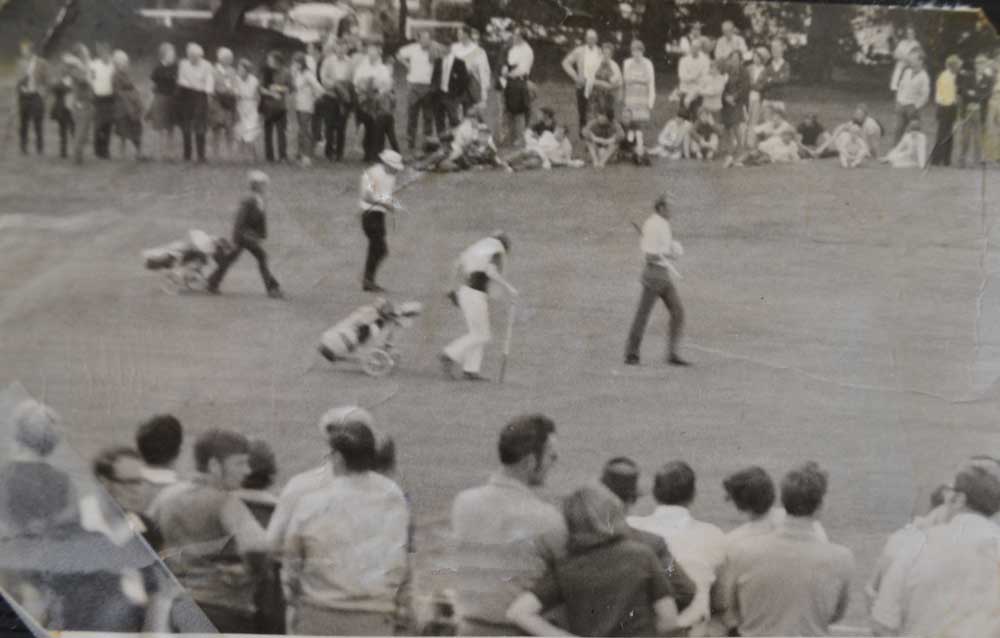
 This grainy photo (apologies) shows me caddying in my first tournament and using a pull buggy for the first and only time.
Following my initial encounter with the world of professional golf, described here in the first of this series, I played golf through my high school years in Dunedin in New Zealand in the late 1960’s and while, like so many other youngsters, I had visions of becoming a much better player than I was ever capable of, I loved the focus and direction the game gave me.
I would spend most afternoons after school rushing down to my local golf course (Chisolm Park), perhaps spending more time there than facing the homework necessary for scholastic success.
Given the experiences I have subsequently had caddying at close to the highest level of the game (around 160 tournaments for 17 wins) I have often been asked how I got started in caddying. Well – for me – this is my story.
In my 5th and final year at school, it was announced that a professional tournament was to be held in Dunedin for the very first time in late 1970 and I began to think how best I could get involved.
Before my high school years, our family had lived in Timaru on the Central East Coast of the South Island of New Zealand and it was there that a family connection would yield benefits.
My sister, Frances, during her school years at Timaru Girl’s High School, had become a good friend of the sister of a man who would eventually have a significant impact on my life, John Lister.
In the late 1960’s John Lister emerged as New Zealand’s best golfer since Bob Charles. In his rookie year on the European Tour in 1969, Lister won two events and was the talk of New Zealand golf as he looked towards a career on the PGA Tour, which he would join in 1971.
Through Lister’s sister, Jenny, I made contact with him and asked if it would be possible for me to caddy for him in the inaugural staging of the Otago Charity Classic.
I thought it was a long shot, but – what the hell – worth investigating at least. When his reply letter arrived, indicating his delight in having me caddy for him, I was ecstatic and set about finding out as much as I could about the role.
Golf on television in 1970, as I recall, was limited to recorded coverage of a couple of the majors and events such as Shell’s Wonderful World of Golf and the World Series of Golf, and so I spent time studying how caddies operated through that means and through one or two books I was able to get my hands on.
The profession of caddying was still in a relative infancy then but I had become aware that some caddies were creating their own yardage books for their players and although I wasn’t sure exactly what I was doing, I set about creating a yardage book for the St Clair Golf Club in the hope that it would be of assistance when John arrived for the event and, hopefully, impress him.
As a 17-year-old meeting a New Zealand sporting star for the first occasion, I was nervous when John arrived in his Mark 2 Zephyr for the event, having driven down from Timaru, but I was relieved with his welcoming nature and we headed out for a practice round.
To my surprise, he was delighted with the extent of the preparation work I had gone to and referred to my yardages from that point on and for the next 12 years or so when caddying for him in New Zealand events, for two or three in Australia, and for eight months in the US.
We actually hit it off very well in that first event, and even though there was an occasion where I (either stupidly or bravely) answered him back when he got a little angry about a shot, he would later say he admired me standing up to him. It was a comment and an incentive to back myself that I remember to this day.

Lister and I in one of his many wins
John played well enough that week and finished 5th behind Kel Nagle but we had gotten on so well that he asked whether I would be interested in traveling with him to Hastings in New Zealand’s North Island the following week to caddy for him at the Watties Tournament at Bridge Pa Golf Club.
I had just finished my University Entrance exam and so was free to travel, and although my parents (bless them) paid for the airfare, John paid for my accommodation, which I shared with him, two other New Zealand golfers Walter Godfrey and Brian Boys and John’s to be wife, Dianna.
Just being accepted as a 17-year-old amongst men was another of life’s valuable lessons.
John finished 4th that week behind a man who would later play a significant role in my golfing life, Graham Marsh, but the two weeks had cemented a long-standing working relationship and friendship with him, and gave me my first taste of caddying at a relatively high level.
While I might not have realised it at the time, those two events formed the catalyst for a love of professional golf and gave me the incentive to further investigate how I might expand on this initial experience.
Further episodes will tell how that experience in late 1970 manifested itself in what was to become and is still, a very special journey.
This link to an article I wrote on John Lister for New Zealand Golf’s Digest highlights the significant regard I had for the amazingly talented golfer.

Circa 1975

The Otago Charity Classic – My Caddying Debut
Following my initial encounter with the world of professional golf, described here in the first of this series, I played golf through my high school years in Dunedin in New Zealand in the late 1960’s and while, like so many other youngsters, I had visions of becoming a much better player than I was ever capable of, I loved the focus and direction the game gave me.
I would spend most afternoons after school rushing down to my local golf course (Chisolm Park), perhaps spending more time there than facing the homework necessary for scholastic success.
Given the experiences I have subsequently had caddying at close to the highest level of the game (around 160 tournaments for 17 wins) I have often been asked how I got started in caddying. Well – for me – this is my story.
In my 5th and final year at school, it was announced that a professional tournament was to be held in Dunedin for the very first time in late 1970 and I began to think how best I could get involved.
Before my high school years, our family had lived in Timaru on the Central East Coast of the South Island of New Zealand and it was there that a family connection would yield benefits.
My sister, Frances, during her school years at Timaru Girl’s High School, had become a good friend of the sister of a man who would eventually have a significant impact on my life, John Lister.
In the late 1960’s John Lister emerged as New Zealand’s best golfer since Bob Charles. In his rookie year on the European Tour in 1969, Lister won two events and was the talk of New Zealand golf as he looked towards a career on the PGA Tour, which he would join in 1971.
Through Lister’s sister, Jenny, I made contact with him and asked if it would be possible for me to caddy for him in the inaugural staging of the Otago Charity Classic.
I thought it was a long shot, but – what the hell – worth investigating at least. When his reply letter arrived, indicating his delight in having me caddy for him, I was ecstatic and set about finding out as much as I could about the role.
Golf on television in 1970, as I recall, was limited to recorded coverage of a couple of the majors and events such as Shell’s Wonderful World of Golf and the World Series of Golf, and so I spent time studying how caddies operated through that means and through one or two books I was able to get my hands on.
The profession of caddying was still in a relative infancy then but I had become aware that some caddies were creating their own yardage books for their players and although I wasn’t sure exactly what I was doing, I set about creating a yardage book for the St Clair Golf Club in the hope that it would be of assistance when John arrived for the event and, hopefully, impress him.
As a 17-year-old meeting a New Zealand sporting star for the first occasion, I was nervous when John arrived in his Mark 2 Zephyr for the event, having driven down from Timaru, but I was relieved with his welcoming nature and we headed out for a practice round.
To my surprise, he was delighted with the extent of the preparation work I had gone to and referred to my yardages from that point on and for the next 12 years or so when caddying for him in New Zealand events, for two or three in Australia, and for eight months in the US.
We actually hit it off very well in that first event, and even though there was an occasion where I (either stupidly or bravely) answered him back when he got a little angry about a shot, he would later say he admired me standing up to him. It was a comment and an incentive to back myself that I remember to this day.
Lister and I in one of his many wins
John played well enough that week and finished 5th behind Kel Nagle but we had gotten on so well that he asked whether I would be interested in traveling with him to Hastings in New Zealand’s North Island the following week to caddy for him at the Watties Tournament at Bridge Pa Golf Club.
I had just finished my University Entrance exam and so was free to travel, and although my parents (bless them) paid for the airfare, John paid for my accommodation, which I shared with him, two other New Zealand golfers Walter Godfrey and Brian Boys and John’s to be wife, Dianna.
Just being accepted as a 17-year-old amongst men was another of life’s valuable lessons.
John finished 4th that week behind a man who would later play a significant role in my golfing life, Graham Marsh, but the two weeks had cemented a long-standing working relationship and friendship with him, and gave me my first taste of caddying at a relatively high level.
While I might not have realised it at the time, those two events formed the catalyst for a love of professional golf and gave me the incentive to further investigate how I might expand on this initial experience.
Further episodes will tell how that experience in late 1970 manifested itself in what was to become and is still, a very special journey.
This link to an article I wrote on John Lister for New Zealand Golf’s Digest highlights the significant regard I had for the amazingly talented golfer.
Circa 1975
The Golfing Hiatus – An Opportunity for Reflection
At this time, when the golfing world is very much in limbo at both the professional and amateur level, I felt it might be an opportunity to describe some of the very special moments I have been blessed to experience during 54 years exposure to the game at a range of levels.
It won’t be all of them, as hopefully I might write a book at some stage, but the stories I tell in this series might be of interest to many golf fans especially those of my vintage and even for those younger who might enjoy an insight into some of the really interesting and fascinating times I have experienced.
Beginning first in 1966 when, as a school kid, attending an exhibition between New Zealand’s greatest golfer, Bob Charles, and one the game’s greatest at that time, Arnold Palmer, through to my most recent involvement at a professional level as an on course commentator at the New Zealand Open in late February, I have lived and worked through some of the game’s great eras and witnessed many of its greatest characters and moments.
It is my intention to share some of them with you in a series of short anecdotes and I trust you will enjoy the stories as much as I know, I will, bringing them to you.
Let’s begin with that first encounter with professional golf.
By early 1966 Arnold Palmer had won all of his seven major titles but he still had plenty of winning golf left in him (he would win the last of his 82 PGA Tour titles in 1973) and was undoubtedly the game’s biggest name when he arrived in New Zealand to play a series of four exhibition matches against New Zealand’s Bob Charles (now Sir Bob).
The match-up between the IMG managed pair was to be played at the Otago Golf Club’s Balmacewan Course in Dunedin in New Zealand’s South Island but first I had to get permission from my high school principal in order to get the afternoon off to attend as it was played on a school day.
I was early in my first year in high school and the idea of approaching the school’s Rector (Principal) to seek permission was a daunting one but given the opportunity I knew existed to see two of the game’s greats playing in the town where I lived was too good to not pursue.
I approached the door of the school principal’s (Harry Craig) with trepidation having told his assistant that I would like to speak with him. I was just 12 and at a new school and just meeting with him was going to be a tough enough task never mind trying to explain to him that I was keen to take the afternoon off to attend a golf exhibition.
The match-up between Palmer and Charles was well advertised and common knowledge in Dunedin but so limited was the golfing knowledge of Mr Craig that he asked me if I was going to ‘caddy’ for one of the players.
Now, several later, that would have been not such a preposterous suggestion as I would later caddy for Charles on three or four occasions but, at the age of 12, Craig’s suggestion was almost laughable
To his absolute credit, however, he agreed to my taking the time off and for that I will be forever grateful.
Many years later, the great Norman Von Nida, with whom I became a close friend in the later stages of his life, told me of the indelible impression that caddying for Walter Hagen at Royal Queensland in 1929 as a 15 year old had left on him.
Hagen’s interaction with the galleries that day and the glamour of his ways gave Von Nida a glimpse into the world of professional golf and to some extent that day in Dunedin had a similar impact on me.
Arnold Palmer carried a charisma that sticks with me to this day and while Bob Charles could never be described as Palmer-like in that regard, he was, as always, immaculately dressed and had quite a presence of his own on the golf course.
In later pieces, I will describe some of the events that led to the me eventually caddying for Bob Charles on one or two occasions, one of which was his 1974 victory in the Swiss Open (photo above).
In early 1966, however, even the thought of caddying for any professional golfer for that matter was the furthest thing from my mind as I walked amongst the largish crowd at Balmacewan just trying to get close-up views of the two golfers who, unbeknownst to me, would create a desire in me to follow the path I have taken.
I can’t even recall who won that day although I do know that Charles won the four round series. It did not matter however as my destiny had been set.
Not the same event but the same participants – Palmer and Charles at the 1972 World Match Play
Hideki Matsuyama’s Brilliance In Vain
Matsuyama in action today – photo Getty Images
Japan’s Hideki Matsuyama has not won an event on the PGA Tour in early three years but after his opening round of 63 at Players Championship in Ponte Vedra Beach in Florida today, there was every reason to believe that the drought might end in the game’s richest event.
The joy of his brilliant effort on day one at the TPC Sawgrass was short lived, however, as, after much soul searching and consternation, the PGA Tour has now made the decision to cancel the event due to the issues surrounding the Corona Virus.
All events on the PGA Tour’s schedule including not only those of the PGA Tour but those of the Korn Ferry Tour, the PGA Tour Champions and the PGA Tour Latino America will be cancelled until the Masters in early April.
“It is with regret that we are announcing the cancellation of THE PLAYERS Championship,” read a statement issued by the PGA Tour late on Thursday evening Florida time.
“We have also decided to cancel all PGA TOUR events – across all of our Tours – in the coming weeks, through the Valero Texas Open.
“We have pledged from the start to be responsible, thoughtful and transparent with our decision process. We did everything possible to create a safe environment for our players in order to continue the event throughout the weekend, and we were endeavoring to give our fans a much-needed respite from the current climate.
“But at this point – and as the situation continues to rapidly change – the right thing to do for our players and our fans is to pause.”
A meeting early on Friday morning will reveal more on this decision but, clearly, after initially making the decision to play the final 54 holes without fans being allowed into the Stadium Course, the more impactful decision became necessary.
Matsuyama, who has been showing a return to some of his best form of late, began and finished his round in style. He opened with four consecutive birdies and then holed a lengthy eagle put at his last hole (the 9th) for his 9 under par round and finished the day two ahead of Harris English, Christian Bezuidenhout and former champion Si Woo Kim.
“I have a lot of confidence now in my swing, and last week was a tough week at Bay Hill, but today I made some putts and that seems to be the difference of late and that was really the catapult to me to have a good round,” said Matsuyama whose round equaled the course record.
Marc Leishman headed the Australians after his round of 67 had him in a share of 5th but all to no avail although given his mediocre record in the event to date it was an encouraging start.
“Golf’s a funny game,” said Leishman before the decision to cancel the event was made. “Always something new. I only had one top-10 here, I had an 8th. I don’t know, not sure what it is. Just hopefully I can keep doing what I’m doing and do better than the past.”
Adam Scott recovered from a slow start to be home in 32 for a round of 70 to be tied with Matt Jones as the next best of the Australians.
And so for players on the PGA Tour there will be no competitive golf ahead of the Masters beginning on March 9th and that, of course, providing the Masters is unaffected by the drama impacting the world at present.
Scores
The Players Championship – The Chances
This week’s Players Championship attracts the attention of the golfing world perhaps more than any other non major event and some might say more than a couple of the majors.
I assess the chances this week and provide evidence as to just why they might be considered as such.
Below: Last year’s champion and now world number one Rory McIlroy – Getty Images
Hatton Holds Off Leishman at Arnold Palmer Invitational
Leishman – file photo
Marc Leishman has fallen just short of winning his second tournament of 2020 but by finishing in outright second position at the Arnold Palmer Invitational in Orlando the 36 year old Victorian will improve to 15th place in the world ranking, his highest ranking since winning this same event two years ago.
Leishman fell one short of forcing Englishman, Tyrrell Hatton into a playoff where Hatton proved to be the last man standing on a week where only four players would finish the event under par.
In fact, so demanding was the Bay Hill Club and Lodge layout that only one player, Matthew Fitzpatrick, would break 70 on Sunday.
Hatton was chasing his first PGA Tour title in his 60th start and after a shaky start to his final round he appeared to have things under control until driving it in the water at the 11th and taking double bogey.
He steadied the ship over his closing seven holes with a series of pars and no dropped shots however and as his challengers dropped off he was able to hold on under the greatest of pressure from Leishman who was looking to not only win this event for the second occasion but to add even greater accolades to his role of tournament ambassador for the week.
For Hatton, the victory helped overcome the perception that his volatile personality would count against him over the closing stages and the quality of the shots he hit over the final few holes proved to many, including himself, he had what it takes to win at the highest level.
“Yeah, it was really tough out there and obviously I was getting frustrated at times, but nowhere near the blow-ups that I am capable of,” said Hatton.
“And it’s just one of those days where you just got to stick in there, and patience is one of the hardest things with me. To think that I’ve shot, what was it? 3-over for the weekend and ended up winning the tournament.
“If you told me that on Friday night I wouldn’t have believed you. But it just shows how tough it was. And obviously, like I said earlier, I’m very thankful to sit next to this trophy.”
For Leishman he gave it his best shot and came up just short, but not only does he improve to 15th in the world ranking but he jumps to 7th in the FedEx Cup table and picks up another US$1 million for his second place finish.
“No, I never give up,” said Leishman. “I said to Matty — we were walking down 16, I said, Of all the courses on the PGA TOUR, this is the last one you’d pick if you had a two-shot lead your three to go.
“So, Tyrell never gave up. He did what he needed to do there at the end. Great par on 18 particularly. That’s a brutal hole, tough pin placement, you have to really hold your shot. So yeah, made it interesting. Would have been nice if that putt would have dropped on 17. I felt pretty good when I hit it.
“Not to be. But happy with the week. With really tough conditions, I played probably as good as I played for quite a while. So, it was good to play well under pressure there too at the end. So, yeah, happy with the week and all credit to Tyrell.”
Matt Jones was the next best of the Australians when he finished in 47th place but New Zealander Danny Lee tied for 5th and earned one of the three starts from this event for the Open Championship in July.
Andrew Dodt’s Near Miss in Malaysia
The Malaysia Open Champion – Trevor Simsby
Queensland’s Andrew Dodt has lost a playoff for the Banda Malaysia Open in Kuala Lumpur today, the Queenslander eventually being knocked out of the race for the title at the second extra hole when beaten by 27 year old American, Trevor Simsby, who won his first event as a professional.
Dodt appeared in the driver’s seat for much of the 54 holes of the weather reduced event until a double bogey at the 15th hole saw him slip one off the lead of three others.
He bounced back with a birdie at the 16th but a missed six foot birdie chance at the 17th would ultimately prove costly as, unable to birdie the 18th, he, Simsby and American Jarin Todd headed back down the 18th to determine the champion.
Todd was eliminated at the first extra hole after Simsby and Dodt both birdied but Simsby birdied at the second extra hole to take the title and the US$180,000 first prize.
Dodt and Todd tied for second and earned US$86,500 each.
Simsby, a graduate from the University of Washington where he played alongside PGA TOUR champion C.T. Pan of Chinese Taipei, was thrilled to claim his career biggest win yet in only his 12th start on the Asian Tour and first this season at the Malaysian showpiece.
The lanky American, who hails from Carlsbad, California, is playing in only his second year in Asia. He came through the 2019 Qualifying School and plied his trade on both the Asian Tour and the ADT last season.
Wade Ormsby was the next best of the Australians when he tied for 10th but remains on top of the 2020 Asian Tour money list courtesy in the main of his win in Hong Kong in January.
Queensland’s left hand amateur, Lawry Flynn, was the next best Australian when he finished a very impressive 16th.
The Asian Tour now has a one week break before the Hero Indian Open in New Delhi.
Leishman Well Placed as Day Withdraws at Bay Hill
Marc Leishman- file photo
Former winner, Marc Leishman, is just three from the lead at the halfway mark of the Arnold Palmer Invitational in Orlando, four birdies in his first seven holes of round two setting up a round of 69 and a share of 7th place in the event he won three years ago.
Leishman trails the leaders Tyrrell Hatton of England and Korea’s Sung Kang by three with New Zealander Danny Lee one off the lead.
Leishman, who was made a tournament host for the event, was delighted with his score and the honour bestowed on him to be the player host for what is essentially Arnold Palmer’s event.
“Yeah, really happy,” said the Victorian. It was tough out there again. Got off to a really good start the first 8 holes and then kind of hung on after that. So yeah, it’s tough. It’s good. I’m really enjoying it. It’s nice playing when par’s a good score.
While he was happy with his play, the honour of hosting the event was an even greater thrill.
“It’s a huge honour. To even be thought of for a role like that is pretty special. Then to get, for them to choose me to do that, it’s a massive honour.
“Of all the things you do, you think of, if you hadn’t had a great day, do you go sign or not go sign? He would have done it, so you do it. And that’s just, little things like that, that kind of, I guess, that’s why you pick certain role models and he was certainly one.
The ever present Sungjae Im, who last week won his first PGA Tour title, is tied for 4th and just two from the lead, a position he shares with Harris English.
Matt Jones was the only other Australian to make the weekend, the current Australian Open champion in 24th place and six shots from the lead.
The surprise of the week amongst the Australians was the performance of Adam Scott who was unable to recover from his opening round of 77 yesterday and finished two shots outside the cutline.
Jason Day was forced to withdraw from his second round after only four holes citing a back injury. It was the second straight year Day, a former winner of this event, has withdrawn from the event.
Andrew Dodt Chasing Further Queensland Success
Dodt in action this week – photo courtesy of Asian Tour
Australia’s Andrew Dodt is on target to continue the outstanding run of Queensland based professionals when he takes to the Kota Permai layout in Kuala Lumpur in round three of the Bandar Malaysia Open.
Although 77 players are yet to complete round two, Dodt was able to build on his opening round of 63 by adding a 68 on Friday to move one ahead of China’s Lu Yanwei through 36 holes. His lead appears safe irrespective of how the remainder of the field finish off their second rounds.
A month ago, Gold Coast based, Michael Sim, won the Queensland PGA Championship, followed a week later by the maiden win of another Gold Coast based golfer, Anthony Quayle, at the Queensland Open and just last week yet another Gold Coaster, Brad Kennedy, outlasted Lucas Herbert to win the New Zealand Open.
Dodt, who hails from Gatton west of Brisbane, missed the cut in New Zealand last week but bounced back immediately with his brilliant opening round on Thursday as he chases his 4th Asian Tour title, two of those events jointly sanctioned with the European Tour.
“It’s hard to back up a 63 but I did with a 68 today, pretty solid,” said Dodt. “I hit a lot of greens but didn’t hole as many putts as I did yesterday. But all in all, it’s a solid day’s work.
“I didn’t think I played cautious today. I just didn’t hit it as close. I didn’t have as many chances as I did yesterday. The pin positions were pretty difficult.
“I’m just playing a little bit technical with my swing. I thought about it a lot on the plane coming here. I haven’t been playing well before this week so I just wanted to throw it up a bit and just play the game.
“I’ve done that so far and happy to be in a good position with two more days to go. I’m just going to have fun, keep things simple and stay relaxed which is what I have done.”
South Australian, Wade Ormsby, who currently leads the Asian Tour Order of Merit in 2019 courtesy of his win at the Hong Kong Open in January, is also well place in a share of 6th place currently after a second round of 65.
Five Australians Earn Asian Tour Cards
Scott Strange – one of five Aussies to gain Asian Tour status
Five Australians have earned Asian Tour Status for 2020 following the completion of the Qualifying Tour’s Qualifying School in Cha Am in Thailand.
Victorian Will Heffernan has finished runner-up, West Australian and former two time European Tour winner, Scott Strange 9th, Victorian Ben Eccles and Queensland’s Cory Crawford 17th and Sydney’s Kevin Yuan 23rd, all finishing within the leading 35 players who earned the right to play the Asian Tour this year.
“I am from Melbourne and I turned professional last year,” said Heffernan. “I have been to a fair few of Qualifying Schools over the last couple of years and I have gained some good experiences which helped this week. To get my Asian Tour card for this season just means a lot to me.
Will Heffernan – photo Asian Tour
Victorian Andrew Martin, a former Australian Amateur Champion missed by one, West Australian Rick Kulacz, NSW’s Dale Brandt Richards and yet another former Australian Amateur Champion, New Zealander, Tae Koh, by two.
The next Asian Tour event is this coming week’s New Zealand Open
Anthony Quayle Rewarded For Consistency At Queensland Open
Anthony Quayle – photo Golf Australia
It might be well short of his biggest previous cheque in professional golf, but Queensland based Anthony Quayle’s playoff victory at the Queensland Open at Pelican Waters on the Sunshine Coast today provides perhaps more than money can buy, namely a victory in a professional event.
Quayle, who has plied his trade with commercial success in Japan for the past two years, had yet to taste success in the paid ranks until today but by holding off a spirited and impressive challenge from South Australian amateur Jack Thompson he has broken through for what is likely to be the first of many wins.
Quayle has been rewarded for a very consistent few months where he has finished inside the top twenty in his last seven starts in both Japan and Australasia, one of those when finishing 3rd at the Casio World Open late in the 2019 Japan Tour season.
The cheque for the finish at the Casio was the equivalent of $A190,000 and while the monetary rewards today paled in comparison (A$20,600) the value of the breakthrough victory alone is hard to put a figure on.
Quayle had his nose in front for much of the final round in a battle with West Australian Kim Felton and Thompson but it was Thompson who refused to go away. Quayle blundered early in his back nine and actually lost the lead to Thompson at one stage but he recovered to force the playoff.
Quayle won by saving par at the first extra hole.
The winner, Quayle, and runner-up, Jack Thompson, (left) – Golf Australia
“It feels incredible,” said Quayle. “I’ve given myself a few chances recently and haven’t been able to pull it off and the feeling of frustration or regret walking off the 18th green is definitely not present at the moment,” Quayle said.
“I felt for a while that my first win would be a pretty difficult one to get done and maybe it was difficult because I thought it into reality.
“I showed myself today what it takes to win and it doesn’t have to go perfect. You can make quite a few mistakes and still have a chance to win. I think it’s a pretty good lesson for me today.”
“KB (Ken Berndt) my coach helped me out a lot,” Quayle said while also thanking his parents and wife Sofia for their support.
“We got to a few ahead and then went bogey, double and Jack went par, birdie and all of a sudden he was one ahead and was playing really nicely.
“To catch him I was going to have to play really good golf. KB had a chat to me; got me to compose myself and I barely missed a shot coming in the last five holes.
“He was saying to me as we went to the first playoff hole I didn’t sign up for this extra work, but I wouldn’t be here without him. He’s coached me since I was 14, constantly helping, incredibly selfless, just always there to help you out.”
Brad Kennedy tied for 3rd with New South Wales’ Jake Higginbottom.
The PGA Tour of Australasia now heads to Queenstown in New Zealand’s South Island for the 101st New Zealand Open at the host course Millbrook Resort.