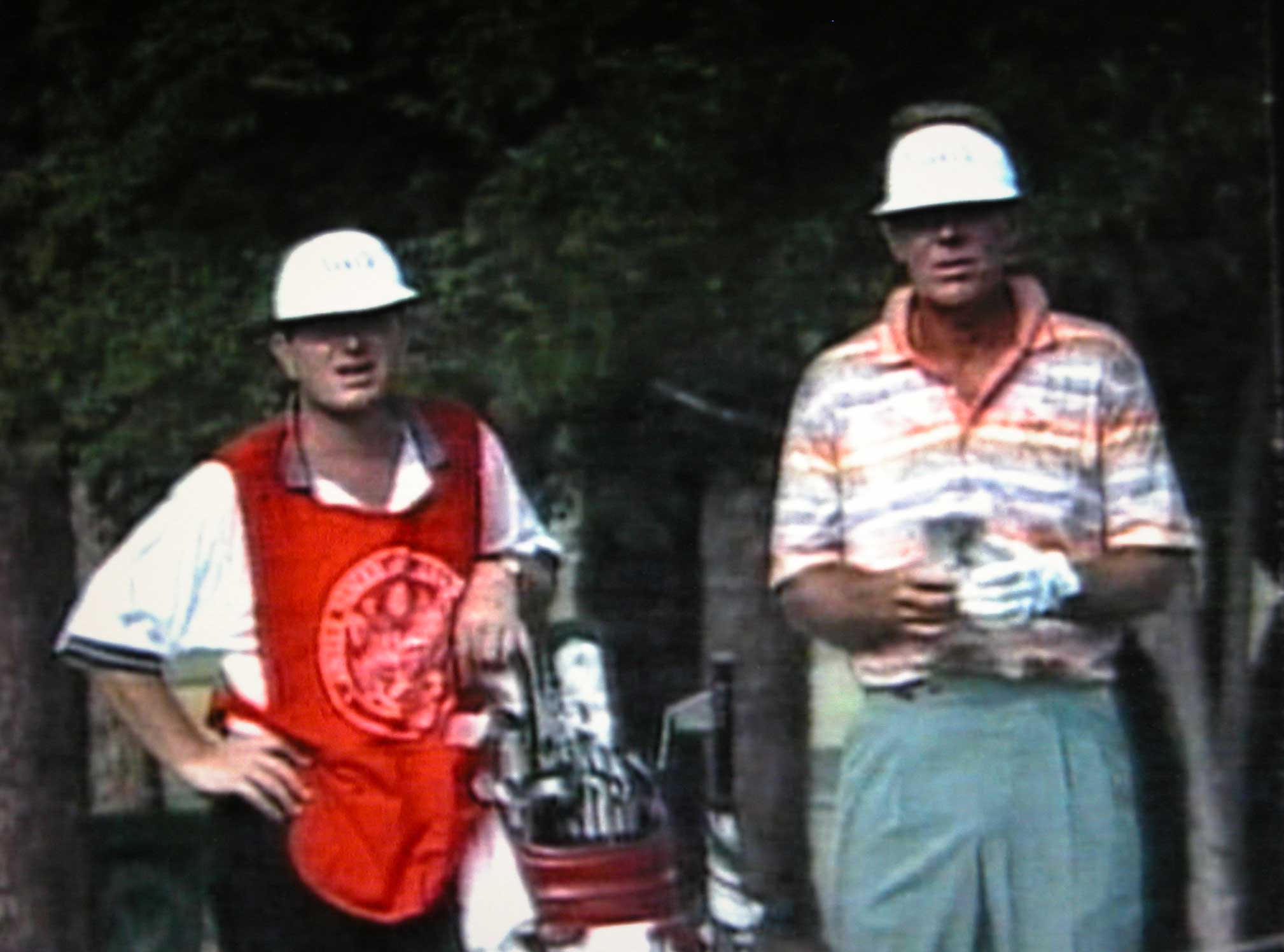
 Grainy footage from the TV coverage shows Graham Marsh and I on the 72nd hole.
As 1990 drew to a close, so too did my involvement in the dual role as caddy / assistant to Graham Marsh, a role which had involved caddying on the Japan Golf Tour amongst other business-related activities.
As Graham’s golf course design company, Marsh Watson, began to grow and secure more work, a larger structure was required to service that work but such matters can be akin to the chicken and egg syndrome, namely, which comes first?
Marsh and his then business partner, Ross Watson, expanded the company’s team but it would then become important to secure on-going work to justify the increased workforce.
A consultant was engaged to restructure the company and I was offered to role as Sales Manager for Marsh Watson which would involve a move from Perth to the company’s head office in Robina on the Gold Coast.
While disappointed to be giving up the caddying side of the role and the time in Japan I had been involved in for the previous 20 months or so, the position that had been created was particularly attractive in terms of my own future prospects.
I left for the Gold Coast in early 1991, took up residence there and began my time sourcing work for the company by regularly traveling through Asia and the Pacific. I will go into greater detail on that role and my own view of the golf course design industry during those times in a later piece.
I caddied for Graham in a one-off event, The Four Tours Championship in Adelaide in late 1991, but that aside it would not be until 1994 when I would caddy again.
In late 1993 and just prior to turning 50, Graham, despite his significant success internationally, was required to go through the very difficult task of qualifying for the US Senior Tour and managed to secure one of the very few cards available for 1994.
I often chuckle when I hear golfers of all sorts of skill levels telling me that once they have reached the age of 50, they intend to play senior golf at a professional level. My experience has highlighted just how tough it was to even get a tour on which to play at that level and the exceptional standard of play required to survive once there.
Graham had, though, remained competitive on the Japan Golf Tour right through to the age of 50 and that would stand him in good stead for what lay ahead.
In his rookie season I expressed a desire to Graham that I would enjoy the chance to travel to the USA to take a few weeks off my role with his design company and caddy for him in a few selected events.
It was agreed and I left for Nashville in June of 1994 for events in Nashville, Dearborn (near Detroit) and finally the US Senior Open at Pinehurst in North Carolina.
The first event was at the Larry Nelson designed Gaylord Opryland Resort just outside of Nashville, Graham finishing 8th behind Lee Trevino.
We then headed to Detroit and, more specifically, Dearborn just outside that city, the home of the Ford Headquarters where a Jack Nicklaus designed layout, the TPC Dearborn, would host the Ford Players Championship.
Graham finished 14th that week behind the winner Dave Stockton and for me there was the thrill of being paired with Nicklaus himself in the final round. I recall it being in an era where caddies and players hardly exchanged pleasantries after a round, as is the case now, but Nicklaus made a point of doing so.
I had, admittedly, caddied in the same group as him previously and would again at Congressional Country Club near Washington DC the following year, but it further confirmed the high regard in which I held the then greatest player of all time.
From Dearborn we headed to Pinehurst in North Carolina, flying down to Raleigh and then driving the hour or so to the outstanding multi-golf course destination.
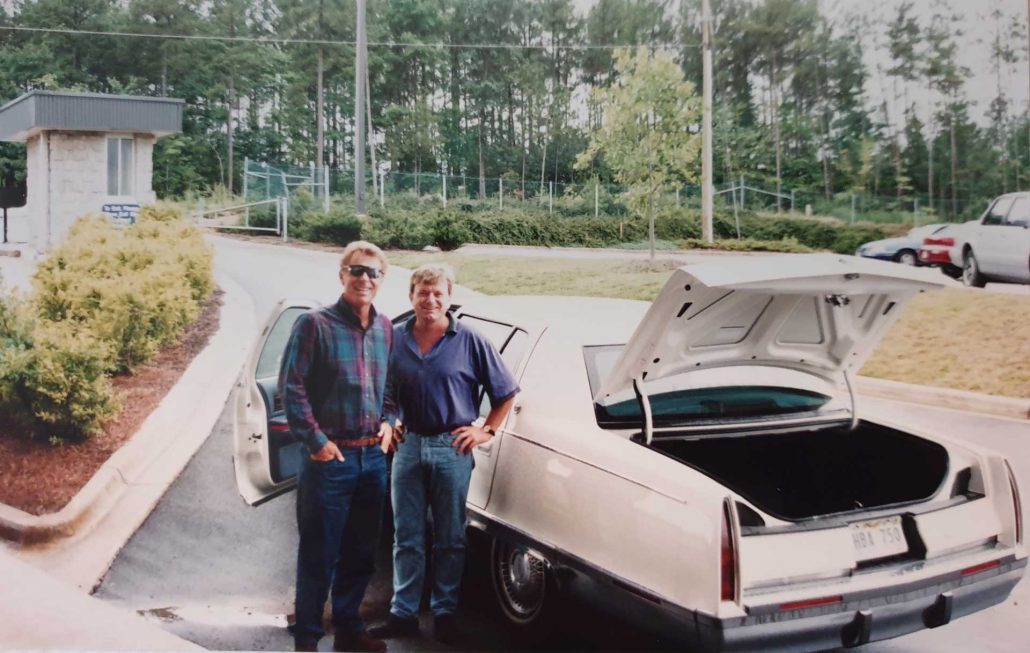
Graham and I leaving Raleigh for Pinehurst.
I had caddied at Pinehurst # 2 in 1979 in the then Colgate World Hall of Fame Classic, named because the Hall of Fame stood at the end of the 4th hole there. It has been more recently relocated to St Augustine in Florida and is now owned by the PGA of America.
My earlier visit, however, had been at a time in my life when my appreciation of golf course design was perhaps not at the level it was when arriving there in 1994.
On arrival and checking into the delightful Carolina Hotel nearby the golf courses, Graham indicated he would take the afternoon off and we would meet for dinner later. I said I would head out onto the golf course to refresh my knowledge of the layout and do the yardages for the front nine and complete the balance early the next morning.
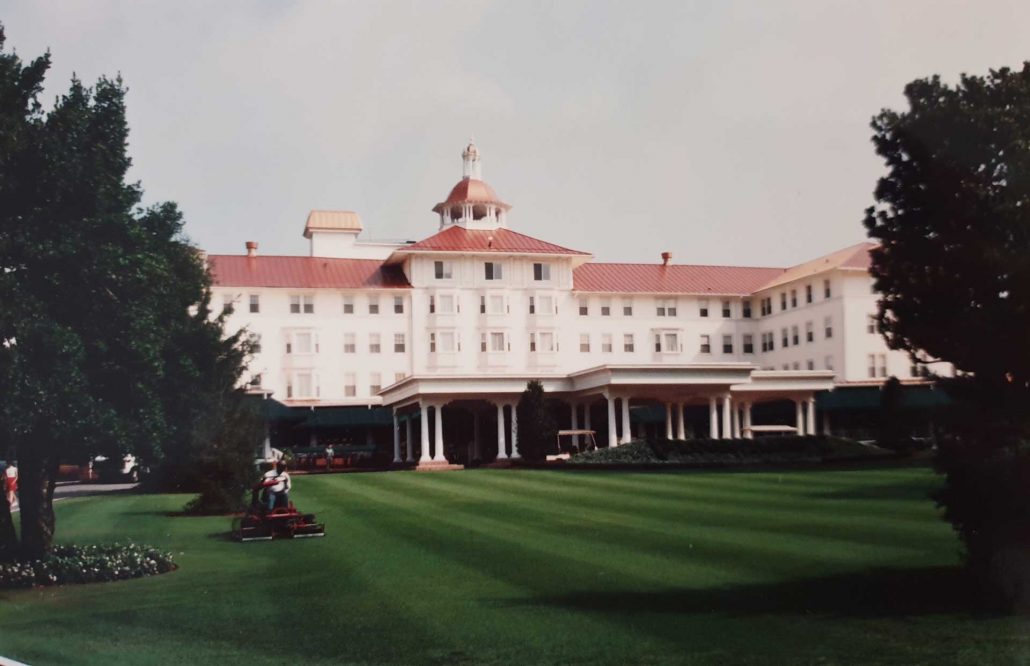
The Carolina Hotel – more salubrious than some of my previous caddie digs
Once on the golf course, however, I simply fell in love with what I was seeing. This was the same layout later used for the 1999 and 2005 US Opens and was before the major alterations by Ben Crenshaw and Bill Coore in 2010.
I found a pay phone on the golf course (it was before the prevalence of mobiles) and called Graham to tell him that I might be a little late for dinner. So taken was I with the golfing environment and the golf course itself that I decided to stay on and do all 18 holes before heading back.
To use a term I often use when describing a golf course that moves me, it smelt of golf as indeed does the village of Pinehurst itself which thrives on golf tourism. While very different in their heritage there are similarities between what Pinehurst means to American golf and what St Andrews means to golf elsewhere.
I immediately had a great feel for the place and really felt it was the sort of golf course on which Graham could do well and so it would prove.
It was a week interrupted by the summer afternoon storms so prevalent in that particular region part of the US and on three occasions the field was required to return to the golf course in the morning to complete a round from the previous day.
By Sunday morning, after the completion of a delayed third round early that day, Graham trailed Zimbabwe’s Simon Hobday by six shots but was alone in second place and played with Hobday and American Jim Albus in the final round.
Hobday was feeling the pinch throughout and appeared to be falling apart at the seams with the prospect of winning such a significant title. By the time the trio reached the 18th tee on Sunday afternoon, Graham and Hobday were tied at 10 under par one ahead of Albus.
If these names seem a little unfamiliar to you, then a look at the first page of the leader-board which included the likes of Jack Nicklaus, Dave Stockton and Tom Weiskopf might help in assessing the quality of play needed to be in the position in which the leaders found themselves.
The video below captures the final stages of the dramatic day beautifully, but Graham drove first at the 18th and split the fairway although Hobday would also drive it well.
Video footage of the final hole
The par 4 last hole at Pinehurst plays uphill and, on this day, there was a stiff breeze into the players’ face as the trio were about to play their approaches.
Graham had 169 yards to the flag and, as we stood over the ball, he quizzed me by thinking aloud. This was in an era long before the dramatic increase in distances the last 25 years has seen come into the game. I was thinking a 5 iron and Graham appeared as if that was his thinking as well.
There were a couple of circumstances we perhaps did not think through enough. The breeze was sheltered a little by the clubhouse behind the green, the accepted rule of thumb, especially when under pressure, is to hit the lesser club (6 iron) in order to release the club properly and stay committed to the shot and the adrenaline factor needed to be considered.
As to where a shot with a different club might have finished we will never know, the approach by Graham finishing exactly flag high, admittedly, but it was a shot that was always right of the green as he perhaps eased off on the shot a little.
Hobday, who was by that time 4 over for the round, somehow found the green albeit some 35 feet behind the hole.
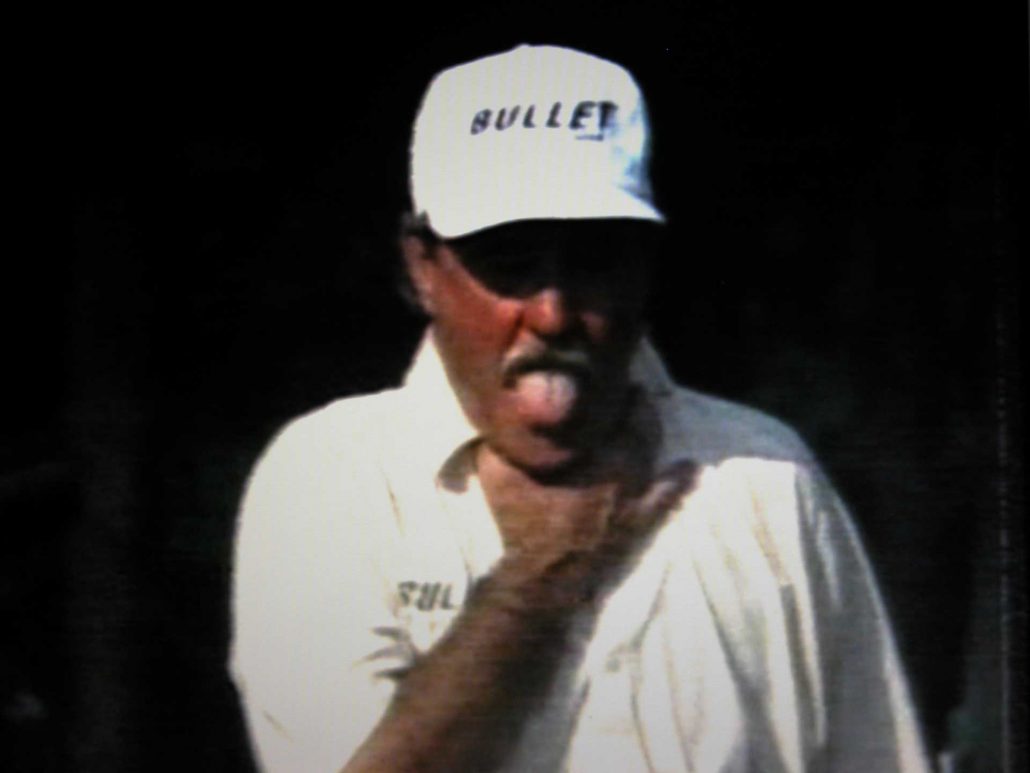
From the television coverage – Hobday was comically showing the world the pressure he was feeling
I stood alongside the ball as Graham surveyed his shot. I really felt it was a pitch a run across the green with perhaps a wedge to negotiate a gentle tier some 20 feet short of the hole but echoing in my mind was a conversation Graham and I had had a couple of weeks earlier in Nashville.
When I had then asked him how things were going with the American caddies he had regularly on his bag he made the comment that they were good but there were times when they wanted to tell him how to play particular shots.
As he grabbed the 56-degree sand iron from the bag, I felt it was the wrong type of shot as to my mind he needed to get the ball running but I will admit, especially given his comment three weeks earlier, I was reluctant to say anything. He had not sought my advice and at this crucial moment I was not about to offer it without him asking.
As the video shows, the pitch from a slightly uphill lie was not struck well, failed to negotiate the tier and finished 12 feet short. He would miss that putt and, somehow, Hobday two putted while admitting himself to ‘choking’ as he referred to his own open and visible display of nerves.
Hobday shakes hands with Albus and Marsh
So Hobday had beaten Graham and Jim Albus by one. It was an opportunity lost as it was hard to imagine Hobday could have held on the following day in an 18-hole playoff.
I headed into the locker room and waited for Graham to finish his media commitments, wondering how he might accept what was a missed opportunity for a senior major in his rookie season. He had, after all, won in his rookie season on the regular PGA Tour in 1976, and this would have made a nice double.
“I think we might have hit the wrong club at the last,” was his comment (referring to his 5-iron approach) when he walked in to find me packing up the bag.
“Yes, and I think there were two wrong clubs hit on that hole,” I replied.
We dined together that evening at one of the many restaurants in the Pinehurst village and as we headed back to the hotel we walked past a noisy gathering in one of the other hotels. It was Hobday and a group of his friends and hangers-on having a great old time.
I suggested to Graham we should join them for a drink, which we did, and Hobday, as only Hobday could and in a light-hearted manner, told Graham that he thought it was he (Marsh) who was choking up the last.
He was, of course, referring to the fact that he had held on despite the pressure being applied and, in the end, it had been Graham that had stumbled at the final hurdle. It was all in jest, of course, and treated that way.
We stayed for a couple more drinks, and the interlude had broken the ice on what had been a long and tiring day and ended my three weeks on the US Senior Tour with at least a bit of frivolity.
Simon Hobday kisses Pinehurst’s 18th green after winning

Jason Day Loses PGA Lead But Remains Well Placed
Day hits his tee shot at the 9th – click to open – Photo courtesy of PGA of America
Jason Day might have lost his share of the lead at the PGA Championship at TPC Harding Park near San Francisco, but he is well placed heading into the weekend of the first major of the year.
Day’s second round of 69 has him two behind the leader, Haotong Li, and tied for second place with Tommy Fleetwood, Daniel Berger, Brooks Koepka, Justin Rose and Mike Lorenzo Vera.
After three early birdies, Day had a share of the lead with Li, who had started his second round early, before a messy double bogey at the lengthy par 4 12th hole. He had chances to regain that lost ground in his closing holes but the putter deserted him.
He is, however, very well positioned with Li leading an event of this nature for the first time and the prospect of becoming China’s first male major championship winner, a huge task for the 25-year old.
Leader, Haotong Li – the weight of China’s expectations on his shoulders over the weekend.
“The course played a little bit — obviously a lot harder today for us in the afternoon,” said Day. “I know that the guys got a lot stronger wind yesterday. So to be able to walk off beating the golf course and shooting 69 today, I was pretty pleased with that.
“It’s a big golf course. It’s a big-boy golf course. The strange thing is when we have the southwesterly wind there’s a lot of side-wind golf shots, so you have to really control your ball flight.
“The greens, I think the last time we were here, they had a little bit more poa annua and they were a little more bumpy, but the green surfaces are playing tremendous. They are starting to get that little purple dry look to them, and with this wind, it’s definitely difficult.
“Obviously 12 was a bit of a mess. Wish I could have at least bogeyed that instead of doubled it, but overall, I gave myself plenty of opportunities coming in and just didn’t capitalize on them like I did yesterday.
“So, shooting 69 today, moving in the right direction, which is nice, if I can do that over the weekend, maybe shoot a couple more over the Saturday and Sunday round, hopefully I’m there; Sunday in contention.
“But the game feels good. I’m excited to come out and play every single day. I’m just going to try to tidy up the driving a little bit on the range and try to hole some more putts tomorrow if I can.”
Adam Scott stayed in touch with a round of 70 after being unable to take full advantage of an early tee time on day two. He mentioned after his round that he never felt he was moving forward.
“It was a bit of a mixed bag,” said Scott. “I guess overall my iron play wasn’t very good today, and my scrambling was pretty good. But a round where I never really had the momentum.
“I drove it a lot better than yesterday, which I was happy about, but I just couldn’t get it in there close enough to have really good looks at birdie, and I missed a few extra greens from the fairway, which is kind of not really my style.
“It was a bit of a grind. I’m definitely going to have to find my rhythm with my irons over the weekend.”
In Scott’s defence, it was just his second competitive round in five months so he has importantly kept himself in the mix for a possible run over the final 36 holes on a golf course that appears as if it will become even more demanding.
Of the other Australians, Cameron Smith improved with a second round of 60 to be at even par and tied for 44th while Marc Leishman, Matt Jones and Lucas Herbert will have the weekend off.
Ruffels Remains Alive at US Women’s Am
Ruffels in action today – Chris Keane USGA
Australia’s Gabriela Ruffels hopes of a second consecutive US Women’s Amateur Championship title remain alive following success in her Round of 32 and Round of 16 matches at the Woodmont Golf Club in Maryland today.
Ruffels was behind early in both matches but fought back from a two hole deficit against China’s Lei Ye in her morning round to win 2 up and then overcame a one hole margin through 8 holes against Spain’s Teresa Toscano Borrero in their Round of 16 encounter to eventually win 4&2.
“I’ve been down in all of my matches, but No. 9 has been a big turning point for me,” said Ruffels, who has advanced farther than any defending champion since Danielle Kang in 2011. “If I can be close heading to the back nine, then I feel like I have an advantage.
“I’ve done this before so I don’t really feel the pressure or expectations. I’m just trying to have as much fun as I can out here, and I am doing that, so it’s been awesome.”
Tomorrow Ruffels tackles the well credentialed Emilia Migliaccio from North Carolina who attends Wake Forest University and is currently the 4th highest world ranked women’s in amateur golf. Miglaccio was forced into extra holes of her match this afternoon before winning at the 22nd hole.
The news was not so good for the other remaining Australian in the field Emily Mahar. Mahar suffered an agonising loss to South African Kaleigh Telfer at the 20th hole after holding a 3-up advantage through 14 holes.
Gabriela Ruffels Facts
Jason Day Shares PGA Championship Lead
Jason Day in action today – photo courtesy of PGA of America
Australian Jason Day has opened with a round of 5 under par 65 at the PGA Championship at the TPC Harding near San Francisco and shares the lead with American Brendon Todd at the end of day one.
That pair is one shot ahead of a group of nine players at 4 under 66 but despite 47 players breaking par on the lakeside layout west of San Francisco, the golf course proved to be demanding with no player able to go really low.
Day played early (7.33 tee time) and was bogey free, recording one of his best opening rounds in championship golf following on from several good finishes in recent weeks on the PGA Tour.
“Today I drove it really nicely, and when I was out of position,” said the 32 year old. “I left myself on the right side of the fairways to be able to at least get somewhere around the greens, and if I did miss the greens I left it in the right spot.
“Yeah, pretty sound the whole way around. I hit a lot of good-quality iron shots coming into the greens. Wasn’t overly aggressive. And there was a couple of shots on 9 and 17 where I hit it pretty tight, but overall it was very solid.
“There was definitely a lot of momentum coming in off the previous finishes that I’ve had, three top 10s, which has been nice. The game feels like it’s coming around. I’m pleased with it.
“I’m not like excited — I shouldn’t say I’m not excited. I am excited to come out and play every day, but I know that I can improve, and mainly my putting can improve a little bit more.
“I feel like I’ve been working very hard in the off-weeks and especially when I come to a tournament to be able to get my putting back to where it is because it’s always been a strength of mine, and I feel like the game is slowly coming around, the confidence is coming around because I’m starting to see the results, which has been good.”
Adam Scott has not played a PGA Tour event since February but he did very well to record a round of 68 to be three from the lead, more especially given he was required to overcome a slow start to a round in which he bogeyed three holes on the way to the turn.
“I just hit it in the rough a lot on the front nine, said Scott who played in the afternoon field today.
“Took me four or five holes to kind of figure out my comfort lines on the tee. You know, I’ll give myself a break on having not played any competitive golf for a while, that it took me awhile to find my rhythm out there, but I worked hard and it didn’t slip away from me, which I was really happy with.
“I ground it out on the back nine, because the wind got strong as we got around to around 13, which that was challenging with it coming in hard off the left shoulder. So I’m very happy with that score today.”
Of the other Australians, Matt Jones and Marc Leishman recorded rounds of even par 70, Cameron Smith a 71 and Lucas Herbert a 3 over par 73 in his first appearance at the PGA Championship.
Mahar and Ruffels Advance at US Women’s Amateur
Brisbane’s Emily Mahar in action during her win today – Chris Keane USGA
Australians Gabriela Ruffels and Emily Mahar have advanced to the second round of the US Women’s Amateur Championship in Rockville in Maryland.
The only other Australian in the event, Kirsty Hodgkins, was eliminated after losing to Malaysia’s Alyaa Abdulghany.
Ruffels, who is defending the title she won last year, drew clear in the closing stages of her match against South African, Kajal Mistry, but it was a hard fought contest early, the pair still tied through twelve holes before Ruffels birdied the 13th and 15th holes and eventually won 4&2.
“It was a little bit of a shaky start,” said Ruffels, 20. “It took me a while to kind of get into it, but I was really happy with the way I finished.
“I played a little later today, so the wind was up a lot more and kind of a different direction than the other days, so I did have to make a couple adjustments with what I hit off of tees.”
Brisbane’s, Mahar, who is currently playing collegiate golf while studying at Virginia Tech, is playing her second US Women’s Amateur Championship and emerged as the winner today after a tight battle against Alabama’s Michaela Williams.
Mahar was never behind in her match but it was a close fought affair with never more than two holes between the pair. Mahar held on to win 1 up at the last.
Gabi Ruffels begins well in US Amateur Defence
Ruffels in action today – photo Chris Keane USGA
Victorian, Gabriela Ruffels, has made a promising start to the defence of her US Women’s Amateur Championship, the 20 year old daughter of tennis champions, Ray Ruffels and Anna-Maria Fernandez, and sister to celebrated young Australian professional, Ryan Ruffels, today finishing equal 5th in the stroke-play phase of the Championship at the Woodmont Golf Club in Rockville in Maryland.
In winning the title in 2019, Ruffels became the first Australian to win the coveted championship and with rounds of 72 and 71 on the demanding Woodmont Golf Club layout this week, she is well placed to advance through the match play phases which begin on Thursday (US time).
Currently ranked 9th in the World Women’s Amateur rankings, Ruffels takes on South Africa’s Kajal Mistry in the opening round.
Mistry survived a playoff to get into the field of 64 to contend the match play, bouncing back from an opening round of 81 with a second round of 69 to scrape into the knockout field.
Ruffels, who currently attends the University of Southern California, will be joined in the early rounds of match play by fellow Australians Emily Mahar and Kirsty Hodgkins who finished in a share of 48th place and take their place in tomorrow’s field.
Australian Emily Mahar is also into match play
Jason Day Shaping as Australia’s Hope at Harding Park
Can Day add another major to his 2015 PGA Championship? – photo PGA of America
Four months after it was meant to happen, the first major golf title of the year will be decided this week at the TPC Harding Park, just outside of San Francisco, where the USPGA Championship is up for grabs.
Amongst the six Australians to have made the field, the main hopes appear to rest with Jason Day and Mark Leishman. The country’s leading world ranked ranked player, Adam Scott, plays his first tournament since the Arnold Palmer Invitational in March and must surely need some time ‘in the middle,’ as the cricketing saying goes, if he is to be threatening at this level.
Day, therefore, especially given his encouraging play of late, shapes as Australia’s best prospect despite ongoing niggling back issues. He has been able to overcome his long term ailments with three consecutive top tens in his last three starts and, as a proven big event performer, his chances appear good to record his 16th top ten in major championship golf and, just perhaps, something significantly better.
Day has continued to make changes to his entourage with long-time friend, mentor and coach, Colin Swatton being let go as the now 32 year old pursues the formula that will allow him to return to the level which has seen him win one major and two World Golf Championship events amongst his 12 PGA Tour titles.
Make no mistake, Day has already produced a stellar career in the game, especially given the medical and injury issues he has had to overcome. His vertigo and back issues, amongst others, have held him back from winning even more titles and more money than the massive US$47 million he has already accumulated in on course PGA Tour prizemoney.
That US$47 million has him currently in 12th position on the all-time career money list on the PGA Tour and behind only Adam Scott’s US$55,000 amongst the Australians who have plied their trade on professional golf’s holy grail over the years.
His win at the PGA Championship in 2015 swept him to the elite of Australian golf and one is left to wonder just where an injury free Jason Day might sit amongst the all-time greats of Australian golf had he not been plagued by a body that regularly breaks down.
It should be remembered, however, that Day is but 32 years of age and if he can continue to play at the level he has been of late then another major title is perhaps not the remote possibility it might have been considered six months ago.
Scott has been preparing for his return to the PGA Tour at his home on the Sunshine Coast of Australia and in more recent weeks in the US, determined to let the dust settle before he exposed himself to the new look PGA Tour.
He would, therefore, appear to be a little underdone for a successful tilt at a second major title although he has shown previously that a limited schedule can work in his favour. Despite his undoubted class he would not appear ready for the heat of a major battle.
Adam Scott – one of his more recent wins but is he ready for a major?
Marc Leishman was runner-up in the last event Adam Scott played at Bay Hill but since his return to tournament golf he has finished no better then 40th in five starts and therefore his chances appear slim.
Cameron Smith has been even less impressive in the five events he has played of late and it would be a surprise if he contended.
Matt Jones and Lucas Herbert make up the balance of the Australians, Herbert with just one start since his runner-up finish at the New Zealand Open in early March. He performed with some credit at last week’s WGC event in Memphis but in what will be just his 4th major championship this will be a learning curve for the Victorian who is no doubt enjoying being away from his home state at present.
Jones played well enough in the Workday Charity event a few weeks ago but it would seem that the current Australian Open Champion might struggle this week.
So all roads point to Jason Day to head the Australians and although his injuries tend to make him a week to week proposition, he is all class and has thrown out signals of late that he is returning to his best.
A Friendship With Norman Von Nida
18 months earlier I had made the decision to leave Graham Marsh’s golf course design company and head into the unknown world of golf media and one of the earliest gigs I secured was as golf betting analyst for the Radio TAB network’s morning sports show which had been established to cater for, and capitalise on, the growing sports betting market.
The role involved twice-weekly appearances (normally ten minutes and by phone) assessing likely chances in professional golf events along with wider golfing issues but if a major such as the Masters or Open Championship was being played I would venture to the Brisbane studio for a longer segment.
Just as I was to leave home on the Gold Coast for Brisbane on the Thursday morning of the Open Championship at St Andrews that year, the producer of the show, Graham Rigby, called to inform me that Australian golfing icon, Norman Von Nida, would be joining us by phone to discuss his thoughts on the event and relate some of his experiences at The Open.
I was delighted that such a figure would be included in our discussion and was quickly onto the net which was still in its infancy at that stage to research just how Norman had played at the Open Championship and how he had done at St Andrews. He actually finished 4th behind Sam Snead there on debut in the event in 1946.
I was a little concerned as I had never met Norman and I felt sure he would be unfamiliar with just who the hell I was. I had a perception of Norman as a feisty character and expected to receive a cold shoulder when introduced to him on air. How wrong I was to be.
When Rigby, who was hosting the show that morning in the absence of regular host, Mark Forbes, introduced Norman to our audience on the phone he also introduced me to Norman.
I expected a vague acknowledgement by Norman of my role but to my absolute shock he spoke in very favourable terms of what had been my role on Radio TAB to that point as he had been a regular listener.
Immediately on finishing our half hour segment I called Norman to thank him for his kind words which he reiterated and suggested we should get together for a game at Royal Queensland some time soon.
At that stage of his life (86) Norman was legally blind but thrived on regular games at Royal Queensland where, of course, some 75 years earlier he had developed his passion for the game by caddying for members at that same course.
We did play that game in August of 2000 and for the next seven years of his life Norman Von Nida and I became great friends. I look back now as being blessed to have gotten to know so well one of Australian golf’s greatest players and characters and perhaps its most significant trailblazer.
Until his death in May of 2007 at the age of 93, Norman and I attended numerous functions, golf events, luncheons or just coffee chats (not that he drank coffee) with he and his wife Elva. My then partner Marilyn and I enjoyed being able to accompany them as they sought to escape an increasingly routine lifestyle in an Aged Care facility on the Gold Coast.
Norman’s regular exposure to actually playing the game in his twilight years had been thwarted by an accident he experienced in 2001 while still living at Scarborough in Brisbane’s bay-side suburbs. It denied him the great pleasure he had of playing at Royal Queensland with his mates and anyone else who wanted to sound him out about his great knowledge of the game.
He had been crossing the road to post a cheque (he told me it was to his bookie) one day when a car struck him and broke his arm. At that stage of his life the injury would effectively prevent him from ever playing again other than the occasional few balls he would hit. (more on that later)
Norman in 1952 – Courtesy of Getty Images
So moved by what I was learning of this very special man and his achievements (three Australian Opens, four Australian PGA Championships and countless European titles), the latter during a period when he was blazing the trail for players such as Peter Thomson and others to follow, that I made the decision in 2003 to put together an audio tribute to him.
I collated, narrated, and essentially produced (with a little help from the aforementioned Graham Rigby) the 38-minute piece. I contacted many of those who were players of his era and those who had benefited from his willingness to help his fellow golfer and fellow man.
Included in the piece were contributions from Norman himself, Gary Player, Peter Thomson, Bruce Crampton, the fine Welsh player, Dave Thomas, and even figures from outside golf such as jockey great Scobie Breasley and legendary Australian boxer, Johnny Famechon.
They all spoke at various lengths on what Norman Von Nida had meant to them. The piece won an award and given my relative inexperience in the production of such things I was very proud that I had been able to capture and record such a significant piece of Australian history from such a wide ranging line-up of Australian sporting greats.
For those interested the piece may be listened to by clicking on the audio bar below. I would encourage you to do so.
There were many outings enjoyed by Norman and I during those seven years wherever we went, whether it was to the Carbine and Tattersalls Clubs in Brisbane, to the launch and playing of golf events on the Gold Coast or Ipswich, or to any golf related function. Norman was always the centre of attention and he loved the chance to have his say and to assist those who sought his help and advice.
As the time between his accident and his gathering years grew, however, Norman was becoming increasingly frustrated by not being able to play his beloved game.
One day in the winter of 2005 it came to a head and he called to ask if I could find somewhere where no-one would know but where he could have a hit to see if there was any possibility of him playing again at any level.
I arranged to take him to Lakelands Golf Club on the Gold Coast one lazy Sunday mid-winter afternoon. We stood on the first tee and his deteriorating eyesight would mean that I needed to guide him in the right direction.
He struggled down the first fairway and it was clear he was embarrassed by the experience. I tried to make him aware of how long it had been since he had actually hit a ball and suggested things weren’t really as bad as he might have thought.
Norman was, however, a very proud man and like all of us golfers we all want to play to the best level we can. Imagine, therefore, how it must have been for him, given the great heights he had reached in the game.
I convinced him to play another hole but after his tee shot on that hole he declared he had had enough and to my knowledge that would be the last time he would attempt to play golf on a golf course.
That final tee shot in 2005.
‘‘I’d never contemplated being a good player again, but when I’ve been a reasonably good player it was embarrassing to see an old geezer trying to do what I did,’’ he told a local newspaper at the time.
The drive back to he and Elva’s aged care facility was an awkward one. Clearly, he was feeling the impact of being resigned to bringing to an end of his love affair with playing the game. Anything I was about to add was not going to make any difference to an incredibly poignant moment.
In May of 2007 Norman Von Nida passed away peacefully in his rest home on the Gold Coast. It was the end of one of the greatest stories in Australian golf, from a childhood caddie at Royal Queensland in the 1920’s to the illustrious career which saw him win nearly fifty professional titles.
I was extremely proud to be asked, by his daughter, Kerry, to speak at his funeral, attended by hundreds of Australian golfing dignitaries and others. My role was to finish proceedings and I immediately thought of the last minute or so of the audio tribute I had created on him four years earlier.
In that segment (which I introduced on the day of his funeral) I had asked Norman what it was that had made him so keen to help others in his amazing life. His voice, speaking over the speakers in the church to close the celebration of his life, was a surreal moment.
His response (below) captures the essence of Norman Von Nida beautifully. He certainly backed his own judgement and was never afraid to voice it but, perhaps because of his upbringing, he knew that there were people out there he could help because of his success.
I feel blessed that his friendship and encouragement helped me also.
I pose (L) with the fabulous ‘Von Bronze tribute’ at Nudgee Golf Club in Brisbane having hosted the unveiling several years earlier (R)
Betting: Travelers Championship Stacked Full of Class and Value
With the 2020 PGA Tour now back in full swing, this week’s event in Hartford in Connecticut tells the story of professional golf on the way back to at least some level of normality.
With this in mind, I take a look at the Travelers Championship from a betting angle and try and source some of the likely chances to do well.
The Travelers Championship at the TPC River Highlands is being played in its normal time slot after what would have been the US Open, although this year the event has benefited from its position in the schedule rather than perhaps suffering from being the week following a major.
With PGA Tour members being starved of competitive golf over the past three months or so until their return in Fort Worth two weeks ago, the opportunity for tournament golf has seen an impressive entry list this week with only Adam Scott and Patrick Reed of the World’s top ten missing from the event.
As is always the case in a PGA Tour event, the winning possibilities are endless but in order to narrow it down and to find a bit of value I am considering the following.
Of the more favoured players, and there are many of them, Bryson DeChambeau stands out for the following reasons.
DeChambeau has been in outstanding form in 2020, his last five finishes being inside the top ten and four of those inside the top five. He has been 8th and 9th in each of his last two starts at the TPC River Highlands and so at $13.00 represents some better value amongst the more favoured players.
DeChambeau returned after the break with a 3rd place finish at Forth Worth and last week was again in the mix when 8th at the RBC Heritage Classic. There is a lot to like about those credentials.
Despite the field being stacked with such high-quality players, there appears to be a lot of value around the $30 mark, such players including Sungjae Im, Bubba Watson. Collin Morikawa and Joaquin Niemann.
Im is in his second PGA Tour season after being named the Rookie of the Year in 2019. He did miss the cut last week, admittedly, but he finished 10th at Fort Worth two weeks ago and on his debut in this event last year recorded a final round of 66 to finish 21st. He is a much-improved and more experienced player since then and it would not surprise to see him in the finish this week. At $34.00 he appears good value.
Watson is a course specialist here having won the event on three occasions and finished runner-up on one other, a phenomenal record. He finished 7th two weeks ago at the event at the Colonial Golf Club and, although well back last week, at $29.00 this week over a golf course that clearly fits his eye, he appears a great chance.
Morikawa, like Im, is a rapid mover in professional golf. He had one bad round when on debut here last year but other than that played the course well. He did finish runner-up at Fort Worth two weeks ago and although only average last week he is putting himself in the mix so often now he could well feature again. Morikawa is at $31.00 to win the event.
The final player in my ‘value’ category is Joaquin Niemann who is his only start in this event last year finished an impressive 4th and in his return to tournament golf last week at Hilton Head finished 5th. He is at $34 to win the event and well worth a few dollars given his effort here last year and his impressive last start.
There are 100 players or more who could possibly win this event but we can’t pick them all and so hopefully, amongst the group I have selected, there is someone to give you a good run for your money.
Good luck.
The 1994 US Senior Open – One That Got Away
As 1990 drew to a close, so too did my involvement in the dual role as caddy / assistant to Graham Marsh, a role which had involved caddying on the Japan Golf Tour amongst other business-related activities.
As Graham’s golf course design company, Marsh Watson, began to grow and secure more work, a larger structure was required to service that work but such matters can be akin to the chicken and egg syndrome, namely, which comes first?
Marsh and his then business partner, Ross Watson, expanded the company’s team but it would then become important to secure on-going work to justify the increased workforce.
A consultant was engaged to restructure the company and I was offered to role as Sales Manager for Marsh Watson which would involve a move from Perth to the company’s head office in Robina on the Gold Coast.
While disappointed to be giving up the caddying side of the role and the time in Japan I had been involved in for the previous 20 months or so, the position that had been created was particularly attractive in terms of my own future prospects.
I left for the Gold Coast in early 1991, took up residence there and began my time sourcing work for the company by regularly traveling through Asia and the Pacific. I will go into greater detail on that role and my own view of the golf course design industry during those times in a later piece.
I caddied for Graham in a one-off event, The Four Tours Championship in Adelaide in late 1991, but that aside it would not be until 1994 when I would caddy again.
In late 1993 and just prior to turning 50, Graham, despite his significant success internationally, was required to go through the very difficult task of qualifying for the US Senior Tour and managed to secure one of the very few cards available for 1994.
I often chuckle when I hear golfers of all sorts of skill levels telling me that once they have reached the age of 50, they intend to play senior golf at a professional level. My experience has highlighted just how tough it was to even get a tour on which to play at that level and the exceptional standard of play required to survive once there.
Graham had, though, remained competitive on the Japan Golf Tour right through to the age of 50 and that would stand him in good stead for what lay ahead.
In his rookie season I expressed a desire to Graham that I would enjoy the chance to travel to the USA to take a few weeks off my role with his design company and caddy for him in a few selected events.
It was agreed and I left for Nashville in June of 1994 for events in Nashville, Dearborn (near Detroit) and finally the US Senior Open at Pinehurst in North Carolina.
The first event was at the Larry Nelson designed Gaylord Opryland Resort just outside of Nashville, Graham finishing 8th behind Lee Trevino.
We then headed to Detroit and, more specifically, Dearborn just outside that city, the home of the Ford Headquarters where a Jack Nicklaus designed layout, the TPC Dearborn, would host the Ford Players Championship.
Graham finished 14th that week behind the winner Dave Stockton and for me there was the thrill of being paired with Nicklaus himself in the final round. I recall it being in an era where caddies and players hardly exchanged pleasantries after a round, as is the case now, but Nicklaus made a point of doing so.
I had, admittedly, caddied in the same group as him previously and would again at Congressional Country Club near Washington DC the following year, but it further confirmed the high regard in which I held the then greatest player of all time.
From Dearborn we headed to Pinehurst in North Carolina, flying down to Raleigh and then driving the hour or so to the outstanding multi-golf course destination.
Graham and I leaving Raleigh for Pinehurst.
I had caddied at Pinehurst # 2 in 1979 in the then Colgate World Hall of Fame Classic, named because the Hall of Fame stood at the end of the 4th hole there. It has been more recently relocated to St Augustine in Florida and is now owned by the PGA of America.
My earlier visit, however, had been at a time in my life when my appreciation of golf course design was perhaps not at the level it was when arriving there in 1994.
On arrival and checking into the delightful Carolina Hotel nearby the golf courses, Graham indicated he would take the afternoon off and we would meet for dinner later. I said I would head out onto the golf course to refresh my knowledge of the layout and do the yardages for the front nine and complete the balance early the next morning.
The Carolina Hotel – more salubrious than some of my previous caddie digs
Once on the golf course, however, I simply fell in love with what I was seeing. This was the same layout later used for the 1999 and 2005 US Opens and was before the major alterations by Ben Crenshaw and Bill Coore in 2010.
I found a pay phone on the golf course (it was before the prevalence of mobiles) and called Graham to tell him that I might be a little late for dinner. So taken was I with the golfing environment and the golf course itself that I decided to stay on and do all 18 holes before heading back.
To use a term I often use when describing a golf course that moves me, it smelt of golf as indeed does the village of Pinehurst itself which thrives on golf tourism. While very different in their heritage there are similarities between what Pinehurst means to American golf and what St Andrews means to golf elsewhere.
I immediately had a great feel for the place and really felt it was the sort of golf course on which Graham could do well and so it would prove.
It was a week interrupted by the summer afternoon storms so prevalent in that particular region part of the US and on three occasions the field was required to return to the golf course in the morning to complete a round from the previous day.
By Sunday morning, after the completion of a delayed third round early that day, Graham trailed Zimbabwe’s Simon Hobday by six shots but was alone in second place and played with Hobday and American Jim Albus in the final round.
Hobday was feeling the pinch throughout and appeared to be falling apart at the seams with the prospect of winning such a significant title. By the time the trio reached the 18th tee on Sunday afternoon, Graham and Hobday were tied at 10 under par one ahead of Albus.
If these names seem a little unfamiliar to you, then a look at the first page of the leader-board which included the likes of Jack Nicklaus, Dave Stockton and Tom Weiskopf might help in assessing the quality of play needed to be in the position in which the leaders found themselves.
The video below captures the final stages of the dramatic day beautifully, but Graham drove first at the 18th and split the fairway although Hobday would also drive it well.
Video footage of the final hole
The par 4 last hole at Pinehurst plays uphill and, on this day, there was a stiff breeze into the players’ face as the trio were about to play their approaches.
Graham had 169 yards to the flag and, as we stood over the ball, he quizzed me by thinking aloud. This was in an era long before the dramatic increase in distances the last 25 years has seen come into the game. I was thinking a 5 iron and Graham appeared as if that was his thinking as well.
There were a couple of circumstances we perhaps did not think through enough. The breeze was sheltered a little by the clubhouse behind the green, the accepted rule of thumb, especially when under pressure, is to hit the lesser club (6 iron) in order to release the club properly and stay committed to the shot and the adrenaline factor needed to be considered.
As to where a shot with a different club might have finished we will never know, the approach by Graham finishing exactly flag high, admittedly, but it was a shot that was always right of the green as he perhaps eased off on the shot a little.
Hobday, who was by that time 4 over for the round, somehow found the green albeit some 35 feet behind the hole.
From the television coverage – Hobday was comically showing the world the pressure he was feeling
I stood alongside the ball as Graham surveyed his shot. I really felt it was a pitch a run across the green with perhaps a wedge to negotiate a gentle tier some 20 feet short of the hole but echoing in my mind was a conversation Graham and I had had a couple of weeks earlier in Nashville.
When I had then asked him how things were going with the American caddies he had regularly on his bag he made the comment that they were good but there were times when they wanted to tell him how to play particular shots.
As he grabbed the 56-degree sand iron from the bag, I felt it was the wrong type of shot as to my mind he needed to get the ball running but I will admit, especially given his comment three weeks earlier, I was reluctant to say anything. He had not sought my advice and at this crucial moment I was not about to offer it without him asking.
As the video shows, the pitch from a slightly uphill lie was not struck well, failed to negotiate the tier and finished 12 feet short. He would miss that putt and, somehow, Hobday two putted while admitting himself to ‘choking’ as he referred to his own open and visible display of nerves.
Hobday shakes hands with Albus and Marsh
So Hobday had beaten Graham and Jim Albus by one. It was an opportunity lost as it was hard to imagine Hobday could have held on the following day in an 18-hole playoff.
I headed into the locker room and waited for Graham to finish his media commitments, wondering how he might accept what was a missed opportunity for a senior major in his rookie season. He had, after all, won in his rookie season on the regular PGA Tour in 1976, and this would have made a nice double.
“I think we might have hit the wrong club at the last,” was his comment (referring to his 5-iron approach) when he walked in to find me packing up the bag.
“Yes, and I think there were two wrong clubs hit on that hole,” I replied.
We dined together that evening at one of the many restaurants in the Pinehurst village and as we headed back to the hotel we walked past a noisy gathering in one of the other hotels. It was Hobday and a group of his friends and hangers-on having a great old time.
I suggested to Graham we should join them for a drink, which we did, and Hobday, as only Hobday could and in a light-hearted manner, told Graham that he thought it was he (Marsh) who was choking up the last.
He was, of course, referring to the fact that he had held on despite the pressure being applied and, in the end, it had been Graham that had stumbled at the final hurdle. It was all in jest, of course, and treated that way.
We stayed for a couple more drinks, and the interlude had broken the ice on what had been a long and tiring day and ended my three weeks on the US Senior Tour with at least a bit of frivolity.
Simon Hobday kisses Pinehurst’s 18th green after winning
The Japan Golf Tour – A Very Special Experience
My previous memoir included the last event in New Zealand in which I would caddy. It brought one chapter of my involvement in professional golf to an end but another was about to open up.
In September of 1986 I made the decision to move to Australia from Nelson in New Zealand, not having caddied since the 1983 New Zealand PGA Championship in which I caddied for the winner, Graham Marsh.
I joined with my then partner Corals D’Ott who had moved to Sydney to establish an import/export business five months earlier and I took up a sales role with the New Zealand travel company Newmans Tours, a position which had been offered to me before leaving New Zealand.
In August of 1988 I was made Newmans’ Brisbane manager where I would be responsible for not only the Queensland sales of Newmans’ New Zealand product, but also the growing tourism inventory they were developing in Australia.
It was a very enjoyable role in a very social industry but once again the lure of professional golf was calling. I travelled down to one of the early Palm Meadows Cup events at Palm Meadows on the Gold Coast and caught up with Graham Marsh who asked if I might be interested in caddying for him in Sydney a few week later.
That event would be the Tour Players Championship at Riverside Oaks and it was there when Marsh raised the possibility of a working for him in a full-time role.
His then golf course design company, Marsh / Watson, had been established soon after the completion of Palm Meadows on the Gold Coast in which he had been involved as the designer and the workload was beginning to flourish for the fledgling company.
Marsh felt he needed help while on the road as he continued his playing career and it was then that my earlier pursuit of work with him would yield results.
Marsh outlined a role that would require me moving to Perth and filling a position which would essentially involve caddying for him in Japan while, at the same time, acting as a ‘Man Friday’ to assist with the many business issues he would face each day.
The role sounded almost too good to be true and, as excited as I was about the prospect, I recall trying to remain calm as I asked him if he could put something down on a fax to me (it was before the internet) in terms of the offer.
It was, after all, a chance to return to caddying while, at the same time, building some business experience so it ticked the boxes I was keen to pursue while at the same time allowing me to remain involved with one of my great passions, professional golf.
A few days later the fax arrived from Perth (Graham’s hometown) and while I had essentially made up my mind before seeing it, the more specific details made it even more attractive.
Two months later I had tied up all loose ends and had relocated to Perth where Graham’s most significant design project at the time was the Vines Resort. Marsh had played a key role for the Japanese client in both the purchase of the land and the development of the golf course and was very much ‘hands on’ in every aspect of the trailblazing resort.
It would be the start of 12 years working directly for Graham and his company, during which my eyes were opened to the golf course design industry in Asia and the Pacific and to the Japanese Golf Tour.
I settled in Perth but within three weeks we were off to Japan where our first event together would be in Kumamoto. First, however, was a dinner business meeting with golf course clients in Tokyo on the night of our arrival and a rushed trip to Sendai the following day for the opening of a golf course in which Graham had played a role in designing.
Graham and his then partner Ross Watson and I kicked on after the business dinner and in the back streets of Tokyo I soon became aware of the profile Graham had established for himself in his (to that point) 20 + year career in that country.
With the owners of a bar recognising Graham, we were ushered inside where we celebrated the successful earlier meeting and for the first and only time in my life, drank whisky. To say the least, the trip to Sendai on the bullet train the next morning was hard work.
It was the first taste of many such business activities while working for Graham and his company but I have never drunk whisky in its pure form again and never will!!
On the Tuesday morning we flew south to Kumamoto on the southern Japanese island of Kyushu for our first event together in Japan, the Mitsubishi Galant. It was the first of 25 or so events over the next 18 months, two of which resulted in victories in addition to several other near misses.
Graham finished 6th that week behind the winner, Jet Ozaki, brother of Jumbo, following up the next week in Sendai with a top 20 behind Jumbo Ozaki before winning the Sapporo Tokyu Open in the northern island of Hokkaido a few days later (see video).
It was such a thrill to have been involved in a win in just my third event in Japan, Graham at the age of 45 indicating there was a lot of good golf left in him despite being well into his forties.
He was chased home that week by one of the greats of Japanese golf, Tommy Nakajima, who would finish three shots behind in a share of second place. Nakajima won 48 titles on the Japan Tour and is still the third highest earner of money in the history of the Japan Tour behind Jumbo Ozaki and the more current Shingo Katayama. He loomed as a real threat with a few holes to go but Graham held him off.
Marsh wins Sapporo Tokyu Open in our third event together in Japan
It was therefore a great start to the arrangement Graham had put in place for me to work for him in Japan and the first of two victories there during that time. The other would come 15 months later at the Tokai Classic in Nagoya when a third round of 64 had given him the lead before play was abandoned on the final day and Marsh declared the winner.
In one of the more amusing experiences of my caddying career, I was ushered onto the stage setup in the clubhouse to be part of the official party for the presentation ceremony as rain pelted down outside. As the caddie of the winner that week in Nagoya, I was given a year’s supply (in vouchers) of Coca Cola who had sponsored the event. I liked Coca Cola but not that much!!
My time in Japan would come to an end at the end of 1990 when Graham offered me the chance to work in a marketing role for his golf course design company based on the Gold Coast.
I saw that move as a great opportunity to further my business career but have to say I was sorry to have been leaving a relatively brief but very successful sojourn caddying in Japan, a country which I had truly grown to love.
There were so many great experiences both on and off the golf course in Japan. Admittedly, I had the good fortune to be working for Graham and his company and the hotels and travel I enjoyed were at a much higher level than in my earlier caddying days but there was something about the efficiency of Japan and the welcoming nature of the people that was very special.
There were many particularly enjoyable occasions. The Australian Japan Tour regulars tended to socialise together with the likes of Brian Jones, Roger Mackay, Terry Gale, Wayne Smith and Marsh regularly meeting up for dinner and me being part of that group.
Left a fishing expedition in Hokkaido and a celebratory dinner in Osaka.
One particularly poignant memory was when the tour played an event in Hiroshima. Staying just a few hundred metres along the road from where the Atom Bomb fell in 1945, I was drawn to the Hiroshima Peace Memorial Park, established in memory of those who fell victim on August 6th that year. It remains a lasting, thought-provoking and distressing memory in my mind.
The Peace Memorial Park in Hiroshima
Another special memory was when Graham was beaten into second place by West Australian Roger Mackay at the Sendai Classic in 1990. Graham had to head back to Tokyo that evening so Roger and I headed out on the town in Sendai for a particularly enjoyable celebration. He might have indirectly cost me money earlier that day, but I managed to be on the receiving end of some of his generosity that evening.
Mackay won eight times on the Japan Tour, was an Australian Amateur Champion and would also win the 1987 Australian PGA Championship. Despite that success, his career was curtailed by back issues but in late 2001 and 2002 he would face even bigger demons.
Mackay would pass away in 2002 at the age of 46 from complications caused by his battle with grade-four lymphoma. He was a great bloke to be around, his dry sense of humour making time in his company very entertaining but his loss was felt by all, especially given the speed of his demise.
That night in Sendai, celebrating the second of his eight victories in a country where he excelled, however, remains forever in my memory.
Above Roger Mackay a great guy and impressive player taken far too early.
Japan provided so many wonderful memories and experiences, certainly more than I have time to write here but it also allowed the working relationship and friendship between Graham Marsh and I to build further.
I visited destinations from Okinawa in the south to Sapporo in the north during a total of eight separate trips from Perth, allowing me to see some of the best of Japan.
It would also provide a greater understanding of Graham’s golf course design business and the background which I had been seeking in order to further my own goals.
It would be that experience that would ultimately provide the catalyst to my next chapter.