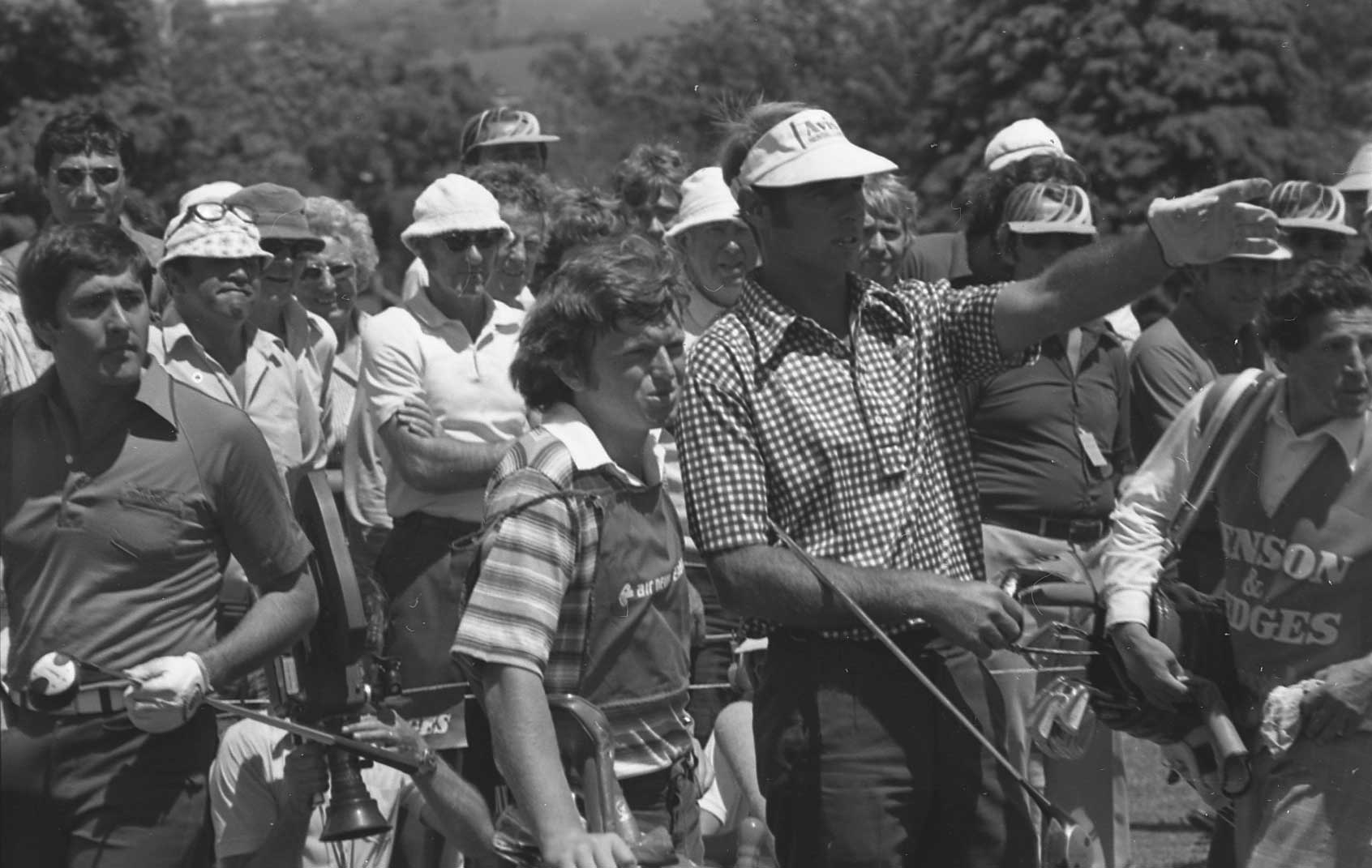
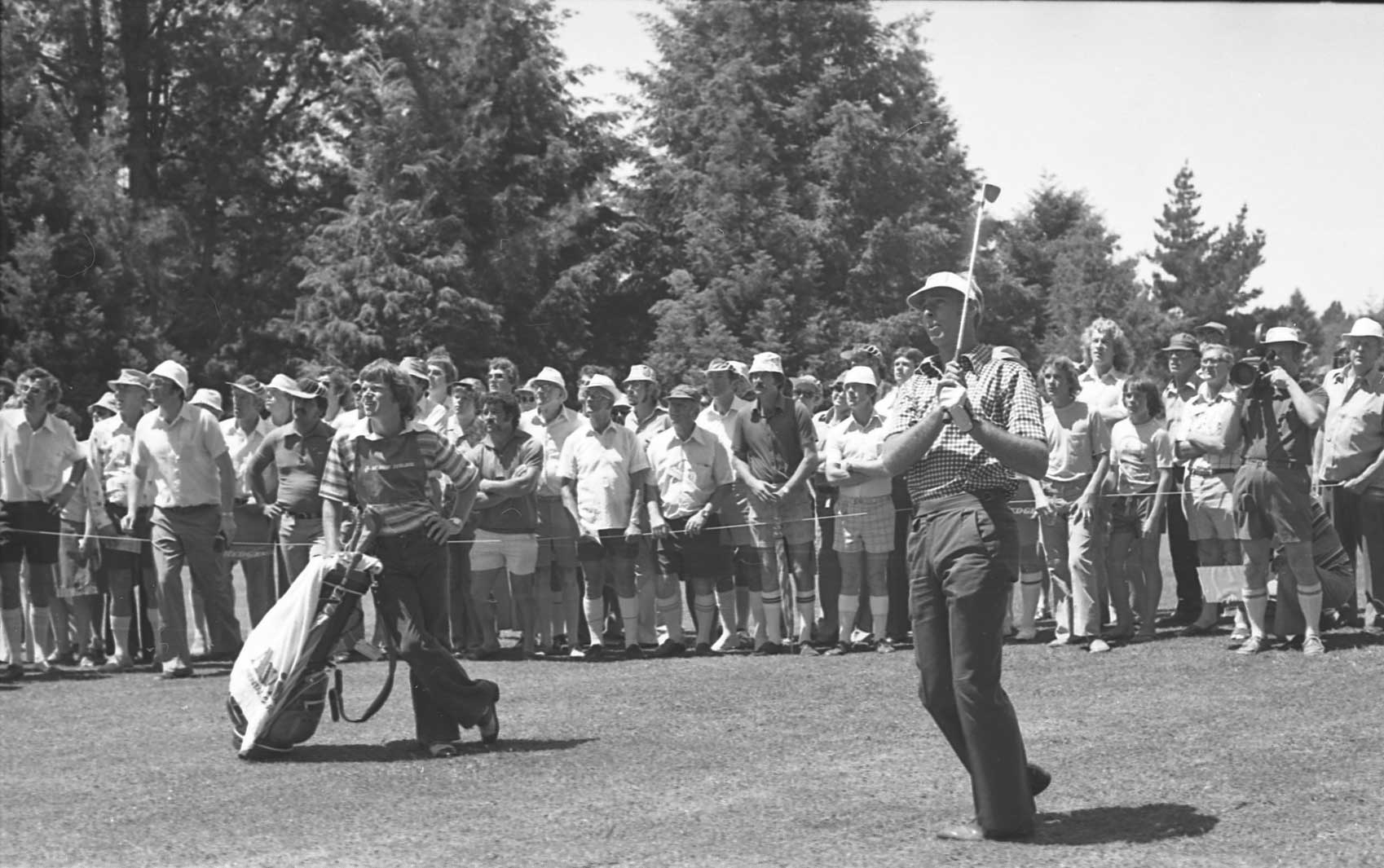
John Lister again thrilling a New Zealand crowd as I look on

1983 would see me caddying in my last season in New Zealand. To some extent the season was bitter/sweet in that it brought to an end a long, rewarding and very successful association with New Zealander John Lister but opened up a new chapter in my golfing and professional life with Australian, Graham Marsh.

John was coming to and end of his playing career as his playing fortunes in the USA continued to wane and we agreed that the New Zealand Open at the then Auckland Golf Club late that year (now Royal Auckland) would be the end of a journey which had seen John win ten events in New Zealand with me on the other side of the bag.

I had learned so much from Lister and he provided me with many great opportunities but as I looked ahead I was keen to make the golf industry a career and Marsh’s growing business interests appeared to me as if they might open career prospects beyond caddying.

I took two weeks off from my hotel job in Nelson and drove north to Auckland for the first of what was to be two events but eventually became three. Lister and I teamed together for our swansong at Middlemore which was won by Ian Baker-Finch, John once again having his struggles with the New Zealand Open style set-ups.

We said our professional good-byes which for both of us I am sure was an emotional moment because of the success we had experienced together and for me especially because John had opened the door to a new world for me.

I still rate him as one of the more dynamic players I have seen when he was in the right frame of mind and form. He was a great shot-maker, doing things with the golf ball that many more credentialed players could only dream about. He was blessed with tremendous length from the tee but, when he was on song, he was also a brilliant putter.

Marsh did not play the New Zealand Open but, as arranged, was there the following week for the Airlines event at Titirangi Golf Club, also in Auckland, and that was where we would team up for the first time since the Piccadilly World Match Play Championship in October of 1975.

The West Australian played well that week and, if my memory serves me correctly, finished 3rd behind Bruce Devlin in an event reduced to 54 holes.

The reason for the reduction in holes from the original 72 was that on day one weather had cancelled out the opening round. Ironically, the man who suffered most from the cancellation of play on the opening day was John Lister who recorded a round of 63 only for it to be washed out.

I am not sure what signal that was giving from Lister. I felt for John but was happy for him that he had found some form at long last after a long hard year in the US.

I discussed with Marsh that week the prospect of working for him in some capacity amongst his growing business interests and while he indicated an interest in my involvement it would be another six years before that actually came to fruition. I will elaborate on how that all transpired in another memoir.

Marsh asked during the week if I would be available to caddy the following week as he had been unexpectedly and belatedly invited to play the New Zealand PGA Championship at Mt Maunganui, about a three hour drive south.

I quickly contacted my employers in Nelson to seek approval for another week off which was given so I headed off to what is one of my favourite holiday destinations in New Zealand – the Mount as it is affectionately known.

I had caddied for Jumbo Ozaki there in his win in 1972 and for Lister when he won in 1977 and also when Lister lost a playoff to Brian Jones in 1981 so I knew the course well and was excited to be continuing my rekindled arrangement with Marsh.

Marsh would go on to win the event by two shots over Vaughn Somers giving me a 4th NZPGA Championship title as a caddie as I had also caddied for Lister when he defeated Bill Brask in a playoff at the nearby Tauranga Golf Club.

I might not have looked it but I was excited about Marsh’s win at the 1983 NZPGA

The two weeks had reconnected Marsh and I and opened the door for ongoing discussions on the possibility of working for him in some capacity at a later date.

I recall him saying to me that he felt I needed more background in sales. While disappointed that nothing had immediately come out of the decision I had made, it gave me thought as to how I might further my skills to allow myself to be more employable in the golfing arena.

I returned to Nelson and was back behind the bar two days later pouring beer and having fun, but with the memories of what would be my final event as a caddie in New Zealand to the front of my mind.

A photo accompanying an article on my return to Nelson

It would be another 4½ years before I caddied again, after relocating to Australia. In the meantime, however and after a few more months in the hotel industry, I would work in the Aquaculture Industry in the Marlborough Sounds of New Zealand and, for a few months before heading for Australia in 1986, in the Kiwifruit Industry in the Nelson area.

They provided further background for what lay ahead but, while fascinating, I never really felt they were what I wanted in the long term.

And so, my journey with John Lister was over but what a journey it had been. We had worked together in some seventy five events in New Zealand, Australia and the US, 55 or so of those in New Zealand in which there had been ten victories and two or three runner-up finishes.

There had been so many highlights but perhaps the Garden City Classic in Christchurch provided some of the greatest memories, John winning on four consecutive occasions and sharing the runner-up position behind Bob Shearer when attempting to win five in a row in 1976.

Lister could win from anywhere and often did. One of his victories in Christchurch came in 1974 when beginning the final round nine shots behind the lead of Tasmanian David Good.

It was heady stuff at times, his sheer brilliance thrilling the crowds and leaving so many, including myself, in awe of his power and deft touch.

He provided me a start in the game for which I will be forever grateful and have nothing but the upmost admiration for his ability to, at times, produce the seemingly impossible.

It was a fun ride.

Lister and I during one his his four consecutive victories at the Garden City Classic.
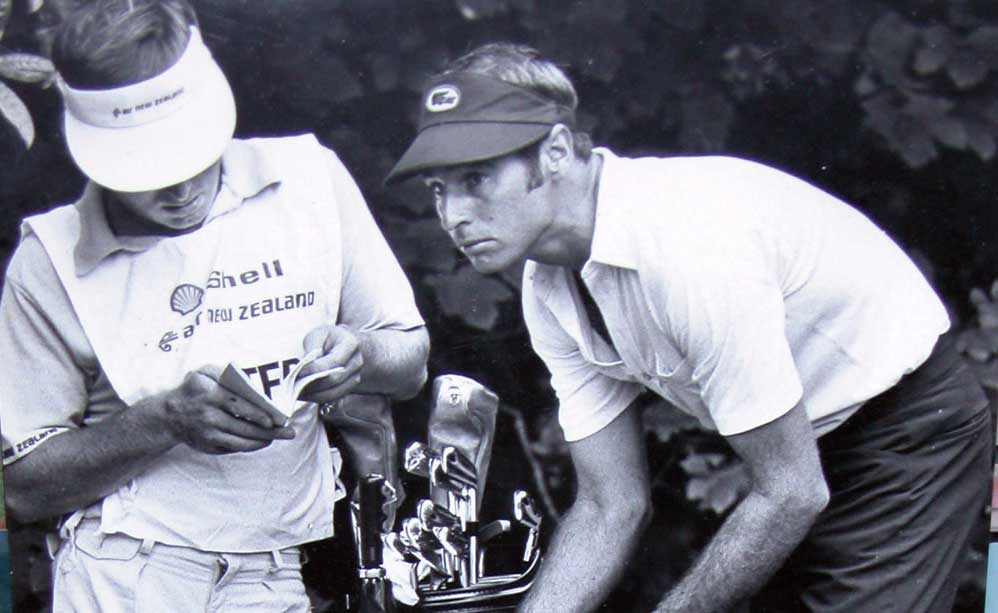


John Lister – who gave me the opportunity to caddy in the US

After three seasons in Europe, my caddying in 1976, 1977 and 1978 had been restricted to Australia and New Zealand and, even then, on a part time basis.

Although there had been several highlights, including three consecutive wins by John Lister in New Zealand in late 1976 and early 1977, a runner-up finish by Lister at the 1977 Australian Open and the match against Seve Ballesteros in 1977, I was beginning to look further afield to satisfy my caddying appetite and lust for travel.

I had worked in various roles including a period in 1978 on a horse stud near Auckland and while the thoroughbred breeding industry was, and still is, a field in which I have had interest, the lure of caddying on the PGA Tour contained more appeal.

I talked with John Lister at events late in 1978 and it was decided that I would caddy for him in the US in 1979. John had been on the PGA Tour since 1971 and given the good rapport and success we had experienced together in New Zealand and to a lesser extent in Australia we were both keen to join forces in the US.

It was too good of an opportunity to turn down. After all, the prospect of caddying on the holy grail of professional golf was, to a caddie, what playing that tour was to a professional golfer.

John’s Lister’s best performance in Australia – runner-up against a strong field at the 1977 Australian Open. 

It was decided that I would not leave until late April of 1979 and join John at the Byron Nelson Classic in Dallas.

I needed a job to tide me over until departing for the US and decided to head to Nelson in New Zealand’s South Island to spend time with my close friend Corals D’Ott and her boys and seek work there.

I looked for work in the hospitality industry and managed to secure bar work at the Wakatu Hotel, a popular watering hole and a very enjoyable but brief period in my life it was. I loved Nelson and dependant on how things worked out in the States felt sure I would return there at a later date.

Sydney based New Zealander, Bob Moore, was keen to head to the US also. I had met Bob caddying in Australia and New Zealand and, after time in Sydney amongst the SP gambling industry, he was keen to escape to a friendlier and less stressful environment and so we headed to Dallas, Bob to caddy for American Mark Lye and myself for Lister.

Despite my extensive travelling experience, I had only spent a limited time in the US and so caddying on the USPGA Tour was an adjustment but one I thoroughly enjoyed despite Lister’s lack of success there in 1979.

Following the very first event in Dallas, John was ineligible for the tournament at Forth Worth the following week and so he, his then wife Diana and I drove the lengthy road trip to their home in Clearwater near Tampa on the west coast of Florida where we stayed for a couple of weeks.

If you had to spend time off anywhere, Clearwater was not a bad place to do so. John was an avid fisherman and he loved nothing more than heading down to the nearby Dunedin beach and encouraged me to join him fishing from the shore and, sometimes, up to our waists in the warm waters of the Gulf of Mexico.

It was the first of two periods of stay at the home of John and Diana and their hospitality during such a great adventure to the PGA Tour is something I will always be thankful for.

We re-joined the tour in Charlotte in North Carolina for the Kemper Open and from that point on I got to visit some great places and some fine golf courses and, as a 25/26-year-old, had a lot of fun.

John was unable to reproduce some of the heroics he would so often display against, admittedly, weaker fields in New Zealand and it remains a mystery to me how the amazing talent and skill set he so often displayed at home was unable to be replicated in the US.

He had won the Quad Cities Classic in 1976 but his best finish in 1979 was at the Greater Milwaukee Open in Wisconsin where he finished 5th behind Calvin Peete and his career in the US never saw the true talent of the real John Lister.

From that point of view the season was a disappointment but I loved my time on the PGA Tour, my knowledge of the game, professional golf and the golf industry in general building on what I had developed while caddying in Europe and Australasia.

Amongst the places I visited while caddying in 18 events that season were courses such as Pinehurst #2 for the Colgate Hall of Fame Classic, Inverness in Toledo in Ohio, where Hale Irwin won his second US Open, Glenn Abbey near Toronto for the Canadian Open and Westchester Country Club north of New York City where the wealth of the American country club set became apparent.

I would revisit Pinehurst 15 years later to caddy at the US Senior Open and fall in love with the place even more, the reason to be expanded on in another memoir.

A special memory was standing alongside the great, but enigmatic and eccentric, Moe Norman, while he was hitting balls on the driving range at Glenn Abbey. He was 50 at the time and visiting with one of the players in the Canadian Open and had been asked to hit a few.

He did so with very formal clothing on but I recall a series of 7 irons being hit almost on a string. I was aware of his reputation at the time but he was not all that familiar to me. I have subsequently become aware of just how much of a legend he was.

Embed from Getty Images

Moe Norman – seeing him casually hit balls in Canada was a treat.

While the higher profile courses were interesting, in many respects just because of the fact they carried profile, it was often the less familiar places we visited that provided great opportunity for fun.

Columbus in Georgia, Pensacola in Florida, Sutton in Massachusetts, Davenport in Illinois, Milwaukee during Summer Fest, Valley Forge in Pennsylvania and Endicott in New York State, amongst others, all hosted PGA Tour events and rekindle memories of great times and experiences on and off the golf course the USPGA Tour provided.

The BC Open in Endicott in New York was always a highly anticipated week for the caddies as, on the Monday following the tournament, the caddies’ championship was held on the En-Joie Golf Club and sponsored by several of the players. Not that I played well in it but the chance to play a PGA Tour layout in tournament conditions for a bit of cash was a real attraction for the caddies.

On one two occasions when John Lister had either failed to make the field in the era of Monday qualifying or was not playing for another reason I had the opportunity to caddy for other players and one that sticks in my mind was when working for Gene Littler in Atlanta.

One of the game’s finest golf swings and what a gentleman – Gene Littler

Even at the age of 49 that week, Littler was a beautiful player and a fine gentleman. He would win 29 PGA Tour titles including the 1961 US Open and was beaten in a playoff on eight further occasions.

He was blessed with a magnificent, classical and uncomplicated golf swing and his capacity to plot his way around the golf course stuck in my mind. He made the cut that week but finished only midfield although to have experienced this iconic American golfer at such close quarters was one of the treats of my time on the PGA Tour.

Littler and I got on well and during the week I talked with him about the idea of playing in New Zealand. I had an ‘arrangement’ with Air NZ who had provided a little support for my visit to the US and the New Zealand Airlines tournament was to be played in Wellington later in the year.

I promoted the idea to him and he would eventually travel to New Zealand to play the event which of course was overshadowed when one of Air New Zealand’s fleet crashed into Mt Erebus in the Antarctic on the eve of the tournament, killing 257 people.

My time in the US would come to an end at the Pensacola Open in Florida and it would be another 15 years before I got back there when the opportunity to caddy for Graham Marsh on the then US Senior Tour presented itself.

I will write a piece on those experiences later but to have caddied on the 1979 PGA Tour was yet another eye-opener and played a role in providing the sort of experience that would lead to ongoing roles in golf as the years progressed.

As I write this I cast my thoughts back to Bob Moore with whom I travelled for much of the time I was caddying in the US. Bob was a great looking guy with a relatively carefree attitude to life and was fun to be around. His looks made him a very handy ‘Wingman’ when we ventured out at night.

On several occasions Bob and I would drive Mark Lye’s van between events and meet Lye at the next venue, one sleeping while the other navigated and drove his way through large parts of the USA.

John Lister also got me to drive his Lincoln Continental between events on one or two occasions, one a lengthy trip after dropping John off at O’Hare airport in Chicago for him to attend a corporate day and meeting him at Valley Forge near Philadelphia the next day. To say the least, driving alone and over long distances on the great US freeways provided a great sense of freedom and escape.

I was devastated to learn years later that Bob had passed away while living the high life in Hong Kong, having developed seemingly successful gambling software there and lived the life of a gambler. He was found deceased in his apartment with some reports suggesting suicide.

Never quite sure how he got to the point of operating in such circles in Hong Kong but he was a wheeler / dealer and gambler although, in my experience, a great guy to travel with. He was always a mysterious and intriguing character, his passing perhaps a reflection on the high life he was leading there.

I loved my time in the US. The caddies were generally very welcoming, the weather warm, although at times oppressive, each week a new adventure and the chance to see some of the greats of the game I had not always encountered in my time caddying elsewhere.

In a later memoir I will discuss my return to caddy in several events on the US Senior Tour in the mid nineties.


Seve Ballesteros, myself, John Lister and Eldon Carswell – photos supplied Rotorua Lakes Council
As outlined in my previous post, 1975 was a year of mixed results for those of whom I was caddying. There were both highlights and lowlights but, as the year progressed, I would get to experience my first exposure to a young man who would go on to become one of the greats of the modern game.

I had seen Seve Ballesteros at several events in 1975, effectively his rookie season in Europe, but I had not seen him at close quarters as such although that was about to change. He had already recorded four or five top tens in European Tour events and was, even then, being considered one of Europe’s great future stars.

In September of that year, an event would be played at Turnberry in Scotland, the Double Diamond International, which would involve teams of five from the Americas, The Rest of the World and the Home Nations, Scotland, Ireland, England and Wales.

I did not appear likely to get one of the bags in the event as my regulars were not playing. Given that the Americans, with one or two exceptions, were unlikely to be traveling with their caddies however, I decided to try my luck in securing one of their players.

I targeted Jim Colbert, an impressive player who had at that stage already won four events on the PGA Tour and, from what my due diligence had indicated, he would not be bringing his caddie to Britain.

My good friend, Michael Glading, had been caddying in Europe with me for much of the 1975 season which had included a win on the bag of South African, Hugh Baiocchi, at the Dutch Open. He was planning on returning to New Zealand via the United States to caddy for Baiocchi at the World Golf Hall of Fame event at Pinehurst and for Irishman, John O’Leary, at the Ryder Cup at Laurel Valley the following week.

Michael agreed to speak to Colbert at the Pinehurst event and to my delight he was more than happy to have that part of his visit to Scotland sorted ahead of time.

I arrived at Turnberry on the delightful Ayrshire Coast for the second time having first caddied there for Billy Dunk at the John Player Classic in 1973 (see here). It was arranged that I would meet with Colbert on the Tuesday morning of the Double Diamond. When I arrived at the course on the Monday to do my yardages, however, I was advised by one of the Scottish caddies that Colbert was already on the course and had taken a local for the week.

Still unsure whether his comment was in jest or a deliberate act to unsettle me given I had one of the more significant bags for the week (some of the Scottish caddies were capable of doing just that) I did some more checking. Then, armed with the knowledge he was not on the golf course, I eventually headed across to the beautiful Turnberry Hotel on the hill.

The Turnberry Hotel where I first caught up with Jim Colbert.

Reception told me Colbert had only just checked in and when they called his room he was happy to come down to meet me for a coffee in the lobby of the hotel.

He was a delight, certainly a confident sort of character but he was great to me and I could tell even from our initial discussion that we would get on.

Jim Colbert

That would turn out to be the case as he would go on to win each of his five matches, playing a key role in the success of an American side which included Colbert, Johnny Miller, Lou Graham, Dave Hill and Mark Hayes.

One of those matches was when he tackled the 18-year old Ballesteros, who was a member of the Rest of the World side.

In the absence of a Continental European side that year, Ballesteros was considered enough of a rising star to be included in that team which included he, Gary Player, Bob Charles, Dale Hayes and Jack Newton.

Certainly Ballesteros impressed that week and, already, it was evident that he would become a fine player. It was, though, hard to imagine back then just what an impact he, his golfing skills, charismatic appeal, creative imagination and artistry would have on the golfing world over the next 25 years.

On reflection, however, it is nice to be able to look back and recall being so close to him so early in his professional career and being on the bag of Jim Colbert when the American won their encounter.

Ballesteros – 1975

Two years later I had worked in the real world back in New Zealand for a couple of years although that world was not exactly feeling too real for me. So, at the end of 1977, I headed to Australia for a few events including the West Lakes Classic, the Australian Open and the Australian PGA Championship where I would again team with John Lister.

Lister would finish runner-up to David Graham at the Australian Open at the Australian Golf Club that year but the remainder of the events in Australia and those in New Zealand were not so lucrative for the player who had dominated New Zealand golf events in recent years.

Lister had won the Otago Charity Classic in Dunedin (the first event back in NZ after Australia) on two occasions in earlier years but in 1977 it would be tournament invite, Seve Ballesteros, who would win by three strokes over American, Bob Byman, who the following week would win the New Zealand Open in Auckland.

Following the event in Dunedin, an exhibition had been arranged in the North Island tourist city of Rotorua by cigarette company Benson & Hedges and Air New Zealand. The participants would therefore involve two of the most recent winners on the New Zealand Tour, Ballesteros and Lister, in a face off at the Springfield Golf Club.

Now, it just so happened that I had been a member of Springfield as a 17 and 18-year-old in the early 1970’s. My mother also lived in Rotorua so I had taken advantage of an earlier trip to my Mum’s place to grab some yardages on the golf course well ahead of the day.

Lister, Ballesteros and I flew from Dunedin to Auckland on the Sunday evening immediately following Ballesteros’ win at the Otago Charity Classic and were put up in a hotel near the airport in Auckland ahead of a flight down to Rotorua the following morning.

We flew the 45 minutes down to Rotorua to be met by those organising the exhibition and representatives of the club.

Lister en route to defeating Ballesteros

The spectator numbers that had assembled that day were impressive and I have subsequently heard from a number golfers who have said they traveled from many parts of the North Island of New Zealand to be there.

Ballesteros was, after all, developing a growing reputation in world golf, highlighted of course by his runner-up finish as a 19-year-old to Johnny Miller at the 1976 Open Championship the previous year.

Lister had won on the PGA Tour the previous year, had finished runner-up at the Australian Open a few weeks earlier and was the leading force in New Zealand events of that era. There was, therefore, every reason for the event, despite it being an exhibition, to attract a good crowd.

This was in an era when, typically, players did not bring their caddies across the world and so Ballesteros teamed up with the Club Champion at Springfield, Eldon Carswell. Carswell would no doubt have been excited at the prospect of guiding such an emerging star around his home course that day.

Lister and Ballesteros in Rotorua

It was not all plain sailing for Eldon, however, Ballesteros letting him know in no uncertain terms when he persisted on calling him ‘Steve’ instead of ‘Seve’. Things were tense for a while but in my memory and eventually, I feel sure, that of Eldon, the day overall was a great and memorable one especially, for me, when Lister managed to defeat Ballesteros.

As a sideline to these experiences was that twenty years later, I met up with Jim Colbert (who had beaten Ballesteros in 1975) once again when I ventured to the US to caddy for Graham Marsh in a few events on the then US Seniors Tour.

Colbert by then was not only a very successful golfer having won multiple times on the Senior Tour in addition to his 8 wins on the PGA Tour, but he was a very successful businessman as a prolific golf course owner and developer.

Because of their mutual interest in golf course development Marsh and Colbert had a lot in common. When he offered Graham and I a ride in his own Sabre jet from Atlanta to Washington DC it was agreed we would leave immediately after the Nationwide event in Duluth in Georgia for the US Senior Open to be held at Congressional Country Club.

Jim Colbert, Graham Marsh and I about to board Colbert’s jet in Atlanta

No sooner had the doors closed on the jet as it readied ready for take-off and Colbert had opened beers for us four passengers on board, than he was quickly into conversation about Ballesteros, asking if I recalled the day he beat him at Turnberry.

Ballesteros had of course, in those twenty years since, won 70 tournaments world-wide including three Open Championships and two Masters titles. He had also been responsible, along with the likes of Nick Faldo and Bernhard Langer, for changing the fortunes of Europe in the Ryder Cup.

I think it was a real source of pleasure and pride for Colbert to be able to say he had beaten the brilliant Spaniard so early in his career and so it should have been.

If I had a dollar for every time I have since heard people, many of whom never had the opportunity to see him play, describing the brilliance and legend of Ballesteros I would be a very wealthy man.

To have gained a taste of it first hand and seen him at such close quarters at such an early stage of his career, however, is yet another of the many memorable golfing occasions I have been fortunate to experience.