Pebble Beach Golf Links – the 7th hole courtesy of USGA J.D Cuban
Imagine, if you will, the chance to play one of the USA’s most iconic golf courses as part of a subsidised trip to the US to play significant amateur events over the northern hemisphere summer.
Well tonight in the US when the U.S. Amateur Championship gets underway eight Australians and one New Zealander have that very opportunity when they tee it up at Pebble Beach Golf Links and Spyglass Hill Golf Club in the opening two rounds of stroke-play at the game’s most significant amateur event.
Playing Pebble Beach, in particular, is on the bucket list of most golfers although for many the cost alone makes it out of reach. It is, though, a public facility and if you can stump up with the US$500 or so you can play a course steeped in history and as American as ‘Apple Pie’.
All 312 competitors at this year’s US Amateur Championship get the chance to play Pebble Beach Links on at least one occasion this week but for those lucky enough to make it into the leading 64 who qualify for the match-play they face the very juicy prospect of playing the five-time US Open venue and the home for the 2019 US Open more often.
Some of golf’s most memorable moments have come at Pebble Beach Golf Links, including the 1 iron from Nicklaus at the par 3 17th in 1972 en-route to his victory over Bruce Crampton which hit the flagstick, the pitch in from left of the green on that same hole by Tom Watson in 1982 to beat Nicklaus and the simply stunning 15 shot win by Tiger Woods in 2000 to win his third major title and his first US Open.
That 1 iron in 1972
For many in this week’s field their mere existence would have been but a figment in their parents imagination when many of those same events transpired but they will have been exposed to the stunning Pebble Beach from afar throughout their golfing lives to date and will be excited by the prospect of just playing the venue never mind that it is in such a significant event.
The highest ranked Australasian in the field is West Australian Minwoo Lee, followed by the ever-improving David Micheluzzi, Dylan Perry, Zach Murray, Shae-Wools Cobb, Blake Windred, Charlie Dann and Nathan Barbieri while Daniel Hillier carries New Zealand hopes.
Barbieri, Dann and Windred claimed their places in the field via the demanding qualifying process while the others have earned the right to play via their standing in the World Amateur Rankings.
First played more than 120 years ago, the US Amateur Championship has seen only two Australians and one New Zealander win the coveted trophy, Nick Flanagan (2003) and Curtis Luck (2016) the Australians and Danny Lee (2008) the New Zealander.
20 year old Minwoo Lee is competing in his third consecutive U.S. Amateur and his fifth USGA championship. He defeated Noah Goodwin, 2 and 1, in the 36-hole final to win the 2016 U.S. Junior Amateur.
Lee became the fourth international champion of the Junior Amateur and the first male Australian in 10 years to win a USGA title. His sister, Minjee, won the 2012 U.S. Girls’ Junior and owns four LPGA Tour victories.
They are the first brother-sister tandem to win USGA junior championships. Min Woo reached the Round of 32 in the 2018 Australian Amateur and was the 2017 runner-up in the same event. He won the 2018 South Australian Amateur by six strokes on March 22.
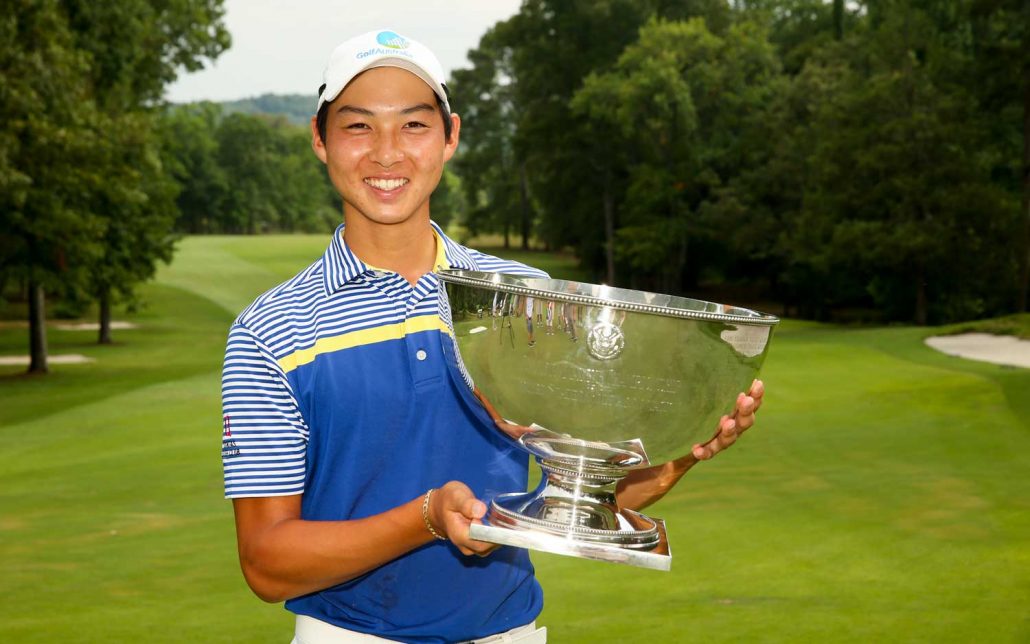
Minwoo Lee – with his US Junior trophy – courtesy of USGA
Victorian Micheluzzi was the runner-up to Keita Nakajima in this year’s Australian Amateur after defeating Shae Wools-Cobb in the semifinals.
He advanced to the quarterfinals of the 2018 Amateur Championship in Britain, losing to Conor Purcell, 3 and 2. Micheluzzi, who is competing in his first USGA championship, won the Australian Master of the Amateurs by five strokes at Royal Melbourne with a four-round total of 270. In 2017, he captured the Port Phillip Open Amateur and the Victoria Amateur (by 11 strokes) on Dec. 13.
23 year old Perry 23, of NSW but now based in Queensland, advanced to the Round of 32 in last year’s U.S. Amateur at The Riviera Country Club, his first USGA championship.
In 2017, he was the runner-up to Harry Ellis in The Amateur Championship, conducted by The R&A, losing in 38 holes, and tied for 10th in the European Amateur. He advanced to the Round of 32 in the Australian Amateur in both 2017 and 2018.
Last year Wools-Cobb of Australia, advanced to the Round of 16 in last year’s U.S. Amateur, his then first USGA championship. The Sunshine Coast (Queensland) golfer tied for sixth in the Porter Cup on July 21 and fired a second-round 65 in the process.
He reached the semi-finals of the 2018 Australian Amateur, losing to David Micheluzzi, and tied for 19th in the Australian Master of the Amateurs. In 2017, he tied for sixth in the Asia-Pacific Amateur, held at Royal Wellington in New Zealand.
Of much interest this week will be the appearance of Gary Nicklaus who of course is the son of the man with whom many people associate Pebble Beach, Jack.
Nicklaus Jnr returned to the amateur ranks in 2007 after many years as a professional and several of those playing the PGA Tour. His main claim to fame during that period was when runner-up to Phil Mickelson after a playoff at the Bell South Tournament near Atlanta.
The winner of the US Amateur potentially sets himself up for a professional career, starts at the Masters, the US Open Championship and the Open Championship just part of the spoils of victory.
The winner also elevates his status and profile in the world of golf to the extent that gaining invites to PGA Tour events becomes a lot easier as does the attraction of potential sponsors ahead of turning to the professional ranks.
Whether one of the nine Australasians in the field can match the deeds of Flangan, Lee or Luck in winning this most coveted title remains to be seen but the opportunity to play at such a treasured golfing venue alone makes the week one they will never forget.

Justin Rose # 1 twenty years on
Photo courtesy of Asian Tour
Justin Rose today became the 22nd player to reach the number one position in men’s golf since world rankings were first introduced in 1986.
Rose’s runner-up finish at this week’s BMW Championship at Newton Square in Philadelphia moved him past Dustin Johnson and to the top of the rankings for the first occasion and in doing so he joined fellow countrymen Nick Faldo, Lee Westwood and Luke Donald as holders of the mantle.
Interestingly, and perhaps highlighting the internationalisation of the game in the past thirty years, 15 of those 22 have been non-Americans.
Seven Americans, four Englishmen, three Australians, two Germans and one each from Spain, South Africa, Wales, Fiji, Northern Ireland and Zimbabwe make up the geographical balance of those reaching the lofty heights of the game’s top mantle.
“Yeah, that’s an end goal dream for sure,” said Rose after his near miss at the BMW. “Obviously today is all about the process, and there will be next week to win tournaments, but to get to world No. 1 is unbelievable. It’s something I can say now in my career I’ve been the best player in the world. I’ve been to the top of the game.
“That’s definitely some consolation – I just wish I could have enjoyed the moment maybe,” added Rose referring to his loss today. “This just slightly dampens it. But tomorrow or the next day, the week after, I’ll look back at this and think it was amazing, an amazing moment in my career.”
Rose began his professional career after a brilliant showing at the 1998 Open Championship at Royal Birkdale where, as a 17-year old amateur, he holed from well off the green at the last to finish 4th behind Mark O’Meara.
Rose turned professional soon after, many saying it was too soon as he struggled in so many events, taking seventeen events to finally make a cheque, that coming in June of 1999 when he finished 4th in a European Tour Challenge Tour event in Austria.
One thing that Rose did show however was a determination to learn his craft. I recall being in Portugal in a commentary role in that event in early 1999 when, after missing the cut at the Algarve Portugal Open, Rose spent time out watching play on the Saturday soaking up as much as he could by just observing players.
It is a sight that sticks with this writer in as much as it gave an insight into the mind of Rose. Despite his early struggles in the paid ranks he wanted to get better and get better quickly and he recognised the benefit of learning by example.
It would, however, take him until early 2001 to record his first top ten on the European Tour when runner-up in consecutive events in the land of his birthplace, South Africa, and the rest as they say is history.
His first victory would again come in South Africa when he won the Dunhill Championship in Johannesburg in early 2002 but two years later he began to focus his attention in the US although, as it had in Europe, it took some time to find his feet across the Atlantic.
He quit the European Tour, then, a year or two later announced a decision to return to Europe before some late season form in the USA in 2005 meant he would stay there from that point on.
To say the least, he has become one of the most successful golfers England has produced, winning the US Open in 2013 and finishing runner-up in three other major championship.
Rose has won ten events on the PGA Tour, two of those World Golf Championship events in addition to his major title. He owns six European Tour titles, the Olympic Gold Medal and four other events worldwide including the Australian Masters in 2006.
This year Rose will play his 5th Ryder Cup and with earnings of close to US$50 million on the PGA Tour alone his career is already a huge success with, it would seem, more to come.
Congratulations Justin Rose for overcoming a potentially soul-destroying start to your professional career and now reaching the lofty heights of the game’s number one ranked player.
Audio Golf Betting Guide September 6th 2018
This week we take a look at the the third event of the FedEx Playoffs, the BMW Championship at the Aronomink Golf Club in Pennsylvania which includes the leading 70 players on the FedEx Cup standings and the Omega European Masters in the stunning Crans Sur Sierre in the mountains of Switzerland.
Australia chasing Eisenhower defence in Ireland
The 2016 Australian Team with their trophy in Mexico.
The World Amateur Team Championship, or Eisenhower Trophy as it is often referred to, begins in County Kildare in Ireland on Wednesday with Australia represented by West Australian Minwoo Lee, Victorian David Micheluzzi and Queensland’s Shae Wools Cobb.
Named after the US President, Dwight Eisenhower, who himself was a keen golfer, the event has become a must play tournament for many aspiring young professional golfers ahead of their transition to the paid ranks.
A week after the Australian women’s side, Rebecca Kay aside, performed well below expectations in their equivalent Espirito Santo Trophy at the same venue, the Australians take to the Montgomerie and O’Meara layouts at Carton House just outside of Dublin.
Australia are the defending champions in the event, the trio of Curtis Luck, Cameron Davis and Harrison Endycott having won the event at Mayakoba in Mexico in 2016, all three now establishing successful professional careers, Davis the current Australian Open Champion and Curtis Luck on the verge of a PGA Tour card for 2019.
Lee is currently ranked 13th in the World Amateur rankings followed by Micheluzzi in 16th place and Cobb 41st and although they face a huge task to repeat the heroics of the 2016 side they are not totally without their chance.
All three are debutantes in this event and are likely to be representing their country as a team for one of the last times in their amateur careers.
Perhaps the player under the most pressure is Wools-Cobb who has struggled through much of the North American summer, a 6th place finish at the Porter Cup the standout.
Lee, though, despite his impressive ranking, has not played at the level we know he is capable of in recent months, missing the cut at the US Amateur and Players Amateur although producing top tens at the Western Amateur and at the Sahalee Players Championship.
Perhaps as a pre-cursor to a professional career Lee played several events on the Korean PGA Tour earlier in the year and did well enough against the strong competition that tour offers.
Victoria’s Micheluzzi played beautifully in amateur events in Australia earlier in the year and did well at the British Amateur when making the quarter-finals but in just two events in the US he has not played well although back in a European environment things might go better for him.
Australia has won the Eisenhower Trophy on four previous occasions, the second most of any nation, the first of those coming in 1958 at the inaugural staging of the event, the last in Mexico.
The USA as expected has dominated the winner’s list having won the trophy on 15 occasions, the last of those coming in 2014 when Bryson De Chambeau, Beau Hossler and Denny McCarthy took the title in Japan.
Their team of Cole Hammer, Collin Morikawa and Justin Suh suggests they may well add to that record.
Audio Betting Guide August 30th
This week we take a look at the Dell Technologies event, the second of the FedEx Cup playoffs, the LPGA Tour’s Cambia Portland Classic, the Made In Denmark event on the European Tour and the second of the Web.Com Tour Finals.
Click below to listen
Audio Golf Betting Guide August 23rd
Betting thoughts this week focus on the opening event of the FedEx Cup Playoffs, the Northern Trust Open in New Jersey, the LPGA Tour’s CP Women’s Open in Saskatchewan in Canada and the European Tour’s Czech Masters in Prague.
Click below to listen.
Audio Betting Guide for August 16th
Is this a chance for Shane Lowry to force his way into the Playoffs
After just one event to attract betting attention last week there are many for consideration this week but we focus our thoughts on the Wyndham Championship in Greensboro, the LPGA Tour’s Indy Women in Tech in Indianapolis, and the European Tour’s Nordea Masters in Gothenburg in Sweden.
Click to listen to my thoughts on the possible prospects.
Bucket-list Opportunity for Aussies at US Amateur
Pebble Beach Golf Links – the 7th hole courtesy of USGA J.D Cuban
Imagine, if you will, the chance to play one of the USA’s most iconic golf courses as part of a subsidised trip to the US to play significant amateur events over the northern hemisphere summer.
Well tonight in the US when the U.S. Amateur Championship gets underway eight Australians and one New Zealander have that very opportunity when they tee it up at Pebble Beach Golf Links and Spyglass Hill Golf Club in the opening two rounds of stroke-play at the game’s most significant amateur event.
Playing Pebble Beach, in particular, is on the bucket list of most golfers although for many the cost alone makes it out of reach. It is, though, a public facility and if you can stump up with the US$500 or so you can play a course steeped in history and as American as ‘Apple Pie’.
All 312 competitors at this year’s US Amateur Championship get the chance to play Pebble Beach Links on at least one occasion this week but for those lucky enough to make it into the leading 64 who qualify for the match-play they face the very juicy prospect of playing the five-time US Open venue and the home for the 2019 US Open more often.
Some of golf’s most memorable moments have come at Pebble Beach Golf Links, including the 1 iron from Nicklaus at the par 3 17th in 1972 en-route to his victory over Bruce Crampton which hit the flagstick, the pitch in from left of the green on that same hole by Tom Watson in 1982 to beat Nicklaus and the simply stunning 15 shot win by Tiger Woods in 2000 to win his third major title and his first US Open.
That 1 iron in 1972
For many in this week’s field their mere existence would have been but a figment in their parents imagination when many of those same events transpired but they will have been exposed to the stunning Pebble Beach from afar throughout their golfing lives to date and will be excited by the prospect of just playing the venue never mind that it is in such a significant event.
The highest ranked Australasian in the field is West Australian Minwoo Lee, followed by the ever-improving David Micheluzzi, Dylan Perry, Zach Murray, Shae-Wools Cobb, Blake Windred, Charlie Dann and Nathan Barbieri while Daniel Hillier carries New Zealand hopes.
Barbieri, Dann and Windred claimed their places in the field via the demanding qualifying process while the others have earned the right to play via their standing in the World Amateur Rankings.
First played more than 120 years ago, the US Amateur Championship has seen only two Australians and one New Zealander win the coveted trophy, Nick Flanagan (2003) and Curtis Luck (2016) the Australians and Danny Lee (2008) the New Zealander.
20 year old Minwoo Lee is competing in his third consecutive U.S. Amateur and his fifth USGA championship. He defeated Noah Goodwin, 2 and 1, in the 36-hole final to win the 2016 U.S. Junior Amateur.
Lee became the fourth international champion of the Junior Amateur and the first male Australian in 10 years to win a USGA title. His sister, Minjee, won the 2012 U.S. Girls’ Junior and owns four LPGA Tour victories.
They are the first brother-sister tandem to win USGA junior championships. Min Woo reached the Round of 32 in the 2018 Australian Amateur and was the 2017 runner-up in the same event. He won the 2018 South Australian Amateur by six strokes on March 22.
Minwoo Lee – with his US Junior trophy – courtesy of USGA
Victorian Micheluzzi was the runner-up to Keita Nakajima in this year’s Australian Amateur after defeating Shae Wools-Cobb in the semifinals.
He advanced to the quarterfinals of the 2018 Amateur Championship in Britain, losing to Conor Purcell, 3 and 2. Micheluzzi, who is competing in his first USGA championship, won the Australian Master of the Amateurs by five strokes at Royal Melbourne with a four-round total of 270. In 2017, he captured the Port Phillip Open Amateur and the Victoria Amateur (by 11 strokes) on Dec. 13.
23 year old Perry 23, of NSW but now based in Queensland, advanced to the Round of 32 in last year’s U.S. Amateur at The Riviera Country Club, his first USGA championship.
In 2017, he was the runner-up to Harry Ellis in The Amateur Championship, conducted by The R&A, losing in 38 holes, and tied for 10th in the European Amateur. He advanced to the Round of 32 in the Australian Amateur in both 2017 and 2018.
Last year Wools-Cobb of Australia, advanced to the Round of 16 in last year’s U.S. Amateur, his then first USGA championship. The Sunshine Coast (Queensland) golfer tied for sixth in the Porter Cup on July 21 and fired a second-round 65 in the process.
He reached the semi-finals of the 2018 Australian Amateur, losing to David Micheluzzi, and tied for 19th in the Australian Master of the Amateurs. In 2017, he tied for sixth in the Asia-Pacific Amateur, held at Royal Wellington in New Zealand.
Of much interest this week will be the appearance of Gary Nicklaus who of course is the son of the man with whom many people associate Pebble Beach, Jack.
Nicklaus Jnr returned to the amateur ranks in 2007 after many years as a professional and several of those playing the PGA Tour. His main claim to fame during that period was when runner-up to Phil Mickelson after a playoff at the Bell South Tournament near Atlanta.
The winner of the US Amateur potentially sets himself up for a professional career, starts at the Masters, the US Open Championship and the Open Championship just part of the spoils of victory.
The winner also elevates his status and profile in the world of golf to the extent that gaining invites to PGA Tour events becomes a lot easier as does the attraction of potential sponsors ahead of turning to the professional ranks.
Whether one of the nine Australasians in the field can match the deeds of Flangan, Lee or Luck in winning this most coveted title remains to be seen but the opportunity to play at such a treasured golfing venue alone makes the week one they will never forget.
Tiger Woods – can he make it 15?
Tiger Woods today – courtesy of PGA of America
Tiger Woods is preparing for his 19th PGA Championship this week, four of the previous 18 which he has won, and ahead of Thursday’s start at the Bellerive Country Club in St Louis he fielded a wide range of questions from the media.
Woods last win at the PGA Championship came in 2007 when defeating Woody Austin at Southern Hills Country Club in Tulsa although he did also finish runner-up in 2009 after returning from knee surgery when being run down by Y.E. Yang.
Woods form in 2018 has given strong indications that a fourth PGA Championship and 15th major title is not beyond him this week and, as so often been the case since he turned professional, Woods’ appearance in the media centre was the most anticipated and attended.
Woods has not played the golf course at Bellerive since playing an exhibition clinic in 2001 ahead of the WGC Championship which was subsequently cancelled due to the 9/11 terrorist attacks.
In 2008 when the only other PGA Tour event since (The BMW Championship) was played Woods was undergoing recovery from the knee surgery he undertook after his stunning 2008 US Open victory.
“I literally haven’t step foot on this golf course since that week in 2001,” said Woods today. “Didn’t get up here pre British Open, and yesterday I took the day off.
“So today we only got in five holes and didn’t really get a chance to see a whole lot, but I only remember a couple of the holes, but I didn’t really remember the first five that I played today. And so I’ll have to do some more homework tomorrow and get a good feel for what’s going on for the rest of the week.”
While Woods believes he can contend and possibly win this week he is happy just to be back competing again in the manner he has in 2018.
“Well, just the fact that I’m playing the TOUR again, it’s been — just for me to be able to have this opportunity again is — it’s a dream come true.
“I said this many times this year, I didn’t know if I could do this again, and lo and behold, here I am. So just coming back and being able to play at this level and compete — I’ve had my share of chances to win this year as well, and hopefully I’ll get it done this week.”
When asked what part of the come-back has been the most difficult – the mental or physical side of the game he was quick to answer.
“Well, definitely more physical. I know how to play the game of golf. It’s just what are my limitations are going to be. And as the year has progressed, I’ve learned some of those things. Certainly can’t do what I used to do 10, 15 years ago, but I’m still able to hit the majority of my shots, and I’ve had to learn a golf swing that is restricted.
“I’ve never had a spinal restriction before, and I played all those years without it. Now, I’ve had a bum knee most of those years, but I could wheel it around that. But having a fixed point in my spine is very different.”
A question came from an Australian journalist regarding the expectation on Jason Day and whether or not Day has over or underachieved in terms of major championships.
“Well, it’s not easy to win major championships. What he’s done, and I think that — I think Jason said it best is that he should be very proud of that he was able to win a major championship after having a family.
“That’s a very different thing. Also, the struggles and the things that he had to endure and his upbringing, and he’s fought tooth and nail to get to where he’s at, and he should be very proud of winning a major championship because it’s not easy to do.”
Woods has missed only two of thirteen cuts in 2018 and with top six finishes in two of his last three starts including when hitting the front during the final round of the Open Championship then perhaps his chances adding that long awaited 15th major are not as unrealistic as some might have predicted earlier this year.
His last of fourteen majors came just over ten years ago and if he was to ‘get it done’ this week then the 16th 17th and 18th to match Jack Nicklaus’ great record are perhaps not as wild a dream as was being suggested six months ago.
Reflecting his standing in the game’s history, Woods, despite being ranked only 51st in the world, will tee it up with the world number 2 and 5 this week when he joins Justin Thomas and Rory McIlroy at 8.23 am on Thursday.
THE PGA CHAMPIONSHIP AUDIO BETTING GUIDE
This week’s PGA Championship at the Bellerive C.C in St Louis brings to a close the 2018 major championship men’s golf season and will there be another first time major winner or will it be one of the more fancied players with a major championship already to their name?
Very little separates the leading players in 2018 and there appears no real standout although Dustin Johnson seems to contend nearly every week and will start as the favourite and deservedly so.
I take a look at the leading chances and the Australasians in the field.
Audio Guide to Golf Betting August 2nd
Photo: Royal Lytham & St Annes – courtesy of Ladies European Tour
This week we take a look at the Women’s British Open at Royal Lytham and St Annes, the WGC Bridgestone Championship in Ohio and the Barracuda Championship in Nevada.