The Japan Tour heads to the Gifuseki Country Club’s East Course in Gifu to the north of Nagoya for the ¥200 million Japan Open an event which Australians have won on only two occasions.

Craig Parry in 1997 and Paul Sheehan in 2006 are those Australians and although another four will get their chance this week none are playing at the level where a win is expected.

Brad Kennedy, Brendan Jones, Adam Bland and Todd Sinnott will take to the fairways of this venue which is being used for the first occasion. They will be joined by New Zealander Michael Hendry who will look to join David Smail as the only other New Zealander to win the title. Smail won in 2002 but is no longer playing on the Japan Golf Tour.

Brad Kennedy leading the Australians in Japan this year

Hideki Matsuyama would have been the defending champion but he is playing in the PGA Tour event in Malaysia this week and the favouritism is likely to go to the leading money winners this season Yusaku Miyazato, Shugo Imahira and Satoshi Kodaira.

Hideki Matsuyama – Can he become Japan’s first major winner this week? – photo Bruce Young

The final men’s golfing major of the year, the PGA Championship begins on August 10th at the Quail Club in Charlotte in North Carolina, a venue that has previously held PGA Tour events over a long period of time but now the outstanding layout gets the chance for even greater profile and accolades by hosting this truly world event.

The layout has undergone some significant changes since an event was last played there in May of 2016, greens re-grassed, a lot of trees removed and essentially four new holes built.

Given the volatility amongst the leading five or six world ranked players, the event remains perhaps the most open major of the year although many are considering three players amongst those most likely to do well namely, Jordan Spieth, Hideki Matsuyama and Rory McIlroy.

Jordan Spieth
Spieth appears to have returned to the level of form that he displayed for much of the last two years prior to February of this year, his recent wins in Hartford and at Royal Birkdale further confirming such. Solid week last week when a last round 68 saw him finish 13th. The 24-year-old is chasing a career Grand Slam having previously won the Masters, the US Open and the Open Championship and so has added pressure but pressure has never really bothered him.

Rory McIlroy
McIlroy has a stunning record at Quail Hollow, this the site of his first PGA Tour victory in 2010 and he has gone on to win one more, be placed second on one other occasion and record several other top tens. His record at Quail Hollow is second to none and he arrives at one of his favourite venues with a 4th place finish at the Open Championship and another good week when 5th at the WGC Bridgestone last week.

Hideki Matsuyama
Matsuyama is destined to win a major championship and this week might just be a great opportunity to do just that. The Japanese star finished runner-up to Brook Koepka at the US Open and has continued to play well since including his brilliant win at last week’s WGC Bridgestone and he does own two solid if unspectacular finishes at Quail Hollow. His credentials stack up this week.

Dustin Johnson
Given his standing as the game’s leading player, Johnson is playing below that level at present despite a final round of 66 last week. He has seldom played at Quail Hollow and has not done well when he has so there is concern for his chances this week. Champions should never be dismissed but on paper it is hard to see him winning.

Sergio Garcia
Garcia has not played Quail Hollow a lot of late but earlier in his career he did and on one occasion finished runner-up after a playoff. Since his Masters win in April Garcia has played solidly enough without contending other than in a European Tour event in Germany. He has had a lot going on off the golf course since Augusta National including getting married recently so with that now behind him he may well focus in on a second major with this week. A last round of 67 in Akron suggests he is getting his focus back.

Jon Rahm
Rahm is the rising star in world golf and having won twice already in 2017 in San Diego and in Ireland he is playing well enough to take yet another step this week. This will be his first PGA Championship and his 6th major but he has little fear and his lack of experience at this level should not faze him. He recovered from a second round 77 last week with a strong weekend so appears to be on track.

Jason Day
After a few indifferent weeks, Day showed signs, especially early, last week that his game was perhaps improving and as a former world number one and PGA Champion he deserves respect. He still needs further improvement to contend however. Day has not played this venue for several years but did finish 9th here in one of his starts at Quail Hollow.

Brooks Koepka
Koepka’s win at the US Open took him to a new level amongst the game’s elite but many felt it was always going to happen at some stage and now that he has another major could come quickly. He took a month off between his US Open win and a 6th place at the Open Championship and after a slow start last week in Akron he made his way through the field to finish inside the top twenty.

Alex Noren
Noren is another big mover in world golf in the last twelve months and although his form has been a little bit of a roller coaster in recent weeks he did finish 6th at the Open Championship and played very well early in Akron last week before finishing midfield.

Matt Kuchar
Kuchar perhaps carries the tag of the best player without a major to his name but it might just be that he can get rid of that this week. His brilliant play at Royal Birkdale was bettered only by a Houdini act by Spieth over the closing stages and he closed off well at last week’s WGC event after a slow start.

Henrik Stenson
Stenson is certainly not playing at the same level he was last year but that was an exceptional year and he has still been playing reasonably well. He finished 11th at the Open Championship and improved over the weekend in Akron to finish 17th there.

Rickie Fowler
Fowler is another in that category of fine players without a major and, in the manner in which he is playing at present, he stands a very good chance of making this his major breakthrough. Importantly for his chances this week is that Fowler has won at Quail Hollow. He did well last week after a relatively slow start to the WGC Bridgestone and there is a lot to like about his chances this week.

Paul Casey
Casey has missed only one cut in the last twelve months and amongst those finishes there have been a number of times in contention. Casey played very well last week to finish in a share of 5th with McIlroy and like Kuchar and Fowler surely he is due a major championship.

Adam Scott
Scott has been skirting the fringes of contention for much of this season without threatening although he did lead during the opening round last week in Akron. If all the elements of his game come together Scott is capable of winning anything and if he was to do so this week it would be no real surprise.

Rafa Cabrera Bello
The Spaniard has played very well this season, winning in Scotland three weeks ago and finishing 4th at the Open Championship. He has also played very well in several events in the US this season also including when 4th at the Players Championship. He might be one for longer odds for a top five although a poor week in Akron is a concern.

My Picks

Rory McIlroy

Hideki Matsuyama

Rickie Fowler

There has been a lot of talk of late about rules and the signing of scorecards and the impact both are having on the game, several high profile incidents ensuring discussion on these issues and possible remedies continues.

While the incident I am about to relate is not quite in the category of those of Lexi Thompson (ANA Inspiration) or Dustin Johnson (US Open) it was significant at the time and for me a little bit of a gut-wrencher and may be of interest to golf lovers.

In the 1975 Dunlop Masters at the fabulous Ganton Golf Club near Scarborough in England I was caddying for Australian Graham Marsh who was playing just his sixth tournament of the year in Europe having focused much of his attention in Japan earlier in the year.

Marsh had recorded several good finishes in Europe that year when he did play however including a runner-up finish in Sweden and a 6th place finish at the Open Championship just two behind the playoff between the winner Tom Watson and Jack Newton. He would therefore start as one of the favourites to win the Dunlop Masters and further enhance his growing reputation in world golf.

It was early October and a week ahead of the Piccadilly World Match Play at Wentworth where Marsh was scheduled to play Tom Watson in the opening round.

Marsh had arrived into Scarborough later than would normally be the case in the preparation for an event of this nature having played the Japan Open the previous week and had little time for preparation ahead of the opening round which in those days in events such as these were played on Wednesdays.

In that opening round conditions were demanding, in fact Marsh’ opening round of 70 gave him a one-shot lead over South Africa’s Dale Hayes, at least at that stage.

Ganton’s back nine holes contain two very similar par fours and, unbeknown to Marsh, his playing partner in round one and the man signing his card, David Chillas of Scotland, has recorded a birdie 3 where Marsh had actually had a par and a 4 where he had in fact birdied and so while the total added up to the correct amount of 70, that the scores had been transposed and signed for would mean Marsh would be disqualified.

Interestingly, Marsh did not find out until later in the evening. A diligent golf journalist back in the media centre had been looking over the scores well after play had finished for the day and compared the scores as they had come in from the course and those on Marsh’s actual signed card and noticed the discrepancy.

The journalist called Marsh at his hotel and explained the situation. Marsh headed back to the course and when he discovered and confirmed what had happened he had no alternative but to disqualify himself.

Chillas was mortified when he found out but Marsh sought him out the following morning to assure him that it was his (Marsh’s) responsibility to check the scores and there were no hard feelings.

I had been staying in accommodation other than those in which Marsh was staying and in an era where there were no mobile phones or any other real means of contacting each other, as such, I was still unaware when I headed to the golf course early the following morning to get the pin positions for round two.

Back then caddies were still required to carry out their own survey each day to determine where the pins were cut. Now, of course, that information is provided to all and sundry as, with so many professional caddies involved in the modern day, the traffic on the golf course early each day would be intolerable if all were required to chase their own pin positions.

As I walked past an early opening news agency that morning I noticed the headline on a billboard which read ‘Marsh disqualified’.

It took a while to register that the headline was referring to Graham but once I had and read the full story I headed back to my own bed and breakfast lodgings before going to visit Graham.

It was disappointing as Graham had played beautifully on a tough and demanding day and on a layout with which he was essentially unfamiliar only to lose out to the stroke of a pencil.

I felt sorry for Graham, for David Chillas and of course myself and before long Graham and his wife and myself headed south to Wentworth to get in some early practice for the World Match Play.


Yesterday was Valentine’s Day and while that is important for obvious reasons, 103 years ago on this day one of the great trailblazers of Australian Golf was born.

Several years ago, before he had left this world, I had the opportunity to produce, script and narrate an audio tribute to Norman Von Nida and involved many of those he had helped along the way including one or two from outside the game.

I hope you enjoy this walk down memory lane with one of Australian golf’s most colourful characters.

The Von and Bruce

I had my first caddying gig at the inaugural Otago Charity Classic in Dunedin in New Zealand when I managed to get the bag of New Zealand’s then rising star, John Lister as a result of my sister being a good friend of John’s sister.

In 1970, at the age of 17, and as what I thought was a reasonable player at the time, it was an unbelievable opportunity and thrill. I had read up many books and as many articles as I could get my hands on (there was obviously no internet at that time to assist in that regard) in order that I would not make a fool of myself or make any stupid mistakes.

I had actually prepared my own yardage book based on information I had read in one of those articles and was delighted when first meeting John and showing him what I had done that he was impressed and actually relied (perhaps foolishly) on the information he got from me for assessing yardages.

Caddying for John Lister circa 1973

When he asked me at the end of that week if I was interested in coming to work for him in Hastings at the then Watties tournament the following week I jumped at the chance and my destiny in the game was set and I guess that earlier preparation for the Dunedin event had paid off.

For the next twenty five or so years, on and off and in various parts of the world, I caddied in around 160 events in New Zealand, Australia, Japan, Europe and the US and for the winners of seventeen of those events which I suppose could be considered a reasonable strike rate.

1975 Open Championship at Carnoustie

As my media career developed through the 2000’s I was privileged to witness first hand many tournaments and as a sometimes on course commentator and golf journalist I got to see in an up close and personal manner the changes in the role of the caddy and the information made available in more recent times compared to that available for much of my early days in the role.

The two most significant changes in that regard, putting far greater reimbursement aside, are the yardage book and the availability of pin positions. Pin positions or new holes were cut fresh for each round and their location played a key role on decision making.

In earlier times pin positions had to be sourced by physically going out on to the course and getting the pins yourself. That would sometimes mean caddies sharing the daily ritual of an early morning rise to get out ahead of play and actually pace the greens to get the pins.

The information was usually jealously guarded although sometimes a mutual understanding between caddies staying together in the same ‘digs’ might mean a sharing of the load in that I might get the pins one day and someone else might get them the next.

It often involved a very early rise and there were times where, after a night out, it was hard to drag oneself out of bed to get to the course.

Caddying in the 1974 German Open playoff between Simon Owen and Peter Oosterhuis

Soon after that, a rule was introduced where caddies were not allowed on greens ahead of play and so you could walk alongside the green and assess the distance from the front of the green but could not walk on the green.

As that level of information became more and more a requirement for a caddy to acquire and as prizemoney grew it became important for a caddy to have that information and so more and more caddies were walking the course.

Eventually the penny dropped and tournament officials began providing pin positions on the first tee to players and caddies thereby reducing any advantage, reducing the number of caddies out on the course before play and making it an even playing field for all in that regard. It also made life a lot easier for those that had been conscientious in acquiring the information the old way.

A couple of memorable instances I remember while getting pin positions. At the 1975 Dunlop Masters at Ganton in Yorkshire, Graham Marsh, who I was caddying for, led after the first round and while on my way to the golf course early the following morning, diligently in search of the pins for that day, I noticed, at around 6.00am, a board outside a newspaper shop with the headline ‘Marsh disqualified’.

I could not get my head around it initially and thought it must have related to something other than golf but sure enough on further investigation it went on to say Graham Marsh had inadvertently signed an incorrect scorecard and was out of the event while leading. His scores on two holes on the back nine had been transposed by the golfer marking Marsh’s card and while his overall score added up to the same total there was no choice but for him to be disqualified.

A more enjoyable memory was when Gary Player’s then caddy, Alfie Fyles, and I were out separately on the eve of the 1973 Piccadilly World Match Play final at Wentworth in Surrey getting pins for the next day as they had cut the holes in the evening after the semi-finals. As those who have been to Wentworth would know, it is very linear in design and takes some walking to get every pin position.

above and below 1973 World Match Play

With darkness closing in I saw Alfie and we both agreed to share whatever pin positions the other had not already secured and it was a nice moment ahead of what the next day would be a torrid battle. It also saved us about an hour’s work and we headed off to the local pub in Virginia Water for dinner and a pint.

At St Andrews in the middle of the summer I recall getting pin positions at 10.00pm one evening for the third round of the Scottish Open there in 1973 as with so much light to late in the evening getting that information on the way home from dinner made more sense than getting up in the small hours of the morning to do so. The positions or indicators had already been set.

Yardage books have changed dramatically over the years. From the early days of doing your own by pacing yardages from various points on the fairway to the front of the green and to other points of strategic interest to the stage where the surveyors wheel became the popular means of getting more accurate distances to now when the books are so amazingly detailed via laser measurement, not only in terms of yardages but in the information provided around and on the green.

A page from a recent yardage book

The quality of the information available to all now has to some extent neutralised the harder working caddie but there are still those who shine due to their preparedness to go above and beyond the call of duty in securing the point of difference information needed to give their man (or woman) an advantage.

Given the background I have had, many people ask how to get into caddying and what exactly makes a good caddy. My response to the latter is that if you have the information at your fingertips at all times then how much of a role you play will be dependent on how much your boss wants from you.

Different players require different input and clearly the longer you work for someone typically the more they will rely on from you. If however you are performing the role your player wants, irrespective of how much or how little they require from you, you are a good caddy.

The easiest way to get a start in caddying is to find a way to get into the system. Once you are in there then it is surprising how opportunities will come your way.

Start with a young player at a tour school or at a lesser event such as a Tier 2 event here in Australia and see what develops. You might end up with the player you started with who could develop into a very good player but if other players witness your capabilities and demeanour and are interested then you might just be asked.

The caddy network can also be helpful so make friends with some of the others already working the tour and keep your eyes and ears open. Typically, however, you need to be inside the system however to take advantage of these opportunities when they arise.

Contact a tournament and just be proactive in getting a start. It could lead to something very special and a lifetime of opportunity.




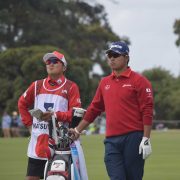
Hideki Matsuyama during World Cup of Golf

The likelihood of Japan’s Hideki Matsuyama becoming the first male golfer from that country to win a major championship looms large, the 24 year old already with three PGA Tour titles to his name in addition to his eight Japan Tour victories and five top tens in the major championships he has played as a professional.

Matsuyama, so early in his career, has shown a preparedness to take his game to the world, a trait not a lot of his fellow countrymen have been all that keen to do. I suppose the opportunity to play 30 or so events at home on the relatively lucrative Japan Tour is appealing to a player from any country if they had that chance and who could blame them but Matsuyama appears to have an international focus and a determination to succeed.

The Masters may well be the major that Matsuyama will win before any other having made the cut on two occasions at Augusta National as an amateur and recorded two top tens in three starts as a professional there he clearly enjoys the venue. Given his current form he shapes as a real chance, even as early as this year.

Having observed, first hand, Matsuyama playing in events in Australia and Thailand, it appears to me the most important attribute he possesses is self-belief. Sure, his stats are good especially in the area of ball striking but to have had as much success as he has already in the US, despite speaking very little English, tells the story of a young man with a great ability to adapt to any environment.

Other Japanese players have won on the PGA Tour namely, Isao Aoki and Shigeki Maruyama, the latter of whom won three times in the US but there is a feeling that Matsuyama is well on track to take Japanese golf to another level completely with victory in a major.

Japanese have occasionally gone close to winning a major, more especially Isao Aoki who finished runner-up to Jack Nicklaus at the 1980 US Open and in 1988 Tommy Nakajima finished 3rd at the US PGA Championship but that first major breakthrough is proving elusive.

Interest in golf in Japan gained a huge boost began when the World Cup of Golf, or Canada Cup as it was known then, was hosted by Japan in 1957, the home-side defeating Americans, Sam Snead and Jimmy Demaret, to win the event in their homeland and cause a frenzy and golfing awareness amongst Japanese fans.

Japan would win the World Cup of Golf again in 2002 but by then the Japan Golf Tour was well and truly up and running and players such as Aoki, Maruyama and Tommy Nakajima had been performing with distinction worldwide.

Later Ryo Ishikawa would play well on the PGA Tour, without winning, and more recently Matsuyama appears ready to claim that all important first major.

In the early 1970’s a Japanese player who achieved almost folklore status in that country emerged from a baseball career to take the Japan Tour by storm. Masashi (or Jumbo) Ozaki won more than 100 events in his own country and dominated the Japan Golf Tour for the best part of twenty five years but although he played 90 or so PGA Tour events he was never a member of that tour.

Jumbo Ozaki and the writer at the 1972 NZ PGA

Ozaki recorded top tens in majors on three occasions and actually played the Masters on 19 occasions but his only overseas victory would come at the 1972 New Zealand PGA Championship at Mt Maunganui in the North Island where he defeated Bob Charles by six shots.

I was lucky enough to fluke the role as his caddy that week and to say the least his win was impressive, hitting the ball prodigious distances with the then small (1.62’) ball and easily accounting for a field of Australasian and other players so early in his career (he was 24).

I was 18 and it was the first occasion that I had experienced such success as a caddy and it left a lasting impression on what would be my own future in the industry of golf.

Ozaki, however, had it pretty easy at home in Japan. He was almost a cult figure there and other than a desire to be one of the greats in the game there was no real incentive for him to chase the riches of the PGA Tour.

He would, therefore, remain relatively unfulfilled in terms of what he might otherwise achieved if he had the determination and desire to capitalise on his amazing game at a higher level than the Japan Golf Tour.

Matsuyama, though, is a very much different character and it would seem realises that if he is to become one of the game’s greats then he has to compete on international tours on a regular basis and perhaps view the PGA Tour as his main tour rather than the Japan Tour.

Matsuyama took his game to another level in 2016 rising to the number 6 place in the world ranking but it would seem he is likely to take his place in the game to even greater heights in 2017.