There has been so much speculation ahead of the 2018 Masters as to just where this year’s version sits in terms of anticipation – many suggesting, because of the numerous story-lines involved, that it is perhaps the most anticipated ever.
The events of day one have suggested that hype was not overdone with not only one of Augusta National’s now favourite sons (Jordan Spieth) producing brilliance to lead but the perhaps feel good story of the week to date, Tony Finau, rising like a phoenix from the ashes of disappointment to lead until very late in the day.
Finau’s excruciating (just to watch) dislocated ankle during the Par 3 contest on Wednesday appeared to have ruined the chances of a Masters debut for the tall 28 year old American but after overnight treatment, elevating his ankle all night and an MRI this morning he was cleared to play around 7.00am and an hour later he was at the course to test the ankle and prepare for his afternoon round.
That he had a few hours to warm up and assess his capabilities of playing perhaps worked in his favour but so too did a round of golf that began with perhaps an unsettling bogey given the circumstances but evolved into a a brilliant debut further emphasising the roller coaster golf can offer.
From the despair of being forced to potentially sit out a Masters debut to taking the lead when finishing a round is stuff that dreams are made of and, after the nightmares of 24 hours earlier, Finau could not hide his excitement.
“Yeah, it’s been pretty crazy. To be in this position I’m at now; when I woke up this morning, nothing short of a miracle if you ask me. I could barely put any pressure on it. I could barely walk. But obviously, after the MRI we had, you know, there was no real damage. So at that point, at about 8:00 this morning, I knew I was going to play.
“From that time till I teed off was just about getting together with my doc and just having him do some tissue work and just make sure I was good to go.
“I went to the range quite a bit earlier than I would have, just to see how I was going to feel and hit some shots.
“But the emotions have been pretty crazy. I looked forward to this week for a really long time, and to see the possibility of that slipping away; you know, I had the confidence that I would come back, but I wanted to play now and I want to play this week.
“Waiting for another opportunity to play my first Masters, or whenever that was, whether it was next year or another time, was going to be hard for me to swallow.”
Finau finished about an hour ahead of the eventual first round leader Spieth and would eventually lose his lead to the the 2015 champion but it was a round he will not forget for so many reasons.
“I don’t know if I could sum it up in one word. But, you know, to me, it’s nothing short of a miracle sitting here right now, just because, you know, when it happened, I felt like there probably could be something seriously wrong. And after the X‑ray, there wasn’t and after the MRI, there wasn’t.
“To me, it’s a miracle; my foot was out of place 24 hours ago, and I sit here in second place at the Masters possibly after round one. It’s nothing short of a miracle for me. Just blessed.”
Spieth birdied holes 2 and 4 and then dropped shots at 5 and 6 and as he reached the 8th tee he was at even par. Most scoring opportunites at Augusta National come on the back nine but he needed to build momentum quickly and it came in the form of an eagle at the 8th hole from 14 feet.
While his run of five consecutive birdies from the 13th swept him into a then three shot lead it may well have been the great par saves he made at the 7th, 11th and 12th that would establish the base for his late onslaught.
A bogey after the last put a dampener of sorts on the round but it proved to be a good bogey as after finding the trees he was still facing 250 yards for his 3rd. That he saved bogey from the left of the green is further evidence if indeed it is needed that Spieth is firing on all cylinders.
“You know, I feel like ‑‑ and I talk about this almost every interview I do, is we build plans for the year to peak at certain times,” said Spieth. “And I believe that not just here at Augusta, but the major championships, going back a number of years, I’ve played really well, and I think that has to do with the work of our team.
“We’ve got a great plan, and then gearing up myself and getting psyched for them and the right amount of kind of confidence and composure that it takes.
“Out here, this golf course specifically, brings out a lot of feel in my game, and I think that’s advantageous. I don’t do well in domes or driving range shots, and you don’t have many of those out here.”
He acknowledged that the grinding today was just as important as the brilliance.
“If I look back on my highlights for the day, I’d say I had three of them. Two of them were bogeys and one was an eagle. My bogey save that I made on No. 7 was a fantastic putt that kept, you know ‑‑ I saw a putt go in. It was a very difficult putt, and I could have dropped to over par, and it led to, you know, stepping on 8 tee feeling like, okay, regrouped, let’s grab three coming in.”
Spieth leads by two over Finau and Kuchar, Kuchar perhaps one of the dark horses this week. Kuchar has often played well at Augusta National and has had a good season already in 2018 and so some of the odds about his chances ahead of the event appeared very appealing.
The large group at 3 under and three from Spieth’s lead includes Henrik Stenson and Rory McIlroy, McIlroy making his second best start in the event and Stenson also doing considerably better then in previous years.
Of the Australians Marc Leishman well with his round of 70 to be just four from the lead although a double bogey at the par 5 15th will hurt given he was then tied for the lead.
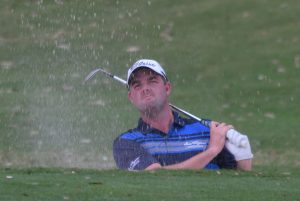
Marc Leishman
Leishman played with Tiger Woods and given the distractions of that pairing he did well.
Cameron Smith is playing his second Masters and produced his best round by two shots to be at 71, while Jason Day and Adam Scott had 75’s.
Twenty players are under par and the cut appears as if it will fall around the 3 or 4 over mark tomorrow.

Cameron Smith’s rise continues with Masters 5th placing
Patrick Reed’s Masters victory today takes him to another level in the game, moving the 27 year old to 11th in the world ranking from his previous 24th and although he has been as high as 7th 18 months ago, this win takes him to a level in the game both in reality and perception that he has never been to previously.
As a major champion he joins a particularly elite group of the game’s best and perhaps even more so as a winner of the Masters.
While all the talk internationally will be on the breakthrough major championship for the feisty now six-time PGA Tour title winner and his showdown with Rory McIlroy, Jordan Spieth and Rickie Fowler, for Australians the performance of both Cameron Smith and Marc Leishman remain as their highlights from the 2018 Masters.
Both Smith and Leishman stormed home over the closing few holes of the Augusta National layout to finish tied 5th and 9th respectively today, Smith in particular continuing to build on his reputation as a player capable of joining the elite of the game himself in the years ahead.
Brisbane’s, Smith, was playing in just his 7th major championship, his first appearance when 4th at the 2015 US Open at Chambers Bay essentially launching him onto the world stage for the first time, eventually that effort earning him the right to play the PGA Tour in 2016.
It was that performance that also gained him his first start at Augusta National in 2016. The leading four players at the previous year’s US Open are automatically invited to the Masters and Smith did well when making the cut on debut.
A third round of 82 that year was a little hard to take but importantly he had learned so much in that first year about the nuances and subtleties of the great layout to stand him in such good stead the next time round.
Back in 2018 as a considerably more experienced and skilled player he slowly but surely worked his way into the tournament and after comfortably making the weekend by finishing six shots inside the cutline he had established a base on which to build over the final 36 holes.
Round three was going very nicely until two late bogeys but at 3 under he was nicely poised to post one of his best major championship finishes and further his credentials for the road ahead.
Sunday however would see much better than that. Only two players, Paul Casey and Jordan Spieth, would better his final round 66 although a missed four-footer at the last proved both frustrating and costly for Smith.
His back nine of 30 however was sensational, a run of four consecutive birdies from the 12th setting up the brilliant closing nine holes.
“I saw a good putt go in on the 10th and that set things up for the rest of the back nine,” he said after his round today. “I hit a really good shot into 16 also and came up a little short but 6 under around here on the back nine I will take any day.
“The best part of today was to get a little bit of confidence going into next week with the driver. I struggled with that earlier in the week but hit it really good today so that is perhaps the best thing I will take out of today.”
Smith moves to 39th in the world ranking his highest standing ever, he earns US$368,000, takes his career earnings in the US to well over US$ 5 million and importantly gets another crack at the Masters in 2019.
Getting to know Cameron Smith
Smith took to the game like a duck to water when first introduced by his father at the age of 3 and after winning the Australian Stroke-play twice in 2011 and 2012 and the Australian Amateur Championship in 2013 he quickly adapted to professional life in 2014 after gaining his Asian Tour card early that year.
He finished runner-up to Anirban Lahiri in one of the early season events in Jakarta and he was on his way. It would however be a 5th place finish at the CIMB Classic late in the Asian Tour season, an event jointly sanctioned with the PGA Tour that elevated his standing even further.
As a result of that finish he had a start on the PGA tour and with his management company working overtime more would come. A 15th place finish at Hilton Head helped his cause but it was his big cheque at Chambers Bay that changed his direction.
His first PGA Tour win came in 2017 when partnering Swede Jonas Blixt to victory in a tournament in New Orleans but his first professional victory on his own came when winning the Australian PGA Championship in a playoff (see photo above) against Jordan Zunic last December.
At home also he so nearly won the 2016 Australian Open when losing a playoff to Jordan Spieth and Ashley Hall at Royal Sydney but it is in the US where he keeps stepping up to the plate and in some respects ‘boxing above his weight’.
His first individual win in the US must come soon and there will be little surprise when it does either from his peers or the golfing public generally who are becoming increasingly aware of the considerable game and mindset he possesses.
Next week for Smith will be the RBC Heritage Classic at Hilton Head a course he has played well previously and the style of course that should suit his game admirably. That first solo win might not be so far away.
Leishman, too, must take a lot of credit for the manner in which he fought back after losing his way early in round 4, four late birdies moving him to 8 under and into a share of 9th.
Like Smith, Leishman flies under the radar to a large extent but he has now earned US$21.5 million in earnings on the USPGA Tour alone and is regularly putting himself into contention in major championships.
His unflappable manner and significant game must surely be rewarded with a major at some stage and that may well be sooner rather than later.
Australians did well at the 2018 Masters. It was not the most expected who were to the fore, however, but rather others who might do even better in the future.
Marc Leishman – Is It His Turn?
Marc Leishman has often shown in his now nearly ten years on the PGA Tour that he has the right stuff in terms of contending and potentially winning a major championship.
This weekend he gets another chance to break through and win at the one of the four major titles when he heads into the final 36 holes of the Masters just two behind Patrick Reed.
Ever since finishing as the PGA Tour’s Rookie of the Year in 2009 and making it to the Tour Championship that year, Leishman has gone quietly about his business, often flying under the radar but achieving at close to the highest level on several occasions.
Performing under the considerable shadows produced by Jason day and Adam Scott during much of his time on the PGA Tour, Leishman has managed to win three PGA Tour titles and produce ten other second or third place finishes and accumulate more than US$21 million in prizemoney earnings alone.
He has contended for a major on several occasions, the best of those when runner-up at the Open Championship in 2015, his unflappable manner allowing him to cope with the roller coaster that prevails when such high stakes are up for grabs.
This is Leishman’s sixth appearance at Augusta National although other than a 4th place finish in 2013 there has not been a lot to get excited about. He is, however, a more experienced player and as he displayed in today’s second round of The Masters he appears primed to take the big step.
Leishman birdied his opening three holes to join the lead on Friday but while that was an impressive start it was his second the Par 5 15th that was the shot of the day and perhaps told the story of Leishman’s perhaps more brilliant game and aggressive mindset than it would outwardly appear.
“I considered other options, but to win this tournament, you’re going to have to take a chance at some point,” he said when asked about taking on that spectacular shot.”
“I felt like that was one where the reward was worth the risk because that’s such a hard wedge shot, and it’s probably hard to make par from that wedge shot, hitting off a down-slope on to a narrow green.
“So I thought if I could get it up there somewhere and possibly 2‑putt for birdie, that would be a good outcome and it was a better outcome than that.”
From 226 yards with a 5 iron Leishman executed the shot beautifully turning the shot as much as 40 yards and releasing to 5 feet from where he converted for an eagle which at that point got him within one.
Reed would finish strongly to extend his lead to two shots but Leishman gets the chance to eye the leader when the pair play tomorrow.
He is not bothered by the prospect of playing in the final group, after all he played with Tiger Woods on the opening two days and outplayed one of the game’s greatest by 11 shots and survived the hype involved.
“It certainly can’t hurt,” said Leishman when asked how that experience might have helped in preparing for the weekend. “When I saw I was paired with Tiger, I really did look at it as a positive. We get along really well.
“If you are going to win this tournament, you’re going to play in front of some really big crowds and you’re going to have a lot of energy around your group, whether it’s in the crowd or inside the ropes.
“I really looked at it as preparation for that later in the week, so it’s ‑‑ I enjoy playing with him, I like playing in front of big crowds, and on the biggest stage, as well. Again, this is why, as a golfer, we do all our practice to be prepared for that. And I feel like I was prepared for it, and I’m glad I played well to show it.”
Leishman will of course not only have to watch the man he is pursuing but also those behind him who include some of the greatest names in the game currently but he there is something about the manner in which he is going about his business that suggests they should be as concerned about the Australian as he should about them.
The Masters lives up to its billing
There has been so much speculation ahead of the 2018 Masters as to just where this year’s version sits in terms of anticipation – many suggesting, because of the numerous story-lines involved, that it is perhaps the most anticipated ever.
The events of day one have suggested that hype was not overdone with not only one of Augusta National’s now favourite sons (Jordan Spieth) producing brilliance to lead but the perhaps feel good story of the week to date, Tony Finau, rising like a phoenix from the ashes of disappointment to lead until very late in the day.
Finau’s excruciating (just to watch) dislocated ankle during the Par 3 contest on Wednesday appeared to have ruined the chances of a Masters debut for the tall 28 year old American but after overnight treatment, elevating his ankle all night and an MRI this morning he was cleared to play around 7.00am and an hour later he was at the course to test the ankle and prepare for his afternoon round.
That he had a few hours to warm up and assess his capabilities of playing perhaps worked in his favour but so too did a round of golf that began with perhaps an unsettling bogey given the circumstances but evolved into a a brilliant debut further emphasising the roller coaster golf can offer.
From the despair of being forced to potentially sit out a Masters debut to taking the lead when finishing a round is stuff that dreams are made of and, after the nightmares of 24 hours earlier, Finau could not hide his excitement.
“Yeah, it’s been pretty crazy. To be in this position I’m at now; when I woke up this morning, nothing short of a miracle if you ask me. I could barely put any pressure on it. I could barely walk. But obviously, after the MRI we had, you know, there was no real damage. So at that point, at about 8:00 this morning, I knew I was going to play.
“From that time till I teed off was just about getting together with my doc and just having him do some tissue work and just make sure I was good to go.
“I went to the range quite a bit earlier than I would have, just to see how I was going to feel and hit some shots.
“But the emotions have been pretty crazy. I looked forward to this week for a really long time, and to see the possibility of that slipping away; you know, I had the confidence that I would come back, but I wanted to play now and I want to play this week.
“Waiting for another opportunity to play my first Masters, or whenever that was, whether it was next year or another time, was going to be hard for me to swallow.”
Finau finished about an hour ahead of the eventual first round leader Spieth and would eventually lose his lead to the the 2015 champion but it was a round he will not forget for so many reasons.
“I don’t know if I could sum it up in one word. But, you know, to me, it’s nothing short of a miracle sitting here right now, just because, you know, when it happened, I felt like there probably could be something seriously wrong. And after the X‑ray, there wasn’t and after the MRI, there wasn’t.
“To me, it’s a miracle; my foot was out of place 24 hours ago, and I sit here in second place at the Masters possibly after round one. It’s nothing short of a miracle for me. Just blessed.”
Spieth birdied holes 2 and 4 and then dropped shots at 5 and 6 and as he reached the 8th tee he was at even par. Most scoring opportunites at Augusta National come on the back nine but he needed to build momentum quickly and it came in the form of an eagle at the 8th hole from 14 feet.
While his run of five consecutive birdies from the 13th swept him into a then three shot lead it may well have been the great par saves he made at the 7th, 11th and 12th that would establish the base for his late onslaught.
A bogey after the last put a dampener of sorts on the round but it proved to be a good bogey as after finding the trees he was still facing 250 yards for his 3rd. That he saved bogey from the left of the green is further evidence if indeed it is needed that Spieth is firing on all cylinders.
“You know, I feel like ‑‑ and I talk about this almost every interview I do, is we build plans for the year to peak at certain times,” said Spieth. “And I believe that not just here at Augusta, but the major championships, going back a number of years, I’ve played really well, and I think that has to do with the work of our team.
“We’ve got a great plan, and then gearing up myself and getting psyched for them and the right amount of kind of confidence and composure that it takes.
“Out here, this golf course specifically, brings out a lot of feel in my game, and I think that’s advantageous. I don’t do well in domes or driving range shots, and you don’t have many of those out here.”
He acknowledged that the grinding today was just as important as the brilliance.
“If I look back on my highlights for the day, I’d say I had three of them. Two of them were bogeys and one was an eagle. My bogey save that I made on No. 7 was a fantastic putt that kept, you know ‑‑ I saw a putt go in. It was a very difficult putt, and I could have dropped to over par, and it led to, you know, stepping on 8 tee feeling like, okay, regrouped, let’s grab three coming in.”
Spieth leads by two over Finau and Kuchar, Kuchar perhaps one of the dark horses this week. Kuchar has often played well at Augusta National and has had a good season already in 2018 and so some of the odds about his chances ahead of the event appeared very appealing.
The large group at 3 under and three from Spieth’s lead includes Henrik Stenson and Rory McIlroy, McIlroy making his second best start in the event and Stenson also doing considerably better then in previous years.
Of the Australians Marc Leishman well with his round of 70 to be just four from the lead although a double bogey at the par 5 15th will hurt given he was then tied for the lead.
Marc Leishman
Leishman played with Tiger Woods and given the distractions of that pairing he did well.
Cameron Smith is playing his second Masters and produced his best round by two shots to be at 71, while Jason Day and Adam Scott had 75’s.
Twenty players are under par and the cut appears as if it will fall around the 3 or 4 over mark tomorrow.
Augusta National Women’s Amateur – innovative but no surprise
The news today that Augusta National Golf Club (ANGC) and the Masters Tournament Foundation are the founding partners in establishing the Augusta National Women’s Amateur Championship comes as no real surprise.
Having seen first-hand their just how much tangible support the Masters Tournament provides for not only the Asia Pacific Amateur Championship, but also the Latin America Amateur Championship and the Drive Chip and Putt event, which culminated last weekend at Augusta National, has opened my eyes to the preparedness the ANGC have displayed to give back to the game.
“I think that goes back to really the inception of Augusta National,” said recently appointed ANGC Chairman Fred Ridley. “I read a lot in the past few months about things our founders said about really what our role and obligation was in the game of golf, and it’s been a consistent theme and part of our culture that we have an obligation to give back to the game.”
It would be very easy look at the amazing dollar number the Masters Tournament generates in terms of ticket and merchandising sales and broadcasting rights and wonder just where this money goes but the manner in which they support the development of the game, sometimes in many less obvious golfing regions of the world, is there for all to see.
The success of the Asia Pacific Amateur Championship, which is run as well as nearly any professional event this writer has attended, led then to the creation of the Latin America Amateur Championship. With little expense spared in providing a tournament experience like no others for participants, both events have been a must play event for amateurs from countries through those respective regions as a prelude to a potential professional career or as part of developing their own game or golf in such regions.
Now, another event is added to that list of events which the ANGC and the Masters Tournament support via dollars, expertise and manpower with the announcement of the inaugural event by Ridley during his media conference today ahead of this week’s first men’s major of the year.
“We certainly plan to have this event televised globally,” added Ridley. “We have not had any specific discussions with our television partners, but — as you know, we have great relationships with those television partners, and I wouldn’t be surprised to have a couple messages on my desk when I get back in a few minutes.
The Augusta National Women’s Amateur Championship, a 54-hole, stroke play tournament will feature an international field of 72 players. Invitees will be determined by awarding winners of other recognized championships and using the Women’s World Amateur Golf Ranking.
The opening two rounds are to be played at the Champions Retreat Golf Club in Evans in the suburbs of Augusta in Georgia, the final round taking place on Saturday, April 6, 2019, at Augusta National Golf Club.
Jordan Spieth and Augusta National – inseparable
Jordan Spieth begins this week’s Masters as the player with the hottest record in the event in recent years. Twice a winner and once runner up in his last four starts and 11th last year after being well into contention heading into the final round, Spieth’s game suits Augusta National and vice-versa.
Today, in a press conference the 24-year old spelt out his thoughts on just why he does so well at this event.
“I think this game brings out the feel aspect of my game, which is the better side of me on the golf course. It’s not a technical driving range golf course, you have a lot of uneven lies and very slopey greens, and so you have to play a lot off of feel and what that lie gives you.
“I think that that’s helped me kind of settle in and not overthink things out here and get into a nice groove, and it’s led to some success at this event. So it is my favorite tournament in the world. I’ve certainly made that pretty clear going back the last five years.
“So excited for this week. Game feels good, and the golf course is looking to be already pretty firm and fast. We’ll see how it holds with the weather that’s coming in.”
Spieth has hardly played badly this of late but until last week’s improved effort at Houston he was below his best and his 3rd place finish three days ago has him primed for his 5th appearance at Augusta National.
He is not fazed by the fact that his form in 2018 has taken a little longer to kick in.
“I feel better coming into this week than I did in 2016 and 2014 where I came off of missed cuts in Houston. There’s a lot to be said off of the previous week, the previous week’s momentum. And being able to work my way last week into contention and hit some putts under pressure I kind of pretended like I was tied for lead even though I figured I was a stroke or two back. I kind of wanted that “you need to make this” feeling.”
“I would say this year I’m certainly hoping that I’m approaching this as this is the beginning of the year, it’s not been the greatest start to the year of any that I’ve had. But I kind of look at it almost in like thirds.
“You kind of get the half a dozen to ten events, you get kind of before the Masters, and then you get the Masters through kind of that U.S. Open stretch is the next third, and then you get the last two Majors and the playoffs, the FedExCup is kind of like the last third.
“So this maybe starts kind of the second ‑‑ kind of end of the first, beginning of the second, third of the season.
When asked as to how he feels as to whether this is the most anticipated Masters ever Spieth had his own thoughts but was keen to not overstate the fact.
“I think it probably is. I think the addition of Tiger being healthy and playing well, no matter what else happened, was probably going to make it as anticipated as any going back five, six, seven years. So that in its own.
“But then Phil winning recently, Rory winning recently, Bubba winning recently, Justin playing well, D.J. playing well, I mean, yeah, there’s just a lot of guys playing really good golf that create story lines in general. And then when you put it at kind of the biggest stage in our sport, I think that creates that anticipation. But for me personally, I mean, it’s just ‑‑ it doesn’t feel any different to me.”
Despite his young years Spieth has already built a special relationship with this event and vice versa and when asked how this event sits with him against the other majors he responded.
“The other Majors and other golf tournaments certainly have similar history, and The Open Championship has even more history than any other tournament. But to be played at the same place, to have ‑‑ to play 16 and see Tiger’s chip putt in, to see Phil’s holing bunker shots on 15 for eagle, all the putts guys have made on 18 to that Sunday pin, it’s just ‑‑ and the amphitheater setup as you come up 18, it’s just like, it’s a walk that I’ll certainly never forget.
“So personally it’s a no‑brainer for me to say so. But I don’t know why necessarily other people would feel that way.”
The love affair between Jordan Spieth and Augusta National looks set to continue this week. His is a record like no other in recent years and despite that his 12th hole demise in 2016 could well have left an indelible scar on his memory he has found a way to put that behind him and look ahead to the possibility of not just contending but winning this week.
If he does, few will be surprised.
Jason Day looks ahead to 8th Masters Appearance
Five years after Adam Scott’s breakthrough for Australia at the Masters which in turn came nearly eighty years after the event was first played, Australian hopes at Augusta National this year appear to rely on Jason Day converting his outstanding record at Augusta National into his second major championship title and Australia’s second Green Jacket.
Day is playing the event for the 8th time having made the cut on six of those, the only time he did miss the weekend coming on his second appearance in 2012 when forced to withdraw after the opening round.
Today Day spoke to the media and reflected on his first appearance at the Masters in 2011 and just how far he has come since that amazing debut..
“Yeah, it was funny, when I first came here, I think everyone knows this story about how ‑‑ funny how it opens up the story, but I was almost close to quitting the game in 2011 when I first was a rookie coming and playing this event for the first time.
“I met my agent, Bud, and a sports psychologist, and we ended up coming up with a plan of just going out there and having fun. I ended up finishing second. Had a good chance of winning the Tournament, and Charl Schwartzel came home in a flurry and birdied the last four holes.
“And then in 2013 I was very close again. Had the lead with I think three holes left and didn’t quite get it done, but Adam Scott ended up finishing and being the first Australian to win the Masters.
“Going back on it, obviously, I think the preparation is huge coming to an event like this. Being here the last ‑‑ I got here Thursday night, and I’ve been here the last few days and just been really kind of just fine-tuning things and trying to adjust.
Day has played a limited schedule to date in 2018 but when he has played he has done well but despite that he talked about his confidence levels being a little down on what they might have been in previous years although he did not seem too concerned by that aspect.
“This is probably not close to the high that I’ve had before, coming off 2015 and winning late and then obviously coming into an event where I was No. 1 in the world, I think, that was pretty high, but I just ‑‑ the last two events didn’t really pan out the way that I wanted to, especially at Bay Hill and Match Play. Didn’t quite perform the way I wanted to. But that’s not necessarily a bad thing.”
Day will play his first Masters without his long time caddy Colin Swatton but he has the benefit of Swatton’s presence in a coaching role this week and has one of his closest friends (Rika Batibasaga) on the bag.
“Yeah, I think that to a certain degree you take ownership of your actual golf game, going back with Col, he was great for the 10 years that we had, and he is still my coach. He’s here.
“But to a certain degree I think when you have your coach on the bag, you kind of not worry but you kind of think, okay, well, he’s going to say something about this shot, so I better not play that shot, you know, after the round. And it takes a little bit of free will to your game to let things happen.
“I think that I always get back to if it comes down to the line of me trying a shot on the last hole to win the Masters and it ends up failing, I would much rather fail in front of millions instead of failing in front of nobody. And if I can pull it off, then great.
I think that’s what Rika will bring to this week, is a lot of fun and enjoyment. And we’re best buds, so we’ll go out there and enjoy the time. I think he’s going to be nervous walking down the first hole, but he should be fine.”
Day is aware for him to do well he will have to better a very much in form field.
“This is probably the top of what’s going on. There’s just so many good players right now that can (win). Like, obviously, you look at the odds, I mean, Tiger’s probably a favorite right now, and there’s just so many guys that can play well and win. And there’s guys that you wouldn’t even expect that you go, man, I forgot about him, and you know that he’s a great player.
“So there’s just a lot of medium‑large fish chomping at the bit. It’s just how it is.”
Day might be flying under the radar a little given the hot form of several others but his game overall and his Augusta National record suggest he should be a serious consideration.
Picture shows Day and Batibasaga playing a practice round together at an earlier Australian Open – now they are player /caddie
The 2018 Masters – A Form Guide
The Masters captures the attention of not just the golfing world but the sporting world generally. As is so often the case with all of the great sporting events internationally, everyone, golf fans and others, become experts during tournament week and for golf that is a very good thing.
Picking a winner is never easy in tournament golf but let’s take a look at the leading chances and see if we can do just that in addition to assessing the Australian chances.
Rory McIlroy
McIlroy has a very good record at Augusta National without winning. The one remaining leg of his career Grand Slam has been tantalisingly close at times and his most recent form indicates that such a feat is not beyond him. Four top tens in his last four visits to Augusta National suggest that he has every reason to be one of the favourites if not the favourite.
Jordan Spieth
Spieth’s most recent form until last week’s impressive share of 3rd at the Houston Open has been below his best but his record at Augusta National speaks for itself. Once a winner, twice a runner-up and an 11th place finish last year after starting the final round just two from the lead is a stunning record in his four starts and so if there was a place to regain his brilliance this could well be it. Every reason to believe his great run at the Masters will continue.
Dustin Johnson
Johnson began as the Masters favourite last year although an accident on the eve of the event cost him a chance to continue what was then a great run of form to begin 2017. He has been 4th and 6th at his last two Masters appearances however and his most recent form has been good enough for him to be considered a genuine chance.
Bubba Watson
Firmed in favouritism for this week’s event with his win at the Dell Match Play which followed just a few weeks after his win at the Genesis Open. As a two-time winner of the Masters, the left hander’s game clearly fits Augusta National nicely and he now appears back playing at the level that saw him win here in 2012 and 2014.
Justin Thomas
Thomas is playing his third Masters with two midfield finishes previously and now, with the benefit of that experience at the venue, along with seven PGA Tour titles to his name in that period he should begin as one of the favourites. He has yet to record a round in the 60’s in eight attempts at Augusta National but his most recent form, which includes top four finishes in each of his last three starts, suggests he has the credentials for his best Masters finish and perhaps something significantly better.
John Rahm
The Spanish star and world number three makes just his second Masters appearance following an encouraging debut in 2017. Rahm was well enough placed through 36 holes last year but struggled over the weekend but given his rapid rise in the rankings, his significantly more tournament experience since and that he has won on three occasions worldwide in the last twelve months there is every reason to believe he can better his first attempt. He started 2018 brilliantly and while not at that peak since he has continued to play solidly.
Justin Rose
Rose has been twice runner-up at Augusta National in his last three starts and boasts several other solid Masters finishes. The Englishman was playing in Houston this week and was average at best but his great weeks in Tampa and Orlando recently suggest he is close to his best and if he can produce it then his chances of a breakthrough win at Augusta National and his second major title are good.
Tiger Woods
There is perhaps greater interest in Woods appearance and effort at this year’s Masters than ever before. His recent comeback form has been encouraging having been runner-up in Tampa and 5th at Bay Hill. His record at the Masters is amongst the best in the history of the event and so there is every reason to believe he can at least contend. Dismissing champions has proven folly for many in the past and I am not about to do that. If he was able to win it will be as big a moment as that of Nicklaus in 1986 and while there is little doubting the magnitude of the task, his re-appearance adds an amazing dynamic to an event which he won by 12 shots 21 years ago and subsequently won on three other occasions.
Jason Day
In seven starts at the Masters Day has yet to miss a cut, the only time he did not make the weekend was when forced to withdraw after round one in 2012. A runner-up finish on debut in 2011 and a 3rd place finish behind Scott in 2013 tell the tale of Day’s liking for the Augusta National layout and its suitability for his style of game. His form this season has been excellent with a win at Torrey Pines and a runner-up finish at Pebble Beach and so a second major title is not beyond the 30-year old.
Phil Mickelson
A win by Tiger Woods would no doubt be a great boost for the game and excite golf and sports fans worldwide but so too would a victory by Mickelson. With three wins in the event and so many other top threes Mickelson has arguably the greatest record of those playing this year’s edition and his most recent form has been first class including the WGC win in Mexico. A final round of 67 in Houston will also assist his cause. There is no real reason to believe that Mickelson could not potentially surpass Nicklaus and become the oldest player to win the Masters.
Paul Casey
Casey has not been outside the top six in his last three Masters appearances and his recent form in 2018 suggests he could easily add to that impressive run of form at Augusta National. His great consistency over the last few years is perhaps deserving of a first major and, although golf is rarely fair, if Casey was to produce that major breakthrough then few would deny him the right to do so.
Sergio Garcia
As the defending champion Garcia deserves respect but so too because of his most recent form which includes a win in Singapore in January and three consecutive top tens in his most recent PGA Tour starts. The recent arrival of his first child should serve to inspire him even further. He has not always performed well at Augusta National but his win last year and a new attitude to his life and game served him well in 2017 and he could well become the first player to successfully defend this great title for the first time in 16 years.
Hideki Matsuyama
Matsuyama has, in recent weeks, become the forgotten man to a large extent although an analysis of his form in 2018 suggests it is not as bad as it might seem. Early in the year he finished 4th in Hawaii and then 12th at Torrey Pines before being forced to withdraw from the Waste Management Phoenix Open with a wrist injury. If his recovery from that injury is complete then his record at Augusta National suggests he could be a chance. He has been no worse than 11th at his last three appearances at the Masters and also played well there as an amateur.
THE AUSTRALIANS
Jason Day (see above also)
In seven starts at the Masters Day has yet to miss a cut, the only time he did not make the weekend was when forced to withdraw after round one in 2012. A runner-up finish on debut in 2011 and a 3rd place finish behind Scott in 2013 tell the tale of Day’s liking for the Augusta National layout and its suitability for his style of game. His form this season has been excellent with a win at Torrey Pines and a runner-up finish at Pebble Beach and so a second major title is not beyond the 30-year old.
Adam Scott
Scott has always shown a liking for Augusta National ever since his debut 9th in 2002 and he has missed only two cuts in a total of 16 starts. He has only played five events in 2018 but does appear to be getting better with each start and while contention and winning might be beyond him this year I think we can expect a good showing.
Marc Leishman
Leishman has been going along nicely in 2018 with three top tens in eight starts and appears to be peaking for this. Leishman’s record at Augusta has been mixed, however, finishing 4th behind Adam Scott in 2013 but in four other starts he has missed three cuts and been 43rd in the other.
Cameron Smith
Smith will make his second Masters appearance having made the cut on debut two years ago. His overall form in 2018 has been very solid culminating in a 5th place at the recent WGC Dell Match Play. Smith has jumped most of the bars put in front of him in his career to date as he goes quietly about his business and while contention this year is probably out of the question a good solid week appears likely.
The Original World Match Play
The week of the W.G.C Dell Technologies Match Play Championship, or its equivalent, over the past 18 years rekindles, for me, memories of what was previously known as the World Match Play Championship at Wentworth near London.
While the more recent version of the game’s most significant match play championship contains both a larger field and substantially more prizemoney, the original World Match Play produced some of the great match-ups and moments in the history of the game.
I was fortunate to caddy in what was then known as the Piccadilly World Match Play Championships on three occasions, the first in 1973 as a 20-year old on my first trip to Europe to caddy on the European Tour.
I had caddied for much of the European Tour that year for Australian golfer Bob Shearer but midway through the year became aware that Australia’s rising star, Graham Marsh, had been invited to play the event.
I wrote Marsh a letter which I sent via ‘snail mail’ in those days to Japan where he was a regular on the Japan Tour, expressing an interest in caddying for him if his bag was available. It was a pipe-dream admittedly but I thought it worth giving a shot although on not hearing back from him I all but gave up any hope.
However, three weeks before the event I headed north to Turnberry in Scotland and the John Player Classic where I had a pre-arranged caddying gig with Australia’s Billy Dunk who was making one of his very few trips to Europe.
Arriving in Turnberry nearly a week early, as there was no other event on at that time, I caddied in two practice rounds for Bob Charles who was there early as he had business to attend to in the days immediately prior to the event and was keen to familairise himself with the course as he would have little time during tournament week.
While returning Bob Charles clubs to the Turnberry Hotel one afternoon I noticed Marsh in the foyer and tackled him about the possibility of caddying at the World Match Play nearly three weeks later and asked if he had recieved my letter.
Marsh, too, had business to attend to (in France) in the days leading up to the John Player Classic and was at Turnberry early to get in a few practice rounds and asked if I would work those rounds for him.
Marsh had received my letter, but indicated that the Scottish caddie who had worked for him at the Scottish Open at St Andrews in July would have the bag at the John Player Classic, the Dunlop Masters the following week at St Pierre in Chepstow in Wales and the World Match Play.
Marsh did, though, add that if anything went awry with those arrangements I could have first option on the bag. That was a ray of hope but, honestly, the chances of that happening seemed remote as caddying in those three tournaments was a dream for a caddie, more especially at the World Match Play which involved eight of the game’s best players and a relatively good purse.
When Marsh returned to Turnberry after his trip to France, however, he sought me out and asked whether I would be available for the Match Play. His caddie had called him and indicated that his wife was ill and he was unable to be at Turnberry or the Dunlop Masters and although he would be trying to get to Wentworth was unsure whether circumstances would allow.
Marsh wanted surety heading into an event with the significance of the World Match Play and wanted to know well ahead of time of the availability of a caddie. You can imagine my joy on hearing the news.
Marsh was an emerging star in World golf and having won the Scottish Open in July and numerous events in Japan and Asia he was considered a potential worldwide star and as such the tournament promoters, IMG, felt he would make an interesting inclusion into the field.
The World Match Play in that era attracted most of the game’s greats with major winners that year at least targeted for inclusion. Tommy Aaron had won the Masters that year, Tom Weiskopf the Open Championship and with both in the side of the draw with Graham Marsh it appeared a daunting task for Marsh to make it past the opening round.
Matches were played over 36 holes and Marsh managed to beat Aaron in the opening round and then, up against Weiskopf in round two, he would again succeed.
None of this round robin stuff back then, Marsh was into the final on the Saturday against Gary Player who had won the event on four previous occasions and, up against a relative novice at this level, it appeared to many that number five was just a matter of course.
Marsh was, though, a tough competitor and in that regard carried similarities to Player and the final would be an epic, in fact it would go on to become the longest in this history of the event.
Two down with just six to play in the 36-hole final Marsh won the 31st and then Player surprisingly three putted the 34th and the match was back to square.
As the pair stood on the 17th (35th) tee, the first of two consecutive par fives to finish on the outstanding and intimate Burma Road layout at Wentworth lay ahead, and having won the previous hole, Marsh drove first and split the fairway on what is a particularly demanding tee shot.
Marsh agonising as his second to the 35th flirts with OB
As Player stood over the ball, Marsh advised Player he was ahead of the markers (which he was) and Player then replaced his ball and played the hole out with Marsh winning the hole and the underdog headed off to the 36th hole 1 up.
As the pair left the green Player walked over to Marsh waving his finger and said (paraphrasing); “I teed my ball up in exactly the same position as you back there on the tee but as far as I am concerned I don’t worry about petty things like inches so we will forget the whole thing”
Marsh was dumbfounded but the intensity of the match was certainly taken to a new level.
I invite you to view the youtube video (below) which beautifully highlights the outcome of the match and just how Player found a way to win at the 4th extra hole. Player’s bunker play and tenacity in the playoff was stunning not to mention my shoulder length hair !
This was match play at its best.
Persistence paying off for David McKenzie
The recent form of 50-year old Australian David McKenzie on the Champions Tour is an example of what can be achieved by persevering with an already lengthy career while at the same time offering an understanding just how difficult success on the Champions Tour can be.
I wouldn’t mind a dollar for every time I have heard someone say that such and such a golfer will do well in senior golf but for those who have attempted to gain access to the Champions Tour they will be fully aware just how much of a task it is.
Credit therefore must go to McKenzie who throughout his twenty-seven year professional career kept his game alive by playing wherever he could including the Australasian, Canadian, China, Nationwide and PGA Tours, winning on five occasions, the most significant perhaps being his win on the then Nationwide Tour in 2005 which eventually allowed him to graduate to the PGA Tour.
McKenzie’s most important result in Australia was arguably his playoff loss to Richard Green at the 2004 Australian Masters at Huntingdale but he continued to play regular tour golf wherever he could right up till the age of 50 and in fact still does.
His first start at Senior level was just a few days after his 50th birthday at the Senior Open Championship at Royal Porthcawl where he finished 9th against an impressive field, all of whom chased home the winner that week, Bernhard Langer.
Buoyed by the experience and relative success on debut at that level, McKenzie headed for the US and attempted to pre-qualify for several Champions Tour events and gained starts in a further five in 2017, two of which resulted in top five finishes.
The US$320,00 he won for his efforts on the 2017 Champions Tour saw him finish the season in 53rd position and although not able to advance his cause to any great degree when 12th at the Champions Tour School he had sufficient status to afford him some starts in 2018.
This past week he was playing his 4th event of the 2018 season and by finishing in a share of 3rd behind Steve Stricker at the Rapiscan Systems Classic in Mississippi he earned a cheque for US$88,000 and has moved to 30th on the Charles Schwab Money list.
30th is an important figure as by season’s end it will determine those plays who successfully retain their rights for 2019 but it appears McKenzie is already showing that his sights might be set higher than that.
The Melbourne based golfer is a great example of what playing competitively through to the age of 50 might offer in the wider world of Senior golf and if his start is anything to go by then more is to come for the man who could be considered one of the grinders of Australian golf.
Steve Williams – passing on his vast knowledge
The ISPS New Zealand Open has proven innovative in many of the features it has introduced to its week of activities at The Millbrook Resort and the Hills Golf Club near Queenstown in Central Otago.
A Caddie Clinic hosted by Steve Williams on the Wednesday of the event is further evidence of how such initiative can assist in making the week an even greater success.
Williams has become a household name in New Zealand golf and, indeed, in New Zealand sport and with so many caddies, both experienced and those volunteering without any previous experience, needed for the combined amateur and professional field of more than 250 players, Williams was asked three years ago to assist in passing on some of his extensive knowledge to others.
Not only has Williams’ record in caddying for the winners of some 150 titles including 14 majors (13 of those with Tiger Woods) allowed him to speak as the foremost authority on his craft, it provides him the background and knowledge to impart on to those who were caddying for the first time in Queenstown and even some with more experience looking for a refresher course.
Some were there to not only hear about the finer points of the caddie’s role they were also there to listen to many of Williams’ thoughts generally on the game of golf and to hear some of the ‘war stories’ he has accumulated over nearly forty years.
Just as was the case for so much of his caddying career Williams is candid and forthright in his opinions and the 90 or so in the audience that afternoon lapped up his every word.
I have known Steve Williams for nearly all of that time and have been a great admirer of someone who found a way to turn what was seen all those years ago as a hobby into a very successful career.
After two years of hosting the Clinic on his own, Williams was keen to have someone to share the day with, bounce thoughts and ideas off and to MC the function and, as I was at the event in my role as an on-course commentator that week, I was only too happy to do so.
Williams and the writer during Caddie Clinic – Photosport
I had the good fortune in my caddying days to caddy for the winners of 17 tournaments in Europe, Japan, and New Zealand and while it pales into comparison to the stunning career of Williams, it afforded me the background to host a Q&A session between myself and Williams and then between Williams and those who attended the gathering.
Williams also took aside for a special session those rookies who were keen to learn the basics of caddying and others, more experienced, who were keen to understand the finer points of the craft from a man whose success in the role is unquestioned
That break out session involved things as simple as how best to carry the bag, bunker raking, bunker rake positioning, where to stand when you are caddying etc, where to place the bag near the green, how to relate to your player and other things which might sound very automatic for those who have been involved previously but tips for the newcomer which were very well received.
Then, the larger group re-formed and Steve and I talked about so many different aspects of caddying and some of the many stories he has accumulated over the years.
That the tournament put on a few beers and a sausage sizzle added to the late afternoon gathering no doubt made attending the event even more enticing, but Williams kept the audience captivated for over an hour as we chewed through so many different aspects of toting the bag.
I have always found Steve Williams to be articulate and open with his ideas and he has always been a most charitable character and happy to give of his time.
His decisive manner and loyal character have been key ingredients in maintaining longevity in his role with several of the game’s leading players and he continues to display those traits now that his caddying career is winding down.
Adam Scott winning the Australian PGA with Williams on the bag – photo Bruce Young
The charity he and his wife Kirsty have run in New Zealand has been responsible for assisting underprivileged youngsters and several years ago donated more than a million dollars towards an oncology unit at an Auckland hospital.
He is therefore giving back in more ways than in golf itself but the advice and stories he passed on during this year’s New Zealand Open will leave those who were there on the eve of the event thankful for the information he was only too happy to share.
head photo courtesy of Photosport NZ