
The Ryder Cup – one of sport’s greatest contests
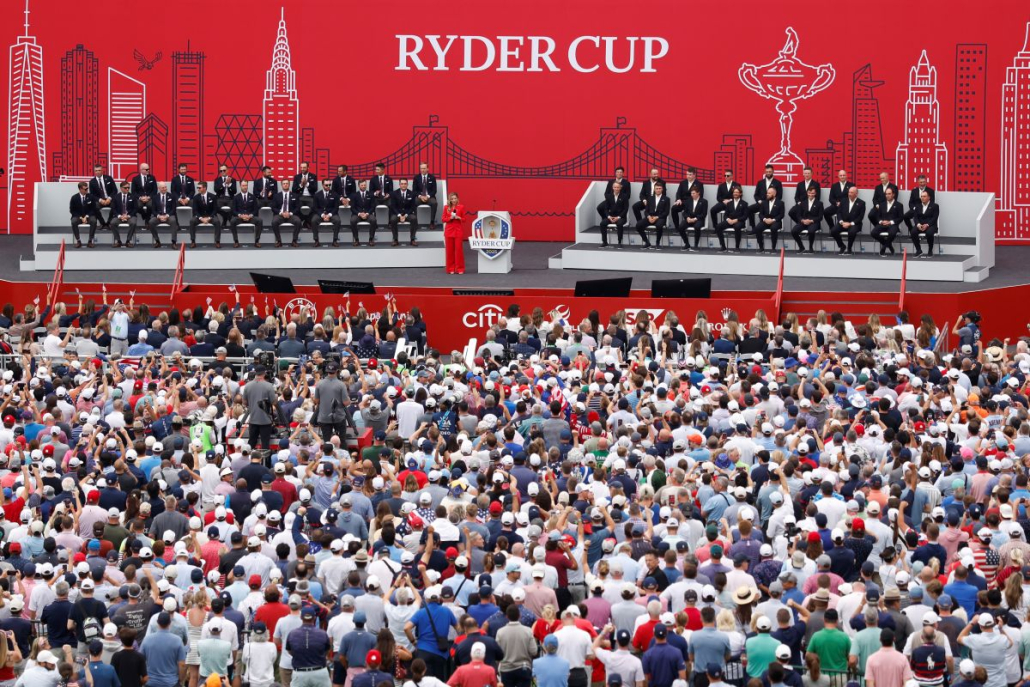

The opening ceremony earlier this week – image PGA of America
Now considered not only one of the world’s great golfing events, but one of the greatest and most eagerly anticipated sporting events, the 45th Ryder Cup encounter between Europe and the USA at New York’s Bethpage Black gets underway on Friday, 26th September, when the 4 Foursome matches begin at 7.10 am, followed later that day by the afternoon Fourball match-ups.
28 points are up for grabs over the three days, 16 coming from the eight Foursome and Eight Fourball matches on Friday and Saturday, followed by Sunday’s Singles in which 12 points bring the total of points available to 28, the side first to 14.5 the winners. However, Europe needs only to record 14 points to retain the trophy, given they are the defending champions following their win in Italy in 2023.
As has regularly been the case since its inception in 1927 and even since the turnaround in fortunes since Europe included players from Continental Europe into its side for the first time in 1979, the Ryder Cup between the USA and Europe has always appeared on paper (for what that is worth) to be a one sided contest, the Americans typically outweighing the Europeans in terms of player strength.
But, the results since the new-look European side claimed its first victory in 1985 highlight that what is on paper is not always as it is on grass, and that statistics count for little when the outcome of the revitalised Ryder Cup is at stake.
Players such as Continentals, Bernhard Langer, Seve Ballesteros, Manuel Pinero, Jose Maria Canizares, Jose Maria Olazabal and major-winning British players such as Nick Faldo, Ian Woosnam and Sandy Lyle played a great part in turning what was essentially a one-sided exhibition into one of the most eagerly awaited and scrutinised of all sporting battles.
This year’s contest again highlights the discrepancy in the world ranking of the two teams, with the Americans boasting seven of their team members (and arguably eight, given Bryson De Chambeau’s participation in very few world ranking events since moving to LIV) currently inside the top ten in the official world ranking.
Compare that to the European side, in which only three are currently ranked inside the top ten, although it could also be argued that Tyrrell Hatton should be considered a top ten golfer at least, given his performances in world ranking events when he gets the opportunity.
Typically, the Ryder Cup has remained a case of David versus Goliath, even allowing for the results being very much in Europe’s favour since 1985 when they won their first contest with a convincing 16.5 to 11.5 at the Belfry, and, since that momentous occasion, the Europeans have won 11 of the 18 encounters, the Americans 6 with one tied.
While the 1985 victory was historic in that it was the first occasion in which the combined European side had won the event, it was probably 1987, when they would win again, this time in Ohio, that gave the Europeans the real belief they could take on the Americans anywhere and win.
Only four of those 11 victories since and not including 1985 have been away games, however, while the Americans have won five of six encounters in front of home fans and given what the passionate, raucous and patriotic fervour that the New York crowd at Bethpage Black will bring to the encounter this week, then that aspect is perhaps the biggest factor the Europeans will have to overcome.
One aspect that might work in the Europeans’ favour is that four of the Americans are Ryder Cup rookies, namely J.J. Spaun, Russell Henley, Ben Griffin, and Cameron Young, while for the Europeans, only Rasmus Hojgaard will face an atmosphere, the likes of which he has ever experienced previously.
Despite the imbalance in world ranking, however, the Europeans have more than displayed a capacity to outthink and outplay the Americans, even if there was to be such a thing as neutral ground. Still, the hostile cauldron they will face in front of arguably the most patriotic sporting fans anywhere is a bridge that may prove too far.
Admittedly, the Europeans did win in New York state in 1995, but that was in Pittsford and away from the intense partisan crowd they will face so close to the thriving metropolis of New York City this week.
It’s hard to pick a winner; the patriotic crowd should, in theory, provide the edge the Americans need to regain the Cup, but hometown advantage can work in two ways. It offers unequalled vocal support, but it also creates expectation, the likes of which most of the American team, irrespective of their significant success when playing as individuals and not for their country, have seldom experienced.
I can see this encounter going down to the wire and adding further to the ever-growing intrigue and intensity of one of golf and sport’s most analysed events.

